
Bike Park Kranjska Gora sits on the wooded slopes of Vitranc, only a short distance from the centre of Kranjska Gora. Riders travel uphill with their bicycles on the Vitranc 1 chairlift and return on purpose-built mountain-bike lines: some flowing and forgiving by bike-park standards, others steep, rooted, technical or shaped around jumps.
I know Kranjska Gora more as a returning visitor and photographer than as a downhill rider. It is one of my favourite places in Slovenia and, after years of holidays here in different seasons, it feels close to home. In August 2019, I brought my Canon EOS 77D and a 50 mm f/1.8 lens to the bike park. The photographs in this guide come from that session.
This is the guide I would want before going back: where the park is, how the lift and tickets work, what “easy” means in a gravity park, what equipment is available and what to check before committing to the journey. The camera story comes later, because a place guide should first help you understand the place.
Bike Park Kranjska Gora at a glance
| Detail | What to know |
|---|---|
| Location | Vitranc slope, Kranjska Gora, northwestern Slovenia |
| Main uplift | Vitranc 1 chairlift with bicycle transport |
| Vertical character | More than 300 metres of lift-served descent |
| Terrain | Flow, downhill, enduro, north-shore, technical and jump-oriented lines |
| Difficulty | Easier family lines through expert race terrain; not suitable for complete beginners according to the operator’s 2026 rules |
| 2026 main season | Daily, 25 June – 31 August, 09:00–17:00, subject to weather and technical conditions |
| 2026 adult day pass | €42 |
| Rental | Downhill and enduro bicycles advertised through MTB Republic; reserve and confirm equipment in advance |
| Mandatory protection | A helmet; additional protection is strongly advisable |
| Photography | Personal photography is allowed if it does not obstruct riders or staff; commercial work requires permission |
| Before travelling | Check the operator’s live status, weather, current trail board and closures |
Bike Park Kranjska Gora opened in 2004 under the name Elan Bike Park Kranjska Gora. The operator describes it as Slovenia’s first official bike park. The uplift changed significantly in 2010 with a new chairlift, but the park’s identity still comes from the contrast between a compact alpine resort and serious gravity terrain immediately above it.
The numbers give only part of the picture. What I remember is how quickly a rider could disappear into grass or forest and then return at speed. Kranjska Gora’s mountain backdrop makes the setting unmistakable, yet the concentration inside the helmet is the real subject — whether you are watching, photographing or preparing to ride.
Where is Bike Park Kranjska Gora?
The park is on the Vitranc side of Kranjska Gora, at the summer lift area south of the main road through the resort. The operator lists Borovška cesta 103a, 4280 Kranjska Gora. Once you reach the lift base, use the park information, ticket desk and trail board rather than relying only on the pin on your phone.
Kranjska Gora is close to both Italy and Austria. By road, the usual Slovenian approach is through Jesenice and along the Upper Sava Valley. From Italy, the approach passes Rateče; from Austria, travellers commonly use the Karawanks tunnel or Korensko sedlo, depending on their route and seasonal road conditions.
The nearest mainline railway station is in Jesenice, roughly 20 kilometres away, with onward bus connections. Tarvisio in Italy and Villach in Austria are other regional rail gateways, but travelling with a downhill bicycle makes transfers more complicated. Confirm bicycle carriage on every service rather than assuming a normal passenger ticket covers it.
The map is centred on the Vitranc lift area. For turn-by-turn directions, search the operator’s address, Borovška cesta 103a, in your own navigation application.
What I check before leaving home
Mountain weather is not a small detail here. Heavy rain, lightning, wind, maintenance or a technical issue can interrupt lift operation and close trails. A saved map and an old social-media post cannot tell you what the slope is like this morning.
I would check three things on the day of travel:
- the operator’s live summer status, including Vitranc 1;
- the local weather and webcam, with particular attention to thunderstorms;
- the current trail board and temporary closures when I arrive.
The last item matters because a line can be closed while the park as a whole remains open. If the signs at the lift differ from a third-party trail app, the on-site information wins.
What Bike Park Kranjska Gora is like
This is a lift-served gravity park, not a gentle cycle path through the valley. The chairlift removes the long climb; it does not remove the physical or technical demands of the descent. Riders still need to brake repeatedly, absorb impacts, choose lines and react to roots, stones, berms, jumps and changing grip.
The network includes broad flow sections, tighter technical links, wooden north-shore features, jump lines and a downhill course with racing history. The character can change within one descent. A smooth opening does not guarantee that every connected section below is equally easy.
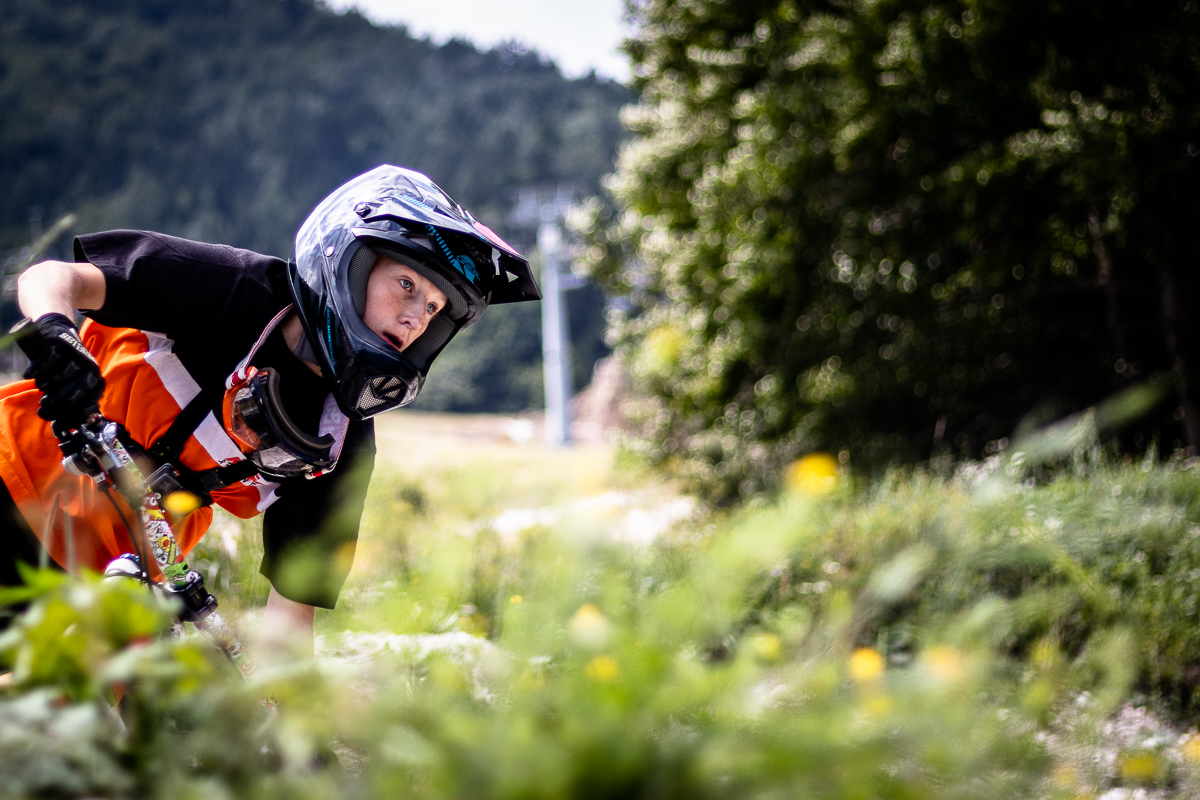
The trail grades are relative
Green, blue, red and black are useful only when read in context. A green bike-park trail is the easiest option within a gravity park; it is not necessarily equivalent to an easy family cycle route. It may still descend continuously, include shaped turns and rollers, and require confident braking while other riders approach from behind.
That distinction is especially important in Kranjska Gora. Older tourism descriptions emphasise that the park has something for beginners and experts. The operator’s current rules are more direct: the trails are not suitable for complete beginners. I would follow the safety document rather than stretch the promotional sentence.
If someone is new to mountain biking, the better first step may be skills instruction or the separate Brsnina Easyloop area introduced in 2026. Even then, “easy” should be confirmed on the day; it is not a substitute for basic control.
A practical guide to the named lines
Trail names and joins can change after rebuilding, so this table is an orientation rather than a permanent official map. Current community mapping groups the park roughly like this:
| Line or family | Common map grade | Character to expect |
|---|---|---|
| Family Line / Family Flow sections | Green | The most approachable flow-oriented parts of the network, but still downhill bike-park riding |
| Intermediate Line, Upper Berms, Middle Berms, DH Flow | Blue | Faster shaped turns, rollers and more consequential speed |
| Northshore and DH Northshore | Blue | Wooden or technical features where surface grip and confidence matter |
| Sandbox | Blue | Berms and jump-oriented features |
| Morning Wood | Red | More demanding north-shore terrain |
| Funky Jazz | Red | Enduro-style, natural technical riding |
| Airline and Luft Waffe(l) | Red | Jump lines; inspect features and ride-arounds before committing |
| Evil Eye and DH Veetranz sections | Black | Steep, technical or race-oriented downhill terrain for advanced riders |
| Old Evil Eye | Pro on current community maps | A specialist technical line, not a progression shortcut |
Names alone never tell you whether a feature is rollable, whether a bypass is open or whether rain has exposed roots. The operator advises using the first run to learn the trail and its obstacles. That is sound practice even for an experienced visitor.
Flow, roots and weather
Shaped flow trails are usually the easiest to read. Berms support the turn, rollers establish rhythm and a clear corridor helps the rider look ahead. Natural or older downhill sections demand a different kind of attention. Roots become slick, braking bumps grow through the season and forest light can hide changes in the surface.
After rain, I would expect both grip and visibility to change. A wet wooden feature deserves particular caution. A tyre that feels predictable on dry soil may break traction on a polished root or board. Conditions are part of the difficulty, not background scenery.
How the Vitranc 1 uplift works
Vitranc 1 carries riders and bicycles from the base area to the upper part of the park. A bike-park ticket gives access according to its duration, but riders remain responsible for following staff instructions, loading securely and getting off safely.
The operator’s 2026 price-list note specifically says e-bike users load their bicycles themselves and accept responsibility for them. Even with staff assistance, the current rules place transport risk on the user. If you have not used a chairlift bike carrier before, ask for the procedure before joining the loading lane.
One ride, four hours or a full day?
The right pass depends less on ambition than on usable riding time.
- A single ride can suit someone who knows exactly what they want to do, but it leaves no second run to correct a missed line.
- A four-hour pass is often the more realistic first visit. In 2026, its four hours begin with the first Vitranc 1 scan, not at a fixed morning or afternoon time.
- A day pass gives more freedom for inspection runs, breaks and repeated lines, but only if fitness and concentration last.
- A multi-day pass reduces the daily price for a planned riding trip, yet weather risk becomes more relevant.
Gravity riding creates fatigue in hands, forearms and legs. A longer ticket is not a reason to keep riding after braking accuracy or judgement starts to fade.
Bike Park Kranjska Gora prices for 2026
The following figures come from the operator’s price list dated 20 April 2026. They are useful for planning this season, not permanent prices. Youth means ages 15–18.99 and children means ages 6–14.99 in the published table.
| 2026 ticket | Adult | Youth | Child |
|---|---|---|---|
| One ride | €17 | €14 | €12 |
| Four hours | €35 | €30 | €25 |
| One day | €42 | €36 | €32 |
| Two days | €75 | €64 | €53 |
| Three days | €96 | €82 | €67 |
| Four days | €118 | €100 | €83 |
| Five days | €129 | €110 | €90 |
| Six days | €139 | €118 | €97 |
| Seven days | €150 | €128 | €105 |
| Season | €295 | €251 | €185 |
The 2026 list also includes a €10 e-bike day ticket without chairlift access for adults and youth. It is not a lift-served bike-park pass. The price document shows no child price for that item.
Before paying, I would confirm what the pass covers that day, which lifts and sections are operating, and how a weather closure is handled. The operator may close for storms, lightning, poor conditions or technical reasons. Current rules also say that voluntarily leaving while the park remains open does not produce a refund.
2026 opening dates and hours
The operator currently lists the main bike park as open every day from 25 June through 31 August 2026, from 09:00 to 17:00. This is a dated summer-season snapshot; the official bike-park page holds the live version.
Do not copy the hours for the Vitranc 2 panoramic chairlift into a bike-park plan. Vitranc 2 has its own schedule and purpose. For the lift-served downhill access discussed in this guide, the relevant operating information is the Bike Park and Vitranc 1 status.
Outside the published core season, or whenever the weather looks unstable, I would contact the operator rather than infer service from the calendar. The live page lists bike-park information through MTB Republic at +386 51 270 505 and [email protected]; general lift information is available from RTC Žičnice Kranjska Gora.
Is Bike Park Kranjska Gora suitable for beginners?
Not for a complete beginner, according to the operator’s current rules. That answer is clearer and more responsible than saying the park is “for everyone.”
A rider may be ready for the easiest line if they can already:
- brake with control on a continuous descent;
- stand in a balanced position over uneven ground;
- look through a turn rather than at the front wheel;
- follow trail direction and stop before entering a closed feature;
- yield space without stopping in a blind location;
- inspect an obstacle and choose a bypass instead of committing under pressure.
An easy line can support progression once those basics exist. It should not be where someone first discovers how their brakes behave downhill.
Children and younger riders
The 2026 rules state that riders under 15 must be accompanied by a parent, guardian or adult. Riders under 18 need signed consent or parental permission. Those are minimum access conditions, not proof that a particular child is ready for a line.
Bike fit matters as much as age. A bicycle that is too large, brakes that a small hand cannot operate comfortably or protection that moves during a fall can undermine otherwise sensible supervision.
Lessons before speed
For a first gravity-park session, instruction can be more valuable than buying a longer pass. A coach can explain body position, braking before a turn, line choice and how to inspect features. Rental availability does not automatically include tuition, so ask separately.
The new Brsnina Easyloop announced for 2026 may provide a smaller-scale progression option, with roughly 100 metres of uplift and a developing mini-park. It is a separate product; verify its current trails, ticket and suitability directly with the operator.
Bike rental, protection and what to bring
The operator advertises downhill and enduro bicycle rental through MTB Republic. Reserve in advance, especially for a specific frame size or a busy weekend. Ask what the rental includes: a full-face helmet, body protection, mechanical support and damage terms should never be assumed.
| Item | Why it matters |
|---|---|
| Suitable downhill, enduro or trail bike | Geometry, suspension, tyres and brakes must match the line and rider |
| Properly fitted helmet | Mandatory under the park’s current rules; a full-face model is the sensible gravity choice |
| Knee and elbow protection | Reduces exposure on roots, berms, jumps and hard surfaces |
| Gloves and eye protection | Support grip and shield against dust, insects, branches and roost |
| Appropriate shoes | Stable contact with pedals matters under repeated impacts |
| Water and food | Lift access removes the climb, not the physical workload |
| Spare tube or repair essentials | A puncture can end a session quickly |
| Phone and emergency details | Report an accident to staff or call 112 |
Check tyre condition, brake-pad life, rotor function, wheel security, suspension and loose bolts before the first uplift. A car-park squeeze of the brake levers is not a complete inspection, but it can reveal a serious problem before altitude and speed magnify it.
E-bikes
The operator permits e-bike transport under specific responsibility terms, but a heavy e-bike changes loading, braking and handling. Confirm that the battery is secured, the bicycle fits the carrier and the chosen trail allows the bike type. The separate €10 e-bike ticket in the 2026 list excludes chairlift use.
Essential park rules and trail etiquette
Bike-park etiquette is mostly a way of making speed predictable. Every rider benefits when the person ahead behaves in a way that can be read.
On the trail
- Ride only in the marked direction and stay on designated routes.
- Do not climb a downhill trail on foot or by bicycle.
- Use the first run to inspect the trail, obstacles and current surface.
- Adjust speed to visibility, weather, ability and the rider ahead.
- Do not stop in blind sections, on jumps or on the landing of a feature.
- Do not modify lines or build unofficial obstacles.
- Follow staff instructions and closure signs immediately.
- Never ride under the influence of alcohol, drugs or other psychoactive substances.
If a rider falls, avoid creating a second incident while trying to help. Make the location visible from above only when it is safe to do so, alert staff and call 112 for an emergency.
Around the lift and base area
Queue calmly, prepare the bicycle before the loading point and listen to staff. Do not experiment with the carrier while the chair is moving into position. At the top, clear the unloading area promptly so the next chair can arrive without obstruction.
The operator prohibits dogs and other pets on the trails. Spectators should also stay out of the riding corridor, even where the grass makes a shortcut look harmless.
When is the best time to visit?
The published core season is summer, when long daylight and daily lift operation make planning simplest. The best day within that window depends on the rider’s priorities.
For quieter progression
A weekday morning can offer more space than a sunny weekend afternoon, although no time is guaranteed to be quiet. Arrive early enough to collect equipment, understand the lift and make an unhurried inspection run. Rushing to “get value” from a ticket is a poor start to a gravity session.
For dry grip
A settled, dry spell generally makes shaped trails easier to read and wooden or rooted sections less slippery. Dust and loose material can still reduce grip after prolonged heat. “Dry” does not mean every corner is clean.
For photography
Summer growth can hide the lower half of the bicycle and create layers around a rider, as it did in my 2019 photographs. Bright midday light is difficult, but forest edges, open grass and a mountain background give several kinds of contrast within a compact area.
Events bring stronger riding and predictable action, but they also bring barriers, restricted positions and permissions. Check the calendar and organiser rules before arriving with a camera.
My history with Kranjska Gora
Kranjska Gora is not a place I know from one hurried stop. I have spent holidays here for years, in different seasons, and the village has become one of those landscapes that feels familiar before I have even parked. The attraction is broader than the ski slopes or one summer activity: the mountains remain close to everyday life.
That familiarity is also why I notice how different parts of the area work together. A quiet morning at Lake Jasna and the clear water at Zelenci belong to the same destination as the noise and concentration of a downhill run, but they ask for completely different pacing.
When I returned to the bike-park files years later, they also brought back a camera I still remember fondly. The Canon EOS 77D was my second camera, after the Canon 1300D. I liked its design and interface. I later moved to a Sony A7 III, but newer equipment does not erase the character of an older session.
How I photographed the riders
I made these photographs in August 2019 with the Canon EOS 77D and Canon 50mm f/1.8. Every frame shown here was shot at 50 mm and f/1.8. That was a demanding combination for fast riders: the lens gave me no zoom to correct my framing, and the wide aperture left little room for focus error.
At moments, riders passed roughly a metre from me. That proximity is part of the memory, but it is not an instruction for where to stand today. Current park rules allow personal photography only when it does not obstruct riders or staff, and commercial work requires permission. I would now choose a position agreed with the operator, outside the riding line and protected from a fall or missed turn.
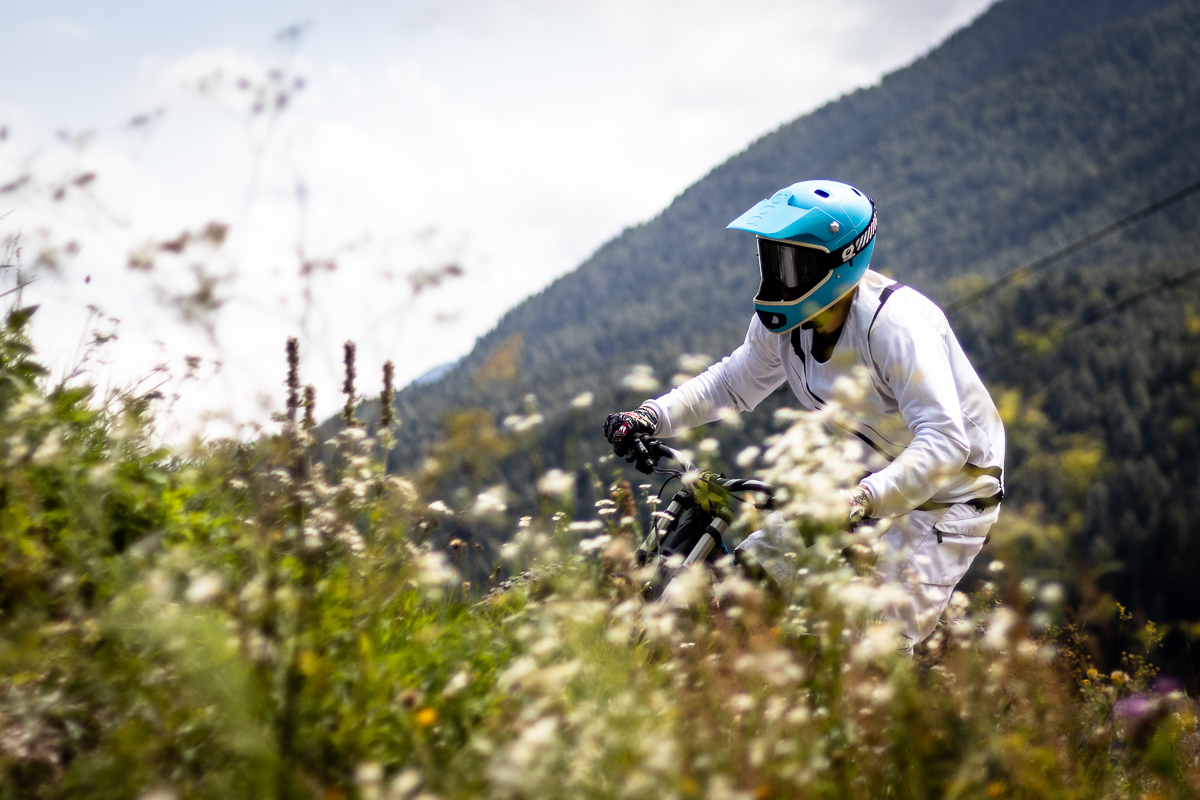
I watched the line before raising the camera
The useful information came before the shutter press. I watched where riders entered the visible section, which part of the turn pulled their upper body into view and how long the helmet remained clear of grass. Once that pattern repeated, I could place the focus area where the face and front of the bicycle would appear.
This is different from following a rider randomly through the viewfinder. A known line gives the camera a destination. The timing still has to be right, but the composition no longer depends on panic.
Fast shutter speeds stopped the decisive movement
The four archived frames range from 1/1500 to 1/4000 second. Those shutter speeds freeze the helmet, hands and bicycle while the rider changes direction. The exact number was not the creative goal by itself. I needed enough speed to preserve the moment I had chosen.
The exposures were:
| Photograph | Camera and lens | Aperture | ISO | Shutter speed |
|---|---|---|---|---|
| Rider above the grass, featured image | Canon EOS 77D, 50 mm | f/1.8 | 100 | 1/1500 s |
| Young rider low over the bars | Canon EOS 77D, 50 mm | f/1.8 | 100 | 1/2000 s |
| Rider in white through wildflowers | Canon EOS 77D, 50 mm | f/1.8 | 100 | 1/3000 s |
| Rider in blue cornering | Canon EOS 77D, 50 mm | f/1.8 | 200 | 1/4000 s |
The variation makes sense. Light, background and the moment changed; the aperture and focal length stayed fixed. I allowed shutter speed and, once, ISO to carry the exposure while keeping the visual language consistent.
The foreground was part of the picture
Tall grass is not merely an obstacle between the camera and the subject. At f/1.8, it can become a soft layer that suggests how the rider moves through the landscape. The risk is obvious: one stalk in the wrong place can cover the eye or pull autofocus away from the helmet.
I kept only the successful frames. That is not false modesty; it is normal action photography. A near-identical burst can contain a blocked face, a weak body position and one frame in which the rider, turn and foreground align.
Why the 50 mm challenge worked
A 50 mm prime on the Canon EOS 77D gives a tighter field of view than the same lens on a full-frame camera. It forced me to commit. I could not zoom out when the rider arrived larger than expected, and I could not reach farther when the action stayed high on the slope.
That limitation created consistency across the set. The riders occupy a similar visual world: compressed vegetation, a readable helmet and a background that hints at Vitranc without turning every frame into a landscape.
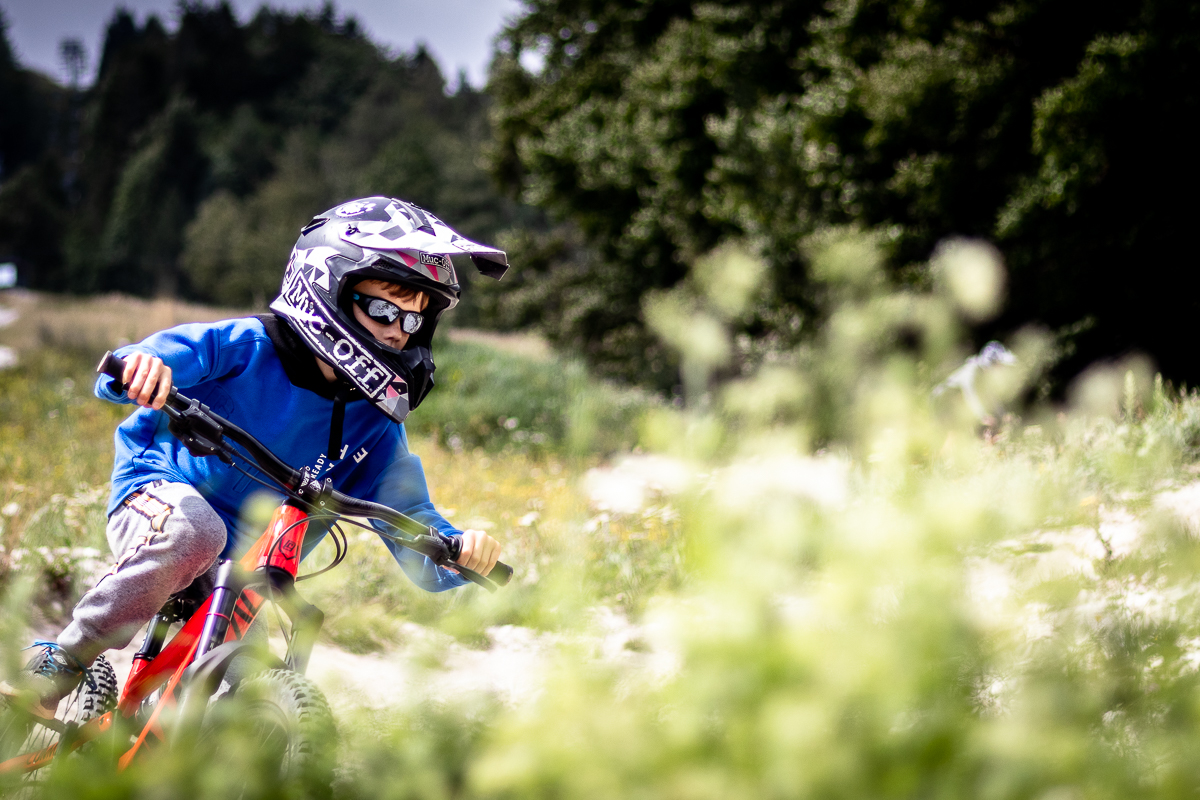
What f/1.8 added — and what it risked
At f/1.8, the vegetation dissolves quickly and the rider can separate from a busy slope. The cost is shallow depth of field. If focus lands on the handlebar, a plant or the edge of the helmet, the eyes may already be too soft.
With a modern camera and another chance, I might test a slightly smaller aperture for a higher keeper rate. But I would not rewrite the 2019 photographs to pretend that was what I did. Their narrow focus is part of the experiment and part of why the strongest frames work.
What I would keep today
I would keep the habit of observing first, the fast shutter speed and the deliberate foreground. I would also keep the 50 mm discipline for at least part of the session. A longer lens offers more distance and a wider lens shows more environment, but neither automatically improves timing.
The main change would be logistical: I would clarify access and safe positions with the operator, especially for any commercial use. Good action photography should not require a rider to alter their line or wonder whether the person ahead will move.
Spectating and photographing without getting in the way
The park’s current rules are unusually helpful on this point. Personal photography is permitted when it does not obstruct cyclists or staff. Commercial photography and filming require permission from the operator.
For a safe personal session, I would use these boundaries:
- stand outside marked trails, landings, berm exits and run-out zones;
- never occupy a blind section, even for a few seconds;
- do not ask a rider to repeat a feature unless the line is controlled and permission is clear;
- keep bags, tripods and straps out of the corridor;
- avoid flash that could distract a rider;
- listen for riders approaching from outside the frame;
- follow staff and event-organiser instructions immediately.
A telephoto lens can create working distance, but distance is not the only safety measure. The likely direction of a fall matters more than the straight-line distance to the trail.
For another view of fast cycling close to the camera, my Pump Track Odranci guide and photo story shows a flatter circuit with very different lines and access decisions.
A sensible first-day plan
A first visit becomes easier when the order is decided before excitement takes over.
1. Confirm operation and reserve equipment
Check Vitranc 1, the park status and the weather. If renting, reserve the correct bicycle size and clarify protection, collection time and return conditions.
2. Read the current trail board
Do not choose the first run from a months-old video. Note closed sections, recent work and how the easiest line connects back to the lift.
3. Make an inspection run
Ride below maximum speed. Look at entries, exits, rollable features, bypasses, surface changes and places where lines merge. The operator explicitly recommends using the first run to learn the trail.
4. Repeat before progressing
A clean second run on the same line tells you more than immediately moving to a harder colour. Progress when braking points and body position feel deliberate, not because another rider disappeared into a red line.
5. Stop before concentration collapses
Forearm fatigue and repeated braking errors are signals, not inconveniences. Take a break or end the session. The chairlift can return the rider to the top faster than the body recovers.
Frequently asked questions
Where is Bike Park Kranjska Gora?
It is on the Vitranc slope beside the summer lift area in Kranjska Gora, Slovenia. The operator’s address is Borovška cesta 103a, 4280 Kranjska Gora. Use the map above and confirm the ticket and lift entrance on arrival.
Which lift serves Bike Park Kranjska Gora?
The main lift-served bike park uses the Vitranc 1 chairlift for riders and bicycles. Vitranc 2 is a separate upper chairlift with its own sightseeing schedule; do not assume its hours apply to the bike park.
How much is a Bike Park Kranjska Gora day pass?
For 2026, the official day-pass prices are €42 for adults, €36 for youth aged 15–18.99 and €32 for children aged 6–14.99. Recheck the operator’s current price list before travelling.
What are the 2026 opening hours?
The operator currently lists daily operation from 25 June through 31 August 2026, 09:00–17:00. Weather, maintenance and technical conditions can change actual service, so check the live status on the day.
Is Bike Park Kranjska Gora good for complete beginners?
No. The operator’s May 2026 rules explicitly say the trails are not suitable for complete beginners. Easier family lines are graded relative to the rest of the bike park and still require basic downhill control.
Can I rent a downhill bike?
The operator advertises downhill and enduro rental through MTB Republic. Contact the rental provider in advance to confirm size, availability, protection, price and booking terms.
Is a helmet required?
Yes. The operator’s current rules require a helmet and recommend protective equipment. For gravity riding, a properly fitted full-face helmet, knee protection, gloves and eye protection are sensible choices.
Can children ride?
The current rules say riders under 15 must be accompanied by a parent, guardian or adult. Riders under 18 require signed consent or parental permission. Readiness still depends on skill, bicycle fit and the selected line.
Are e-bikes allowed?
The 2026 price list addresses e-bikes and says users load them on the chairlift themselves and at their own risk. Confirm the current carrier procedure, trail access and ticket before arrival. The listed €10 e-bike day ticket does not include chairlift use.
Can I take photographs in the bike park?
Personal photography is allowed if it does not obstruct riders or staff. Commercial photography or filming requires operator permission. Stay outside riding lines, blind areas, jump landings and likely fall zones.
What happens in bad weather?
The operator may close the park for storms, lightning, poor trail conditions, technical reasons or other safety concerns. Check the live status rather than relying only on the published seasonal hours.
Final thoughts
Bike Park Kranjska Gora is compelling because it compresses a serious gravity-riding environment into the edge of an alpine village. Vitranc 1 provides the repetition riders want; the network provides enough contrast to make each descent a decision rather than a routine lap.
It also deserves precise expectations. The easiest line is not an invitation to arrive without basic control. A day ticket does not guarantee every trail is open. A chairlift removes the climb but not fatigue. Those distinctions make the visit safer and, in the end, more enjoyable.
My own connection remains photographic. In August 2019, four riders, a 50 mm lens and tall summer grass were enough to turn a familiar place into a demanding little study of timing. The Canon EOS 77D is no longer my current camera, but the photographs still do what I want them to do: hold the concentration of a fast moment while keeping Kranjska Gora visible around it.