
The first thing I noticed at Pump Track Odranci was not its size. It was how rarely the riders seemed to be still. A bicycle disappeared behind one asphalt roller and returned on another line; a scooter paused on a crest; a pair of riders became silhouettes against the evening sky. Even between timed runs, the track seemed to hold momentum.
I came here to photograph a race with my Sony A7 III. The event gave me the close, fast action I enjoy in sports photography, but the photographs also show why people search for this place independently of a race. Pump Track Odranci is a substantial asphalt circuit in Prekmurje, built into the town’s sports and recreation area and shaped for repeated laps, changing lines and progressive skills.
This guide begins with the information I would want before visiting: where the track is, what it is like, who can use it, what to bring and how to share it safely. My photographs and the lessons from covering the race follow after that.
Pump Track Odranci at a glance
| Detail | What to know |
|---|---|
| Location | Odranci, Prekmurje, northeastern Slovenia |
| Setting | Odranci sports and recreation centre |
| Track type | Outdoor asphalt pump track |
| Size | More than 2,000 m² according to construction and recent event sources |
| Typical features | Connected rollers, banked turns, multiple line choices and jump features |
| Suitable wheels | BMX and mountain bikes, balance bikes, scooters, skateboards and inline skates, subject to local rules |
| Skill level | The broad layout supports progression, but users should choose lines and speed appropriate to their control |
| Best conditions | A dry, clean surface with good visibility |
| Events | Local and national-level pump-track races are held here; access can change on event days |
| Hours and admission | No reliable permanent hours or fee schedule was verified; check signage and current local notices |
The track covers more than 2,000 square metres. When it was being completed in 2017, local reports introduced it as the largest asphalt pump track in Slovenia. That description belongs to that moment. New facilities have since been built, and the more accurate current description is that Odranci remains one of Slovenia’s largest pump tracks.
That scale matters less as a record than as an experience. A larger surface allows riders to connect different lines rather than repeat one short loop in exactly the same way. It also gives a photographer more than one predictable corner or jump from which to work.
Where is Pump Track Odranci?
Pump Track Odranci is in the municipality of Odranci in Prekmurje, the northeastern part of Slovenia. It forms part of the local sports and recreation centre rather than standing as an isolated roadside loop.
Public listings do not agree on the nearest street number, so I would navigate to the named venue — Pumptrack Odranci, 9233 Odranci — and follow local signs on arrival. The map below centres on that part of the village rather than pretending that an uncertain house number is definitive.
Before relying on a normal practice session
I check current notices before travelling, particularly during the racing season. The venue has hosted club, regional and national-level events, and a competition can change public access, parking arrangements and the direction in which riders use the course.
The Municipality of Odranci, Kolesarski klub Bula, Pumptrack Slovenija and event-registration pages are the useful places to check. A social post from an earlier season is not a reliable opening-hours notice.
I would also look at the surface on arrival. Asphalt is fast and predictable when dry; rain, gravel, leaves or damage change the risk quickly. If the posted rules or temporary barriers differ from an online description, the information at the track wins.
What is a pump track?
A pump track is a circuit built from rollers, banked turns and linked transitions. Instead of relying on continuous pedalling, a rider gains and preserves speed by shifting body weight through the shape of the track — pressing into the downward side of a roller, becoming lighter over its crest and carrying momentum through the berms.
The English word pump describes that rhythmic movement. Slovenian sources also use tlačilna steza, although pumptrack and pump track are the terms most riders use in everyday conversation.
The movement is simple to describe and difficult to master
From the edge of the course, the strongest riders can make the technique look effortless. Their bicycles remain quiet beneath them while arms, legs and torso absorb one section and drive into the next. The track is doing part of the work, but only when timing and line choice match its contours.
A beginner often pedals between features, becomes stiff over a crest or enters a turn too quickly. Those are not reasons to avoid the track. They are reasons to begin on a manageable line, keep the speed low and learn one movement at a time.
Pump track is not the same as BMX racing
The sports overlap, and BMX bicycles are common on pump tracks, but the facilities and formats are not identical. A conventional BMX race begins from a start gate and uses a purpose-built course with straights, jumps and banked corners. Pump-track racing emphasises the continuous use of rollers and berms, usually with the rider generating speed through pumping rather than pedalling around the lap.
For a visitor, the practical point is simpler: Pump Track Odranci is not reserved for elite BMX competitors. It is a community track that can also support serious racing.
What the track in Odranci is like
The Odranci track is an interlocking field of asphalt rather than a single narrow oval. Rollers rise close to one another, banked turns redirect the rider and several visual lines cross the same compact space. That arrangement is what makes more than 2,000 square metres feel dense rather than empty.
Floodlight masts stand beside the circuit in my photographs, which suggests the site was built with evening use in mind. I could not verify whether or when they are switched on, so treat that as an observation from the pictures rather than a schedule.
Asphalt changes the character of the ride
An asphalt surface rolls quickly and remains more consistent than a dirt track through normal use. It also makes the facility practical for smaller wheels: scooters, skateboards, inline skates and balance bikes can use a surface on which loose soil would stop them abruptly.
The same speed deserves respect. Asphalt is unforgiving in a fall, and small debris can reduce grip. A clean line, working brakes and suitable protection matter even when the track looks smooth.
Berms carry speed through the turns
The banked turns are not simply walls around the circuit. They allow a rider to lean into the curve and preserve momentum that would disappear on a flat corner. Entry speed and body position decide whether the turn feels supportive or abrupt.
For beginners, the safest lesson is not to ride higher and faster immediately. Enter at a controlled speed, look through the turn rather than at the front wheel and leave space for the rider ahead.
Rollers create rhythm
Rollers are the repeating rises and dips from which the track takes its pulse. A rider can first roll across them, then learn to unweight the crest and press into the back side. Jumping is not required to use a pump track, and turning every roller into a jump can be less efficient than staying connected to the surface.
Multiple lines reward repeat visits
One line can be comfortable for a child on a balance bike, another can give an experienced rider a faster or more technical sequence. The attraction is not only completing a lap; it is discovering how one feature connects to the next.
That makes Odranci worth revisiting. Familiarity does not exhaust the track — it lets the rider notice alternatives.
Who can use Pump Track Odranci?
An asphalt pump track can serve several groups at once, but “everyone” does not mean everyone should enter the same line at the same speed.
BMX and mountain-bike riders
BMX bikes suit tight movement and rapid acceleration, while mountain bikes bring larger wheels and a different feel through the rollers. A mechanically sound ordinary bicycle can also work. The decisive factors are control, appropriate sizing and a rider who can stop safely.
A raised saddle can restrict the body movement needed to absorb rollers. Riders who know their bicycle may lower it for the session, but a beginner should not make unfamiliar adjustments without understanding how they affect pedalling and control outside the track.
Children and balance bikes
Pump tracks can help children develop balance, looking ahead, braking and coordination. The first session should be about control rather than completing the fastest lap. A quiet period is better than a crowded race atmosphere for learning.
An adult should inspect the chosen line, explain the direction of travel and remain close enough to supervise without standing where other riders need to pass. Small children should not be placed into a fast mixed session and expected to be visible automatically.
Scooters, skateboards and inline skates
The asphalt surface opens the circuit to more than bicycles. Smaller wheels react more sharply to gravel and surface defects, and their users may travel at a different speed from cyclists. Mixed use works only when everyone observes the same direction, looks before entering and leaves predictable space.
Spectators and photographers
During events, the most dramatic viewpoint is often the one closest to the racing line. That does not make it safe or permitted. Spectators should remain behind event barriers and follow organiser instructions. Photographers need an authorised working position rather than assuming a camera creates access.
On an ordinary day, I avoid standing on rollers, inside blind turns or on the exit of a berm. A rider should never discover a person in the line after committing to the corner.
What to bring for a first visit
The track itself supplies the terrain, not the preparation. I would arrive with less equipment than for a trail ride, but I would make sure the essential items are right.
| Bring | Why it matters |
|---|---|
| Correctly fitted helmet | The basic protection for any wheeled session |
| Mechanically sound bike, scooter or board | Brakes, wheels, tyres, bars and fasteners must tolerate repeated loads |
| Gloves and suitable shoes | Better grip and some protection during a fall |
| Knee and elbow protection | Particularly useful for children, beginners and faster riding |
| Water | Pumping is physically demanding even without constant pedalling |
| Small repair kit | A pump and basic tool can prevent a minor problem ending the visit |
| Clean cloth or brush | Useful for dirt on equipment, not for altering the public track |
Inspect the equipment before entering
I check tyre pressure, brakes, wheel security, handlebars and any folding mechanism on a scooter. A loose component that feels tolerable on a flat path can become obvious under repeated compression.
The wheels should rotate freely, but the brakes must remain usable. “You do not need to pedal” does not mean “you do not need to stop.”
Choose protection for the actual speed
A helmet should fit rather than sit loose at the back of the head. More protective equipment becomes sensible as speed, jumping and consequence increase. Competitive riders in my photographs wear full-face helmets and additional protection because their use of the track is different from a cautious first lap.
I do not copy only the speed visible in a race photograph while ignoring the skill and protective equipment that made it possible.
Leave headphones out of the session
Awareness matters on a shared circuit. Riders need to hear warnings, an approaching user and instructions during an event. A phone can stay available off the track; it should not divide attention while moving through a blind sequence.
How to ride a pump track for the first time
The best introduction is deliberately uneventful. I would rather see a rider complete five controlled laps than survive one fast lap and learn nothing from it.
1. Watch before entering
Observe the direction of travel, faster lines, entry points and where riders leave. If the track is crowded, watch long enough to understand its rhythm. Posted rules and local practice take priority over assumptions from another pump track.
2. Begin with a complete rolling lap
Roll through every feature without trying to jump. Keep the pedals level when they are not being turned, bend the arms and knees, and look beyond the next wheel-length. The first lap is an inspection from the rider’s perspective.
3. Learn one roller at low speed
Approach the rise in a stable position. Become lighter as the front wheel reaches the crest, then press the bicycle or scooter into the downward slope. The movement should be smooth rather than a violent pull on the handlebars.
4. Look through the berm
Eyes guide the body. Looking at the outer edge or front tyre makes the turn feel narrower. Look toward the exit, keep a predictable line and avoid changing direction suddenly when another rider is nearby.
5. Build rhythm before speed
Speed arrives from timing. If each roller feels like a collision, going faster amplifies the problem. A good lap begins to feel quieter as the body works with the surface.
6. Leave space
Wait until the previous rider has cleared enough of the line. Do not stop on a blind feature, cross the circuit without looking or enter against the established direction. Faster riders are also responsible for anticipating beginners rather than treating a public facility as a private timed course.
7. Rest before technique disappears
Pump-track riding works the legs, arms and core. Fatigue first appears as late movement, stiff arms and poor decisions. A short session with useful repetitions is better than continuing until control deteriorates.
Safety and shared-track etiquette
The posted rules at Pump Track Odranci are the authority on site. The principles below are the practical habits I would carry to any shared pump track.
Wear a helmet and appropriate protection
Protection does not make a risky line safe, but it reduces avoidable consequences. Children need equipment that fits now, not a helmet bought large enough for several future seasons.
Inspect the surface
Leaves, stones, standing water, ice, broken glass or damage can turn a smooth berm into a low-grip surface. Do not move barriers or ride a closed section. Report a problem through the appropriate local channel instead of attempting an improvised repair.
Follow the direction and wait your turn
Head-on conflict is one of the easiest hazards to prevent. Before entering, establish how the track is flowing and make eye contact when necessary. During organised practice or racing, follow the marshal or organiser.
Do not block rollers and berm exits
The top of a roller may look like a good place to wait, but it can hide a person from an approaching rider. Leave the riding surface promptly after a stop or fall when it is safe to do so.
Separate learning from racing
Beginners need room to make slow, predictable movements. Experienced riders need enough clear track for higher speed. If the mix is unsafe, alternate runs or return at a quieter time rather than forcing incompatible speeds onto the same line.
A dry track is the sensible default
Asphalt can become slippery when wet, especially where rubber, dust or organic debris collects. The ability to ride in rain is not the same as a good reason to do it. I would postpone a first session rather than turn it into a grip test.
Events at Pump Track Odranci
Pump Track Odranci is both a daily recreation facility and an established competition venue. That combination is part of its identity.
The local Kolesarski klub Bula was central to the original push for a larger track, and later events show continued use rather than a facility left behind after construction. On 27 September 2025, Odranci hosted the Slovenian pump-track national championship together with a round of the Pumpaj Slovenija national series. The report records 65 competitors across age and adult categories.
On 23 May 2026, the venue hosted another race in the Pomurski MTB Cup. These dates are useful evidence that the track remains part of an active local cycling scene. They are not a permanent schedule.
What changes on a race day
A competition adds registration, practice windows, timed runs, barriers, officials and spectators. The normal line may be reserved for competitors, and the track can be inaccessible for casual riding before, during or after the event.
For a visitor, the solution is simple: check the current calendar. For a photographer, race day offers cleaner action and a stronger story, but only within the access set by the organiser.
How pump-track racing works
Formats vary. Riders may complete timed laps individually, use the best result from several runs or advance from qualification into head-to-head elimination. Age categories and licence requirements depend on the competition.
The shared principle is efficiency. Riders create speed through body movement, choose the fastest workable line and try to lose as little momentum as possible in each transition. A tiny hesitation can matter because laps are short and differences are measured closely.
Watching a race well
I would arrive before the most important runs, learn which sections are visible from public areas and avoid changing position while a rider is approaching. Applause and atmosphere belong at an event; stepping through a barrier for a phone photograph does not.
Photographing a race at Pump Track Odranci
When I photographed a race here, I used a Sony A7 III. I was drawn to the same thing that makes the track interesting to ride: repetition without exact duplication. The athletes returned through the same turns, but posture, speed, light and distance changed every frame.
The old version of this article celebrated that excitement without explaining much of the work. The photographs make more sense when I separate the decisions behind them.
I learn the line before choosing the frame
Pump-track action is predictable in location but not in timing. A rider must pass a particular roller or enter a berm, which lets me pre-compose. The variables are the rider’s speed, height, lean and relationship to other competitors.
I watch several passes before committing to one viewpoint. Where do riders become visible? Where does the body compress? Which background separates the helmet and bicycle? Where can I work without entering an escape line or distracting the athlete?
Fast shutter speed and panning tell different stories
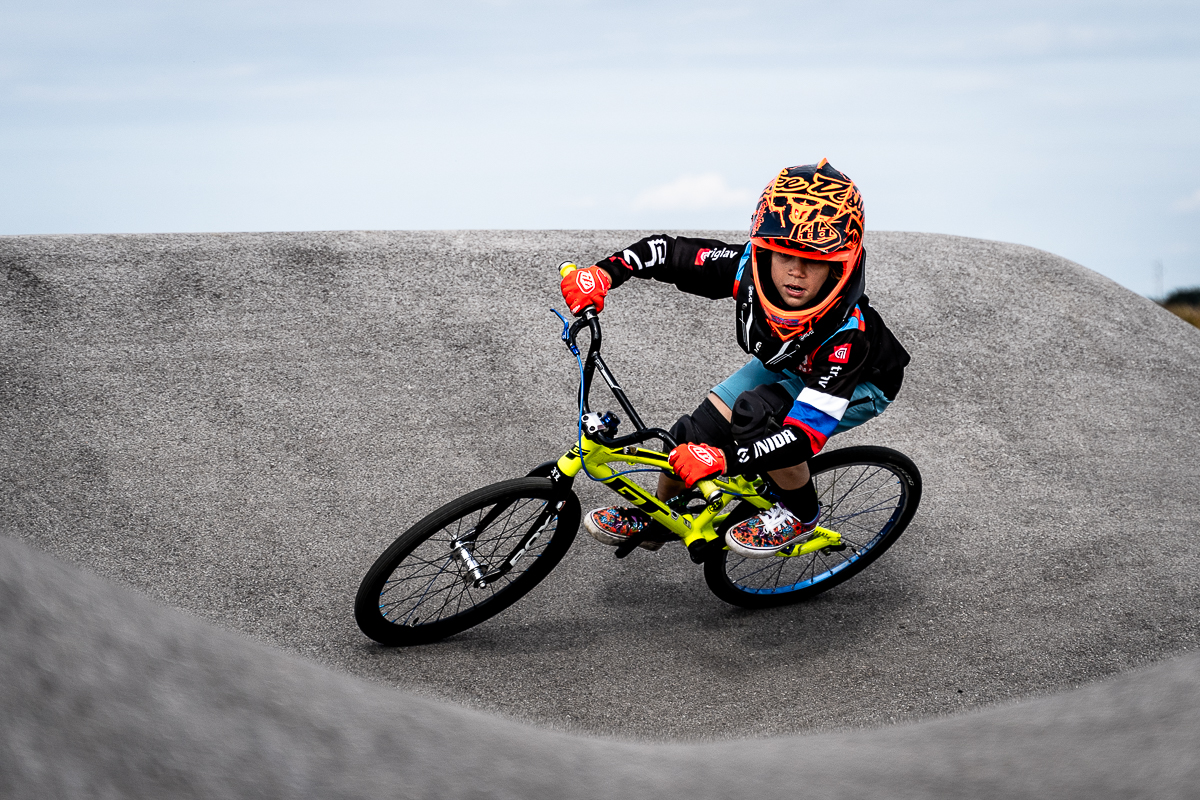
A fast shutter freezes the rider, bicycle and surface. It is useful when body position, expression and equipment are the subject. The sharp berm photograph in this guide depends on that clarity.
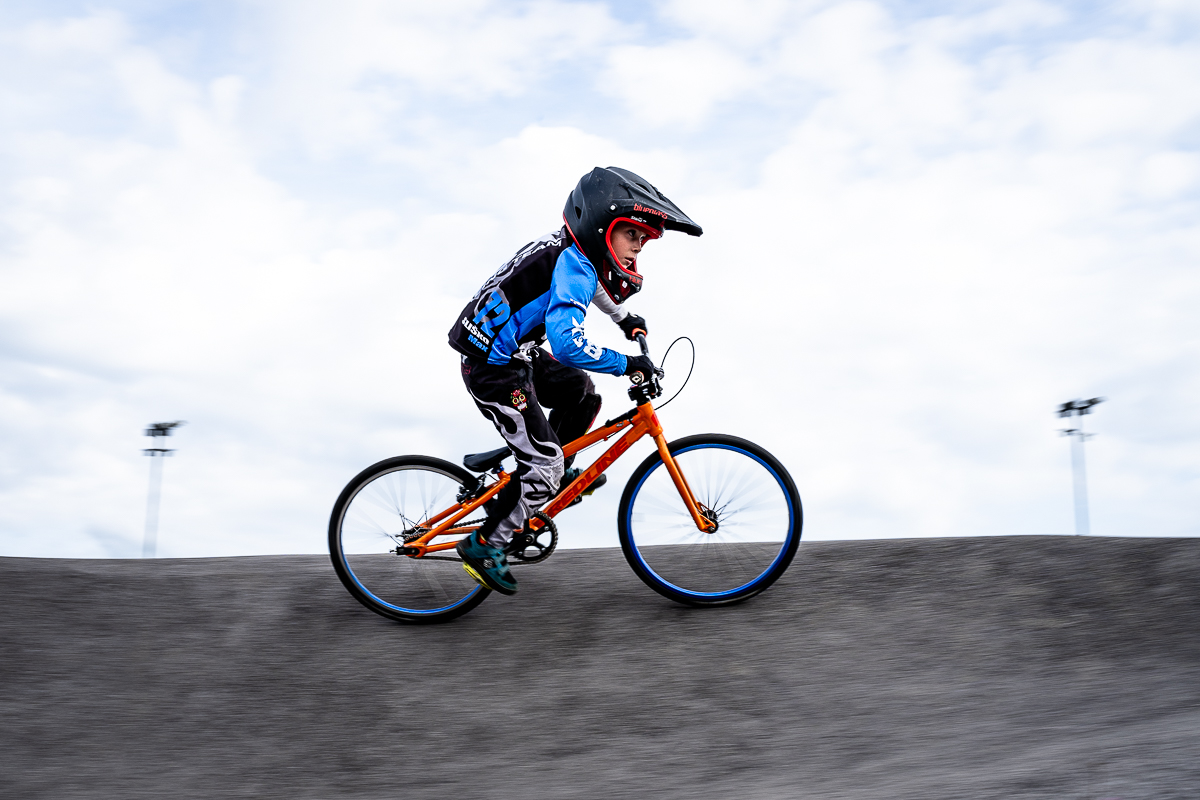
Panning does something else. I follow the rider during the exposure so the subject remains relatively defined while the track and background stretch in the direction of movement. The technique is less reliable, but when it works the frame carries speed instead of merely depicting a fast person. My guide to shutter speed in photography explains the exposure control behind both choices.
I do not have the original exposure metadata for these published files, so I will not reconstruct exact settings years later. A practical starting point for panning might be around 1/60 to 1/125 second, then adjusted to speed, distance, focal length and the amount of blur desired. Freezing action may require something closer to 1/1000 second or faster. Those are starting ranges, not claims about these photographs.
Continuous autofocus needs a clean target
I place the active focus area where I want detail — usually the rider’s helmet, upper body or front section of the bicycle — and begin tracking before the decisive point. A rider appearing suddenly over a roller gives autofocus less time and gives me fewer compositional choices.
Busy backgrounds, barriers and crossing riders can pull focus away. Preselecting the part of the track where the frame will happen is more dependable than asking the camera to understand the entire scene.
Burst mode is useful, but timing still matters
A high frame rate increases the chance of catching the exact lean or wheel position. It also produces many nearly identical files and can fill the buffer at the wrong moment.
I prefer short, timed bursts through the strongest part of the movement. The sequence begins before the ideal position and ends just after it. The camera records choices I have anticipated rather than replacing anticipation.
Backgrounds decide whether speed remains visible
The Odranci track offers broad asphalt forms and open sky. A low viewpoint can place a rider against a clean background; a higher angle can show the geometry of the berm. Neither is automatically better.
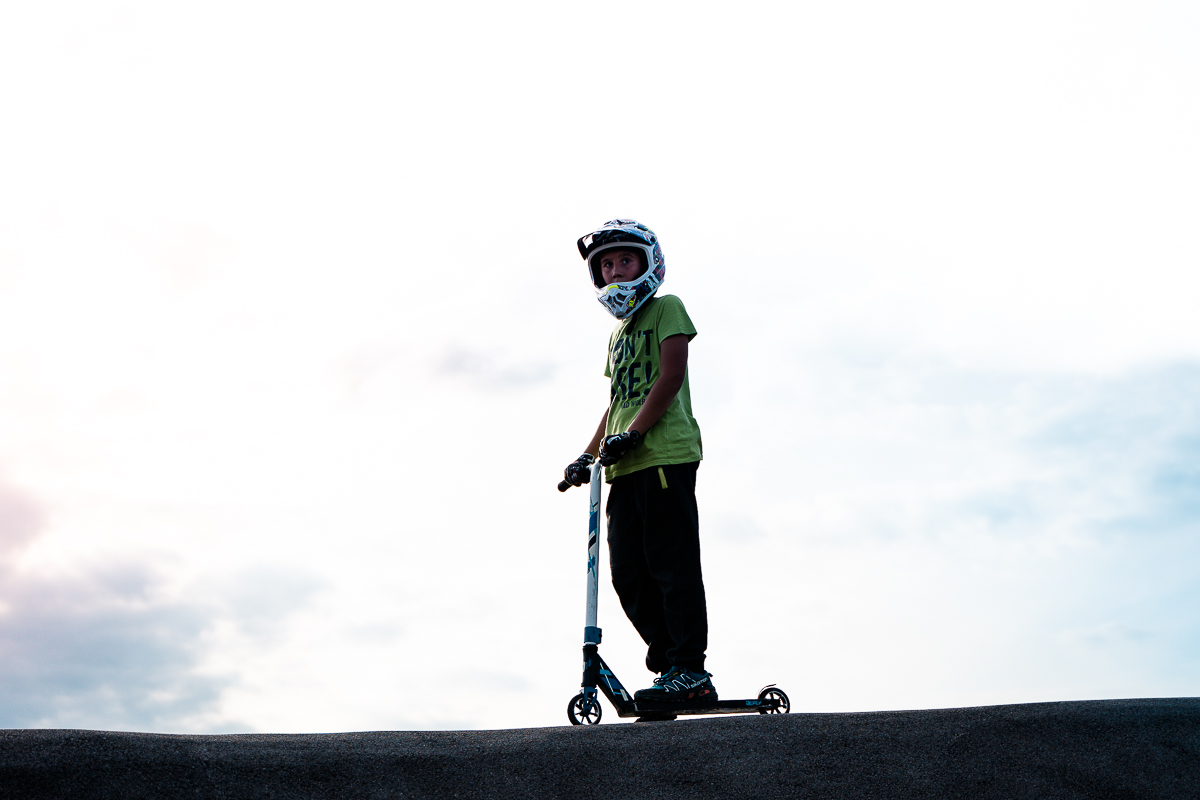
For a silhouette, I expose for the sky and let the rider become shape. For a panning frame, detail in the background can turn into useful horizontal motion. For a sharp action portrait, I look for separation between helmet, clothing and track.
Safety sets the boundary of the photograph
The tempting position is often on the inside of a turn, below a jump or beside a line that appears unused. During a race, “appears unused” is not enough. I work only from organiser-approved areas, remain visible and keep an exit path.
No photograph improves because the rider had to adjust for the photographer.
What I remember from the event
The race was one of the sports events close enough to home that I could arrive for photography rather than for a large production. That local scale did not make it visually small. Riders crossed the frame quickly, families and club members gathered around the circuit, and the same asphalt became a different picture as the light lowered.
I also met people, exchanged contacts and arranged a later photo shoot. That is a quieter benefit of photographing events: the camera can begin a conversation after it has finished recording the action.
What stayed with me most, however, was the concentration. In the close photograph through the berm, the rider’s eyes and body are committed to the exit. In the panning frame, the course dissolves around the bicycle. In the silhouettes above, the event has almost disappeared and the riders become part of the evening outline.
The photographs move from competition toward place. That is why they belong in a guide to Pump Track Odranci rather than only in a lesson about camera settings. My photographs from Bike Park Kranjska Gora show a different cycling environment, where the course, distance and access create another kind of action photograph.
How to plan a useful visit
For a quiet practice session
Choose dry weather and, if possible, a less crowded period. Walk around the outside first, inspect the surface, read the posted rules and begin on the least intimidating complete line. Bring water and take breaks before technique becomes careless.
For a family visit
Match the session to the least experienced child, not the most ambitious rider. Helmets should be fitted before arrival, equipment should be checked and an adult should supervise from a safe position. A busy competition day can be excellent for watching but poor for a first independent ride.
For watching an event
Confirm the date, schedule, access and any parking instructions through the organiser. Arrive before timed runs so you can understand the public viewing areas without rushing. Keep children away from track crossings and follow marshals.
For photography
Ask about access before the first race, not while athletes are staging. Carry only what you can move safely, use a lens that works from the approved position and make the background part of the plan. A rain cover and spare battery are more useful than a bag that cannot be moved quickly.
Frequently asked questions about Pump Track Odranci
Where is Pump Track Odranci?
It is in Odranci in the Prekmurje region of northeastern Slovenia, within the local sports and recreation centre. Search for “Pumptrack Odranci, 9233 Odranci” in navigation because public listings do not consistently use the same nearby street number.
Is Pump Track Odranci the largest in Slovenia?
It was promoted as Slovenia’s largest asphalt pump track when it was built in 2017. Newer facilities have since opened. Current wording should describe Odranci as one of Slovenia’s largest pump tracks, covering more than 2,000 square metres.
Is the surface asphalt?
Yes. The main pump-track surface is asphalt, which supports bicycles as well as smaller wheels when the surface is clean and dry.
Can beginners use the track?
Yes, but beginners should choose a quiet period, roll every feature before trying to jump, keep speed controlled and follow the posted direction. The size of the track provides options; it does not remove the need to match the line to the rider’s ability.
Can children ride at Pump Track Odranci?
Children use pump tracks for balance and skill development, and event programmes have included young age categories. They need a correctly fitted helmet, suitable equipment, supervision and enough separation from faster riders.
Are scooters and skateboards allowed?
Asphalt pump tracks are generally designed for bicycles, scooters, skateboards, inline skates and balance bikes. Check the current rules displayed at Odranci before entering, since local restrictions or event arrangements take priority.
Do I need a special BMX bike?
No. A well-maintained BMX or mountain bike is common, but an ordinary correctly sized bicycle can be used for basic rolling and pumping. It must be controllable and mechanically safe.
Is a helmet necessary?
I would not ride a pump track without one. The helmet must fit properly. Gloves and knee or elbow protection are also sensible, particularly for children, beginners and faster riding.
Is the track free and always open?
I could not verify a reliable permanent fee schedule or fixed opening hours during this update. Check the signs at the venue and current municipal or club notices. Events, maintenance, weather or temporary restrictions can change access.
Can I ride after rain?
A wet asphalt surface can have less grip, especially with dust, leaves or rubber on it. For a first visit, wait for a dry and clean track. Never enter a closed section or move a barrier.
Are races still held in Odranci?
Yes. The venue hosted the Slovenian national championship and a Pumpaj Slovenija round in September 2025, followed by a Pomurski MTB Cup race in May 2026. Check the latest calendar rather than assuming those dates repeat annually.
Is Pump Track Odranci good for photography?
Yes. The repeating lines let a photographer anticipate where riders will appear, while berms, rollers and open sky provide different backgrounds. Photography must remain outside the riding line and within organiser-approved areas during events.
What camera did I use at Odranci?
I used a Sony A7 III. The original article did not record the lens or exact exposure settings, so I have not invented them for this update.
Final thoughts
Pump Track Odranci is easy to summarise as an asphalt circuit of more than 2,000 square metres. That fact explains its scale, but not its rhythm.
The place changes according to who enters it. A child can use one loop to learn balance. An experienced rider can search for speed through a different sequence. A race can turn the same rollers into a measured contest of fractions of a second. From the edge, a photographer can freeze the concentration, follow the movement or wait until the riders become silhouettes.
My first reason for coming was the race. The more complete reason for returning is the track itself: a serious piece of local sports infrastructure that still feels immediate, public and connected to the community around it.