
The first thing I notice in my photograph of Lake Jasna is not the mountain, although it fills the horizon. It is the thin line where the real landscape becomes a reflection. Above it are pale rock, low cloud and the dark green edge of the forest. Below it, the same scene returns in colder colours, softened by a 1.5-second exposure and broken only by the stones visible through the clear water.
This is why Lake Jasna has remained my favourite lake in Slovenia. It is not the country's largest lake, its wildest or its most remote. In fact, it is remarkably easy to reach from Kranjska Gora. But when the water is still and the Julian Alps appear twice—once in front of me and once under my feet—the small scale of the place stops mattering.
I live on the other side of Slovenia, not in the middle of Triglav National Park as the number of photographs I make in this region might suggest. I keep returning because Kranjska Gora and the valleys around it contain many of the landscapes I find most beautiful. Jasna condenses much of that appeal into one frame: clear Alpine water, white river gravel, forest and a wall of rock.
This guide is both the story of that photograph and the practical guide I would want before visiting today. I have included the details that make a real difference—how to arrive without turning a short lake visit into a parking problem, when reflections are most likely, where to compose a photograph, what swimming here actually involves and which nearby places are worth adding to the same day.
My short answer: Lake Jasna is best for an easy walk, a cold summer swim and mountain photography. I would arrive early, walk from Kranjska Gora if possible, allow at least one relaxed hour at the lakes and stay longer if the light is changing.
Lake Jasna at a glance
| Question | Practical answer |
|---|---|
| What is Lake Jasna? | Two interconnected artificial lakes at the confluence of the Velika Pišnica and Mala Pišnica streams |
| Where is it? | Beside the road from Kranjska Gora toward Vršič Pass, in northwestern Slovenia |
| Size | The two lakes cover about 2.2 hectares in total |
| Best for | Reflections, an easy family walk, a short scenic stop, summer cooling and a photography session |
| Time needed | About 1 hour for an unhurried visit; 2–3 hours if I am waiting for light or combining it with a walk from town |
| Walking difficulty | Easy; the official family-friendly circular route from central Kranjska Gora is 2.9 km with only 29 m of ascent |
| Admission | There is no general admission gate for the lake |
| Parking | Two official car parks are close to the shore; tariffs and rules can change, so check the current municipal parking map |
| Swimming | Commonly promoted in summer, but the water is very cold and Jasna is not on Slovenia's 2026 list of designated bathing waters |
| Fishing | Fly-fishing only, with the required licence and current local rules |
| Main backdrop | The Julian Alps; the official destination site highlights Razor and Prisank/Prisojnik |
| Best photography conditions | Early morning, calm water, broken cloud and the quieter edges of the day |
What Lake Jasna is—and what it is not
The name Lake Jasna can make the place sound like one large natural Alpine lake. It is actually a pair of connected artificial lakes, arranged where the Velika Pišnica and Mala Pišnica meet. Together they cover around 2.2 hectares. The road toward Vršič runs beside them before beginning its better-known sequence of mountain bends.
That distinction helps set the right expectations. Jasna is not a wilderness hike or an alternative to Lake Bohinj. It is a landscaped and very accessible mountain-waterfront area with paths, piers, a lookout structure, places to stop for food or a drink, and several recognisable photo features. Its proximity to town is part of its strength, but it also means the shore can feel lively in summer.
I do not come here to pretend I am alone in an untouched landscape. I come because the foreground and background fit together unusually well. The human-made lake holds water from a dramatic natural setting, and the result is one of the most efficient landscape compositions I know in Slovenia. A few steps can change the relationship between the water, trees and mountains completely.
Is Lake Jasna in Triglav National Park?
Jasna is best understood as a gateway landscape. It lies on the approach from Kranjska Gora to Vršič, and journeys beyond the lake soon enter the more strictly protected mountain environment of Triglav National Park. The national park's rules therefore matter to almost anyone using Jasna as the beginning of a longer day, even when the lake itself feels like part of the resort.
I would avoid treating every nearby body of water as if the same rules applied. The official Kranjska Gora tourism site openly presents swimming at Jasna as a summer activity. By contrast, Triglav National Park prohibits swimming in sensitive high-mountain lakes and streams. Jasna's accessible bathing area should not be used as evidence that swimming is acceptable in remote Alpine waters.
The same caution applies to drones. The park prohibits recreational drone use in its natural environment without prior consent, and wider Slovenian aviation and privacy rules still apply outside the park. I would verify the precise launch location, protected-area boundary, current airspace restrictions and permissions before bringing a drone. A convenient shore is not automatically a legal take-off point.
Why Lake Jasna keeps drawing me back
Some landscapes depend on a single spectacular subject. Jasna works through layers.
The clear shallows reveal grey stones at the bottom. Darker water carries reflections. A pale band of gravel separates the lake from the trees, and the trees lead toward the rock faces. Cloud can hide part of the mountain without ruining the view; it often makes the depth more visible. In my photograph, the low cloud does not behave like an obstacle. It moves through the composition and separates one ridge from another.
That is also why the location survives ordinary weather. A blue-sky afternoon is pleasant for swimming, but it is not the only version worth seeing. Mist, rain-darkened forest, fresh snow, autumn colour and a broken evening sky all create different photographs. Jasna is one of the rare places where an easy roadside stop can still reward patience.
There is another, more personal reason. I photograph the Kranjska Gora area often because it feels visually complete to me. The scenery is dramatic without requiring every visit to become a major expedition. I can concentrate on timing, framing and small changes in the water rather than spending the whole day reaching a viewpoint.
The best time to visit Lake Jasna
There is no single best month. The better question is what kind of Jasna I want to see.
| Season | What it feels like | Photography advantages | Main limitations |
|---|---|---|---|
| Spring | Cold water, fresh greens and changeable weather | Snow may remain on higher peaks; showers and broken cloud add depth | Wet paths, fast weather changes and fewer seasonal services |
| Summer | Lively, bright and social | Long days, easy access and the possibility of swimming | Busy shores, parked cars, harsh midday light and less chance of an undisturbed foreground |
| Autumn | Quieter, cooler and more textured | Coloured trees, clearer air and lower-angle light | Shorter days; first snow or ice can arrive early |
| Winter | Graphic, pale and often very still | Snow simplifies the frame; mist and reflected lights can be atmospheric | Slippery surfaces, limited daylight, seasonal closures and unsafe ice |
Early morning: my first choice for reflections
If a clean reflection matters, I would start early. Wind is often lighter, the shore is quieter, and the first visitors have not yet filled the piers and paths. Mountain valleys can hold shadow after the sky has brightened, so I would arrive before the light I expect rather than at the moment a sunrise app predicts.
An early start is not a guarantee. Reflections depend more on the surface of the water than on a particular clock time. A small breeze can erase the mirror in seconds. That is why I prepare the composition first and watch the water rather than constantly moving around.
Late afternoon and evening: better for atmosphere
Late light can be more complex. Parts of the mountain may catch light while the lake is already in shadow, and cloud can pick up colour. That brightness range is demanding, but it can produce a photograph with more tension than a perfectly even morning scene.
This is also when the shore can remain busy in summer. I either incorporate people at a deliberate scale or choose a tighter composition that excludes the most active parts of the lake. Waiting for a clean frame is usually more convincing than removing many people later.
Midday: useful, but rarely my favourite
Midday is practical for walking and swimming. For photography, strong overhead light can flatten the mountains and create glare on the water. A circular polarising filter can help control that glare, but it should not be turned automatically to maximum. The reflected mountain is often the whole point of a Jasna photograph; remove too much reflection and the water can become an empty dark shape.
How to get to Lake Jasna
Walking from Kranjska Gora
Walking is the simplest arrival and the one I recommend when time and mobility allow. The official circular route begins near the Tourist Information Centre, follows the Pišnica toward Jasna and returns on the opposite side. It is 2.9 km in total, gains only 29 m and is classified as easy and suitable for families.
The route also solves two common problems at once: it avoids depending on a lakeside parking space and turns a brief photo stop into a better understanding of the landscape. The Pišnica's pale gravel and clear water provide a visual introduction to the lake before the mountain view opens fully.
I would allow roughly 20–30 minutes each way from central Kranjska Gora, depending on the exact starting point, pace and stops. The official loop is short enough to combine with breakfast, an evening walk or a longer day toward Vršič.
By bicycle
Jasna is a short ride from town and sits on the way toward Krnica and Vršič. The climb is gentle at first, but Vršiška cesta can carry substantial traffic. I would use the calmer path options where cycling is permitted, slow down around pedestrians and never assume that a quiet-looking mountain road will stay quiet.
For a longer outing, the official cycling route toward Krnica passes Jasna and continues beside the Pišnica. Surface conditions become rougher away from the lake, so a casual lakeside ride and a valley cycling tour require different preparation.
By car and parking
The official destination page lists two car parks close to the lake. That makes Jasna convenient, but it does not make parking unlimited. Summer weekends, fine-weather afternoons and holiday periods are the times when I would least want to arrive without a second plan.
Parking tariffs, permitted durations and payment systems change more quickly than a travel article. Rather than publishing a price that may soon be wrong, I recommend checking the official Kranjska Gora municipal parking map and price list on the day of the visit. I would park only in a marked space, not on the roadside or on natural ground.
If the lakeside car parks are busy, parking legally in Kranjska Gora and walking the official route is usually the more enjoyable answer. Circling a small lake in search of the closest possible space saves little walking and creates more traffic where the setting is most sensitive.
By public transport
Regular buses serve Kranjska Gora. In summer, seasonal services also operate around the destination and across Vršič; the 2026 Kranjska Gora shuttle runs from 15 June to 15 September, while the Kranjska Gora–Vršič–Bovec service passes Lake Jasna. Timetables are seasonal and weather or road events can change them, so I would check the official current bus information rather than copy an old departure time.
Kranjska Gora has no railway station. Visitors arriving by train need a road connection for the final part of the journey, usually by bus, taxi or pre-arranged transfer.
What to do at Lake Jasna
Walk around both lakes
The lakes are compact, so the purpose of the walk is not distance. It is perspective. I stop often because each shore gives the mountain a different amount of space. From one position the water dominates; from another the trees become a middle layer; elsewhere a pier or the bronze ibex gives the frame a human scale.
The maintained paths make this a good multigenerational outing, although “easy” is not identical to “fully step-free.” Surfaces, snow, temporary works and access to individual piers or the lookout can change. Anyone who needs confirmed wheelchair or pushchair access should ask the local tourist office about current conditions before travelling.
See the bronze ibex and lookout
The bronze ibex standing on a natural rock has become Jasna's most recognisable foreground subject. It works best when it is treated as part of the setting rather than the entire reason for the photograph. I would step back, leave room around its horns and use the mountain line to give the sculpture context.
At the second lake, a wooden lookout provides a higher view. It can help separate the shore from its reflection and reveal the colour gradation in the water. It is also a reminder that the strongest composition is not always made from eye level.
The official visitor site also lists a wooden photo frame, a small lakeside book exchange and a Kneipp path. These features can be seasonal or maintained over time, so I treat them as additions rather than the foundation of a visit.
Swim—but understand what kind of swim it is
Swimming at Jasna is promoted locally in summer, and the piers make entry inviting. The water remains mountain-cold. I would enter gradually, avoid jumping into unfamiliar water and never treat a short warm spell as proof that the lake is warm below the surface.
There is an important regulatory detail. Lake Jasna is not included in Slovenia's official 2026 list of 49 designated bathing waters. That does not mean swimming is automatically prohibited: the Slovenian government explains that swimming is possible in surface waters wherever it is not expressly banned. It does mean Jasna is not covered by the same statutory bathing-water monitoring programme used at designated sites such as parts of Lakes Bled and Bohinj.
I would therefore check signs and local notices, avoid the water after pollution warnings or severe runoff, supervise children closely and not assume there is a lifeguard. Cold shock can impair breathing and movement even in a small lake close to shore.
Fishing
The official destination site identifies Jasna as a fly-fishing area. A fishing licence and current rules are required. I would confirm the permitted water, season, catch rules and access with the local fishing authority before carrying equipment to the shore; “fly-fishing only” does not mean “free fishing.”
Food, drinks and facilities
There are hospitality options beside the lake, and Kranjska Gora has a much wider choice within walking distance. Opening hours are seasonal. I would not build a tight itinerary around one café without checking it directly, especially early in the morning, outside summer or in poor weather.
The same is true of toilets, equipment rental and organised activities. The old version of this article suggested that visitors could rent a paddleboard, kayak or canoe. I could not verify a dependable, current public rental service from the official visitor information, so I would not promise it. Check the current destination listings or ask the tourist office if paddling is important to the visit.
My Lake Jasna photography guide
Jasna is easy to photograph badly because the obvious view is so attractive. It encourages me to stand where everyone stands, point a wide lens at everything and assume the mountains will do the work. The better approach is slower: decide which relationship matters, then remove anything that weakens it.
1. Build the frame around the reflection
For a symmetrical composition, I place the waterline close to the middle. That breaks a common compositional rule, but rules are tools, not laws. When the reflection carries equal visual weight, a central divide is logical.
I still check the edges carefully. A cropped tree, a bright parked vehicle or half of a pier can disturb the balance more than a slightly imperfect reflection. Moving half a metre can be more useful than changing lenses.
2. Use the clear foreground
The stones below the surface are part of Jasna's identity. A low camera position can give them more space and create a transition from visible lakebed to dark reflection. The risk is clutter. I look for a simple patch of stones, a colour shift or one submerged line that leads toward the mountain.
A polariser changes this foreground dramatically. Rotated one way, it reveals stones; turned another, it preserves the reflected sky. I choose according to the composition rather than trying to maximise clarity everywhere.
3. Use the ibex as scale, not decoration
The statue is photographed constantly, which makes a fresh frame difficult. A longer focal length can compress it against the mountain; a wider lens can show its relationship to the lake. I avoid placing the horns directly against a complex ridge because the silhouette becomes hard to read.
If people are waiting, I make the photograph efficiently and move aside. A public landmark is not a private set.
4. Find height at the second lake
The lookout changes the geometry of the scene. From above, I can see more of the lake's colour and reduce overlap between people, piers and shoreline. A moderate focal length often works better than an extreme wide angle because it keeps the mountains substantial.
5. Follow the Pišnica
The river is more than an access route. White gravel, braided water and forest provide compositions that feel less polished than the lakefront. On a busy day, this is where I would look for a quieter photograph. Water levels and channel shapes change, so I stay on safe, permitted ground and never assume a gravel bar is stable after rain.
6. Photograph weather, not just the postcard
The photograph in this article depends on cloud. The mountains appear and disappear through it, while soft pink light reaches both sky and reflection. A completely clear view would be more descriptive but not necessarily more expressive.
I keep the camera ready when low cloud moves across the rock. The decisive moment may be a brief opening that reveals one peak while leaving another hidden. In changing weather, the best frame often arrives between conditions rather than at the end of them.
The settings behind my Lake Jasna photograph
I made the photograph with a Canon EOS 77D and the Canon EF-S 18–55 mm f/3.5–5.6 IS STM lens. These were the recorded settings:
| Setting | Value | What it did |
|---|---|---|
| Focal length | 18 mm | Captured the lake, reflected foreground and mountain wall in a vertical composition |
| ISO | 100 | Preserved clean detail and gave me room for a longer exposure |
| Aperture | f/13 | Extended depth of field and reduced the amount of light reaching the sensor |
| Shutter speed | 1.5 seconds | Smoothed small movement in the water and softened the reflected cloud |
On the 77D's APS-C sensor, 18 mm gives an angle of view similar to roughly 29 mm on a full-frame camera. It is wide, but not so extreme that the mountains become tiny. That is one reason the photograph still feels anchored by the rock rather than dominated by lens distortion.
A 1.5-second exposure normally requires firm support. Even if a camera or lens has image stabilisation, I would use a tripod, a stable surface or another reliable support at that shutter speed. A two-second timer or remote release reduces vibration from pressing the shutter.
Would I use f/13 again?
F/13 helped me obtain depth of field and a long shutter speed at ISO 100. On an APS-C camera, however, very small apertures can also introduce some diffraction softness. If I were approaching the same scene now, I would begin around f/8 or f/11, focus carefully and add a neutral-density filter if I needed to lengthen the exposure. Then I would compare the files rather than assume one aperture must be correct.
The trade-off matters more than the number. If nearby stones fill the foreground and the mountain must also remain sharp, f/11 or f/13 may be justified. If the nearest detail is several metres away, f/8 may give enough depth with slightly crisper fine detail.
Starting settings for common conditions
| Scene | Starting point | What I adjust first |
|---|---|---|
| Calm dawn on a tripod | ISO 100, f/8–f/11, aperture priority or manual | Shutter speed follows the light; watch highlights in the sky |
| Long-exposure water | ISO 100, f/8–f/11, 0.5–2 seconds | Add an ND filter if needed; check moving leaves for blur |
| Handheld daylight | ISO 100–400, f/5.6–f/8, 1/250 sec or faster | Raise ISO before accepting camera shake |
| Moving cloud | ISO 100, f/8, bracketed exposures if needed | Protect highlights; do not over-smooth the cloud automatically |
| People on the pier | ISO 100–400, f/5.6–f/8, 1/500 sec | Use timing and gesture; avoid accidental half-figures at frame edges |
| Winter snow | ISO 100–400, f/8, positive exposure compensation as needed | Check the histogram so snow remains bright without clipping |
| Phone photograph | Main lens, HDR on auto, exposure slightly reduced | Tap on the bright cloud or mountain; keep the phone level |
These are starting points, not formulas. I make a test frame, inspect the histogram and magnify important detail. Mountain brightness, cloud movement and wind over the lake can change faster than any preset can accommodate.
What I carry for photographing Jasna
I do not need a large expedition kit here. A thoughtful small kit is usually better:
- A standard zoom covers most views. On APS-C, something around 16–55 mm is enough; on full frame, 24–70 mm is a natural equivalent.
- A longer lens is useful for isolating cloud, rock faces or the ibex against the mountain.
- A sturdy tripod makes calm-water studies and blue-hour work possible.
- A circular polariser controls glare, but I watch the reflection as I rotate it.
- A 3-stop or 6-stop ND filter extends exposures in brighter light without forcing the aperture too far closed.
- A lens cloth matters beside cold water, mist and light rain.
- A simple rain cover lets me continue when the weather becomes interesting.
I also carry less photographic equipment than I might expect if I plan to walk farther into the mountains. Weather layers, water, appropriate shoes and enough daylight are more important than a third lens.
A simple one-day plan around Lake Jasna
Morning: Jasna before the crowds
I would begin at the lake early and give the reflection time to form rather than treating sunrise as a single minute. I would make one wide vertical frame, one horizontal view and several tighter studies of cloud or clear foreground. After that, I would walk back toward Kranjska Gora along the Pišnica.
Late morning: Kranjska Gora or Zelenci
For an easy nature-focused continuation, I would visit Zelenci Nature Reserve. Zelenci is not a swimming lake: it is a protected spring and wetland with a constant water temperature of roughly 5–6°C. The viewing paths and tower offer a very different interpretation of clear green water.
Afternoon: choose one larger direction
| If I want… | I would choose… | Why it fits |
|---|---|---|
| Mountain-road scenery | Vršič Pass and the Russian Chapel | Jasna already lies on the route; check road status because winter conditions can close the pass |
| A valley walk | Planica and Tamar | Strong mountain forms, a clear route and a very different valley scale |
| Waterfalls | Martuljek Waterfalls or Peričnik | More walking and variable trail conditions, but a logical photography theme |
| Cycling | Bike Park Kranjska Gora or an official valley cycling route | Adds action and a change of photographic subject |
| A relaxed day | Kranjska Gora centre and a second Jasna visit | Returning in different light is often more productive than rushing to several distant places |
I would choose only one of the larger afternoon options. The map makes the area look compact, but mountain roads, parking and weather absorb time. A day with two well-observed locations usually gives me better photographs than a day with six hurried stops.
Lake Jasna with children, dogs and limited mobility
The short distances and maintained paths make Jasna one of the easier Alpine settings to visit as a family. The official 2.9 km town-to-lake circuit is classified as easy and family-friendly. Water still demands close supervision: the shore changes from shallow gravel to deeper water, surfaces can be slippery and the temperature can be a shock.
With a dog, I would use a lead around busy paths, wildlife, other visitors and food areas, follow posted local signs and carry waste out. If the day continues into Triglav National Park, dogs must be kept on a leash in the natural environment, and they are not allowed to swim in high-mountain lakes or streams.
Visitors who need step-free access should distinguish between reaching the lakes and reaching every feature. The car parks are close, and much of the main area is easy, but a lookout, pier or winter path may not be accessible. Current confirmation from the Kranjska Gora Tourist Information Centre is more reliable than a broad claim that the entire site is wheelchair accessible.
Responsible photography at Jasna
The easiest landscapes to reach are often the ones that receive the most pressure. I follow a few simple rules:
- I use marked parking and paths and do not create a new shoreline route for a slightly cleaner angle.
- I keep tripods out of the centre of narrow paths and piers.
- I do not move stones, branches or plants to manufacture a foreground.
- I take all waste with me and leave wildlife alone.
- I never walk onto lake ice because it looks solid in a photograph.
- I check protected-area, aviation and privacy rules before any drone flight.
- I keep noise low, especially early and late when other visitors also come for quiet.
These choices do not reduce the quality of the work. They force me to observe more carefully and make a composition from the place as it is.
My Lake Jasna mobile wallpaper
I prepared a phone version of my photograph for readers who want to carry the view with them. The wallpaper is a dedicated 1200 × 2574 px vertical crop, not simply the 1200 × 1800 px article image stretched to fit a screen. It keeps the mountain and its reflection while providing a taller composition for modern phones.
Download my Lake Jasna mobile wallpaper
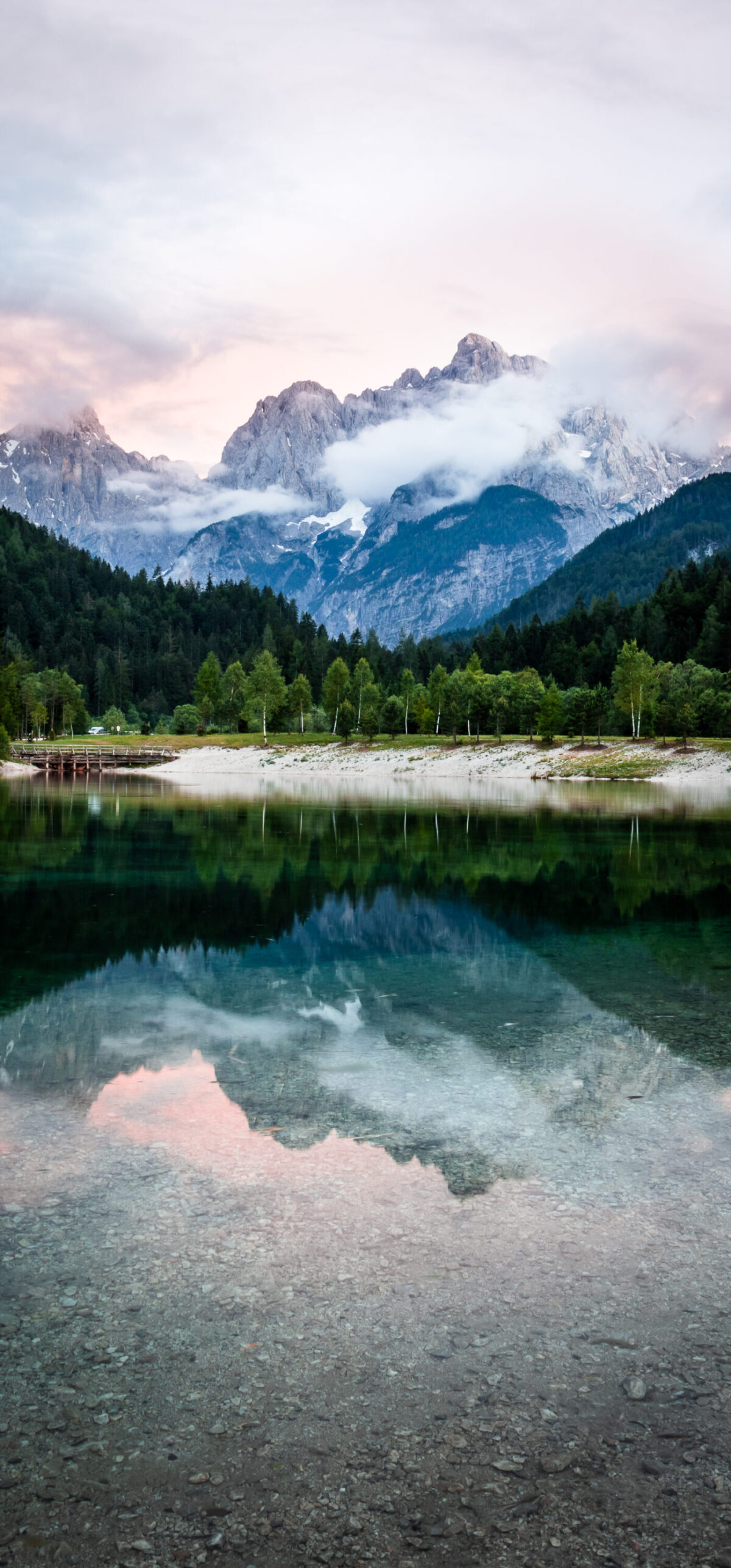
The image is offered for personal wallpaper use. Please do not resell, redistribute or present it as your own photograph.
Frequently asked questions about Lake Jasna
Is Lake Jasna worth visiting?
Yes, especially if I am already in Kranjska Gora. It combines an easy walk, clear water and a strong Julian Alps view without requiring a mountain hike. I would not expect solitude at midday in summer, but early or late visits can feel much calmer.
Is Lake Jasna natural?
No. Lake Jasna consists of two interconnected artificial lakes at the confluence of the Velika Pišnica and Mala Pišnica. Their setting is Alpine, but the present lakes are human-made.
Is Lake Jasna free to visit?
There is no general admission gate or lake entrance ticket. Parking, food, fishing permits and commercial activities may cost extra.
Can I swim in Lake Jasna?
Swimming is promoted locally in summer, but the water is very cold. Jasna is not on Slovenia's official 2026 list of designated bathing waters, so it does not receive the same statutory bathing-season monitoring as listed sites. Check posted notices, assess conditions and do not assume lifeguard supervision.
How cold is Lake Jasna?
There is no single dependable temperature for every day and part of the lake. Mountain-fed water can remain cold even during hot weather. I would avoid treating an old temperature quoted online as a current measurement and enter gradually.
How long does it take to walk around Lake Jasna?
The immediate lakeside walk is short, but stopping at both lakes, the piers, ibex and lookout can easily fill an hour. The official circular walk from central Kranjska Gora is 2.9 km and has only 29 m of ascent.
Can I walk to Lake Jasna from Kranjska Gora?
Yes. It is the arrival I recommend. A pleasant official circular route follows the Pišnica, reaches the lake and returns to town. Allow approximately 20–30 minutes in each direction depending on the starting point and pace.
Where can I park at Lake Jasna?
Two car parks are close to the lake. Spaces can fill at busy times, and tariffs or payment systems may change. Check the official municipal parking site, follow the signs and use Kranjska Gora as a walking alternative if the lakeside area is full.
Is Lake Jasna suitable for children?
The easy paths and short distances make it family-friendly. Adults should supervise children closely around the water, piers and slippery surfaces. The lake is not a controlled swimming pool, and the cold water changes the risk.
Can I take a dog to Lake Jasna?
Dogs can accompany a visit subject to posted local rules. I would keep mine on a lead around the busy shore and always clean up. Stricter rules apply in the natural environment of Triglav National Park, including leashing and a ban on dogs swimming in high-mountain lakes and streams.
Can I fly a drone at Lake Jasna?
Do not assume so. The area is beside Triglav National Park, where drones are prohibited in the natural environment without prior consent, and national aviation restrictions apply more broadly. Verify the exact take-off location, park boundary, airspace and permissions before flying.
Can I skate on Lake Jasna in winter?
I would never step onto the ice unless a competent local authority has explicitly declared and managed it as safe. A frozen-looking surface is not evidence of safe thickness, especially where streams feed connected lakes.
Can I camp beside Lake Jasna?
I would use an official campsite or legal accommodation. Wild camping and overnighting in the natural environment are not acceptable substitutes for a lakeside hotel view, and camping outside designated areas is prohibited in Triglav National Park.
When is the best time to photograph Lake Jasna?
Early morning gives the best general chance of calm water, fewer people and a clean reflection. I also like late-day cloud and low light for atmosphere. Autumn colour, fresh winter snow and spring weather can be more distinctive than a crowded blue-sky summer afternoon.
Final thoughts
Lake Jasna does not demand a heroic journey. That is part of its charm and part of the responsibility that comes with it. A place this accessible can be photographed quickly, consumed as a backdrop and left behind. I prefer to give it time.
My photograph came from a simple set of choices: a vertical frame, a wide but not extreme focal length, ISO 100, a small aperture and enough exposure time for the water to settle visually. The more important choice was to let cloud and reflection carry the picture rather than waiting for a flawless postcard sky.
Jasna remains my favourite lake in Slovenia because it rewards that kind of attention. The scene is easy to reach, but it is not exhausted by the obvious view. Every change in wind, cloud and season rearranges the same few elements. I can stand beside the same clear water and still find a different photograph.