
I grew up beside the Adriatic Sea in Piran, Slovenia, where the water was never merely a blue strip at the edge of town. It was where summer days unfolded. My friends and I swam, dived below the surface, watched small fish scatter through the shallows, and learned that a quiet-looking patch of sea could hold an astonishing amount of life.
That early familiarity also taught me how incomplete our view from land can be. We tend to picture the ocean through a few famous animals: a whale surfacing, a shark cutting through open water, a turtle moving over a reef. Yet most marine life is smaller, stranger and easier to overlook. A coral colony is made of animals. A sea star is not a fish. A Portuguese man o’ war is not a true jellyfish. Even the word shellfish is a culinary shortcut rather than a single biological group.
So this guide begins with what a person searching for animals from the sea is most likely looking for: a clear list. Below are 50 marine animals, organised by their real biological groups, with the places they live and the traits that make them distinctive. After the list, I go deeper into ocean zones, survival strategies, food webs, conservation and the marine life of the northern Adriatic.
The photographs illustrating this article are free stock images rather than my own underwater work, and they are identified only as far as a photograph can reasonably support.
Animals from the sea: the quick list
| Group | Animals included in this guide | How they breathe |
|---|---|---|
| Marine mammals | Blue whale, humpback whale, sperm whale, orca, bottlenose dolphin, harbor seal, sea otter, dugong | Lungs; they must surface |
| Fish | Clownfish, seahorse, tuna, flying fish, anglerfish, ocean sunfish, great white shark, whale shark, hammerhead shark, manta ray, stingray, moray eel | Mostly gills |
| Mollusks | Giant Pacific octopus, common cuttlefish, giant squid, chambered nautilus, blue-ringed octopus, sea hare, giant clam | Mostly gills |
| Crustaceans | Lobster, blue crab, hermit crab, krill, mantis shrimp, copepod | Gills or gas exchange across the body, depending on species |
| Cnidarians and sponges | Moon jelly, Portuguese man o’ war, sea anemone, stony coral, sea fan, sea sponge | Diffusion across tissues rather than lungs or fish-like gills |
| Echinoderms | Sea star, brittle star, sea urchin, sand dollar, sea cucumber | Tube feet, skin gills, respiratory trees, or related structures |
| Marine reptiles | Green sea turtle, leatherback turtle, marine iguana | Lungs; they must surface |
| Seabirds | Emperor penguin, wandering albatross, Atlantic puffin | Lungs |
The blue whale is the largest animal known to have lived on Earth. The whale shark, despite its name, is the largest fish. Those two answers alone show why classification matters: size, habitat and common names do not always tell us what an animal actually is.
What counts as an animal from the sea?
A sea animal is an animal that spends all or a significant part of its life in a marine environment. That includes open ocean, coral reefs, rocky shores, seagrass meadows, estuaries, polar seas, deep trenches and the sediment beneath the seabed.
Some are fully marine. Whales, octopuses and tuna cannot complete their lives on land. Others divide their time. Seals rest and breed on shore but feed at sea. Sea turtles leave the water to lay eggs. Penguins and puffins nest on land while depending on the ocean for food.
The category does not include every living thing found in salt water. Kelp and seagrass, for example, are important marine organisms but not animals. Phytoplankton includes photosynthetic organisms rather than one animal group. Viruses and bacteria belong to entirely different branches of life.
Common names create further confusion:
- A sea star is an echinoderm, not a fish.
- A jellyfish is a cnidarian, not a fish.
- A seahorse really is a fish.
- A whale shark is a shark and therefore a fish, not a whale.
- A killer whale, or orca, is the largest member of the dolphin family.
- Coral is built by tiny animals called polyps, often living in colonies.
- Shellfish usually means edible mollusks and crustaceans; it is not a formal taxonomic group.
Scientists estimate that the ocean may contain roughly 700,000 to one million species, excluding most microorganisms, and that a large proportion remain undiscovered or undescribed. Any list of 50 is therefore an introduction, not a census.
1. Marine mammals
Marine mammals are warm-blooded vertebrates that breathe air with lungs, give birth to live young and nurse them with milk. Their ancestors lived on land, and every whale, dolphin, seal and dugong still carries that history in its anatomy. Unlike fish, they can drown if they cannot reach the surface.
| # | Animal | Where it lives | What makes it distinctive |
|---|---|---|---|
| 1 | Blue whale (Balaenoptera musculus) | Most oceans, generally following seasonal feeding areas | The largest animal known to have lived; it filter-feeds mainly on tiny krill |
| 2 | Humpback whale (Megaptera novaeangliae) | Oceans worldwide, often migrating between high-latitude feeding grounds and tropical breeding areas | Known for long migrations, complex songs and acrobatic breaches |
| 3 | Sperm whale (Physeter macrocephalus) | Deep waters worldwide | The largest toothed whale; it makes deep dives in search of squid |
| 4 | Orca (Orcinus orca) | Every ocean | A highly social apex predator with populations that use different diets and hunting traditions |
| 5 | Common bottlenose dolphin (Tursiops truncatus) | Temperate and tropical coastal and offshore waters | Uses whistles for communication and echolocation clicks to investigate its surroundings and find prey |
| 6 | Harbor seal (Phoca vitulina) | Temperate and subarctic coasts of the Northern Hemisphere | A true seal that hauls out on beaches and rocks but hunts fish and invertebrates at sea |
| 7 | Sea otter (Enhydra lutris) | Coastal North Pacific | Uses tools to open hard-shelled prey and helps control sea urchins in kelp-forest ecosystems |
| 8 | Dugong (Dugong dugon) | Warm, shallow coastal waters from East Africa to the western Pacific | A herbivorous relative of the manatee that grazes seagrass meadows |
The blue whale is not simply the largest animal alive today. NOAA describes it as the largest animal ever known to live on the planet. Some Antarctic individuals can reach about 33.5 metres (110 feet), yet their primary prey is krill, a crustacean small enough to fit in a hand. That contrast is one of the ocean’s recurring patterns: enormous animals can depend on very small ones.
Toothed whales, including sperm whales, orcas and dolphins, are often discussed as if all whales use echolocation. They do not. Echolocation is characteristic of toothed whales, while baleen whales such as blue and humpback whales produce sounds for communication but are not known to echolocate in the same way.
2. Fish, including sharks and rays
Fish are aquatic vertebrates that generally breathe through gills. The category includes two major lineages represented here: bony fish, such as tuna and clownfish, and cartilaginous fish, such as sharks and rays. A shark’s skeleton is made primarily from cartilage rather than bone, but a shark is still a fish.
| # | Animal | Where it lives | What makes it distinctive |
|---|---|---|---|
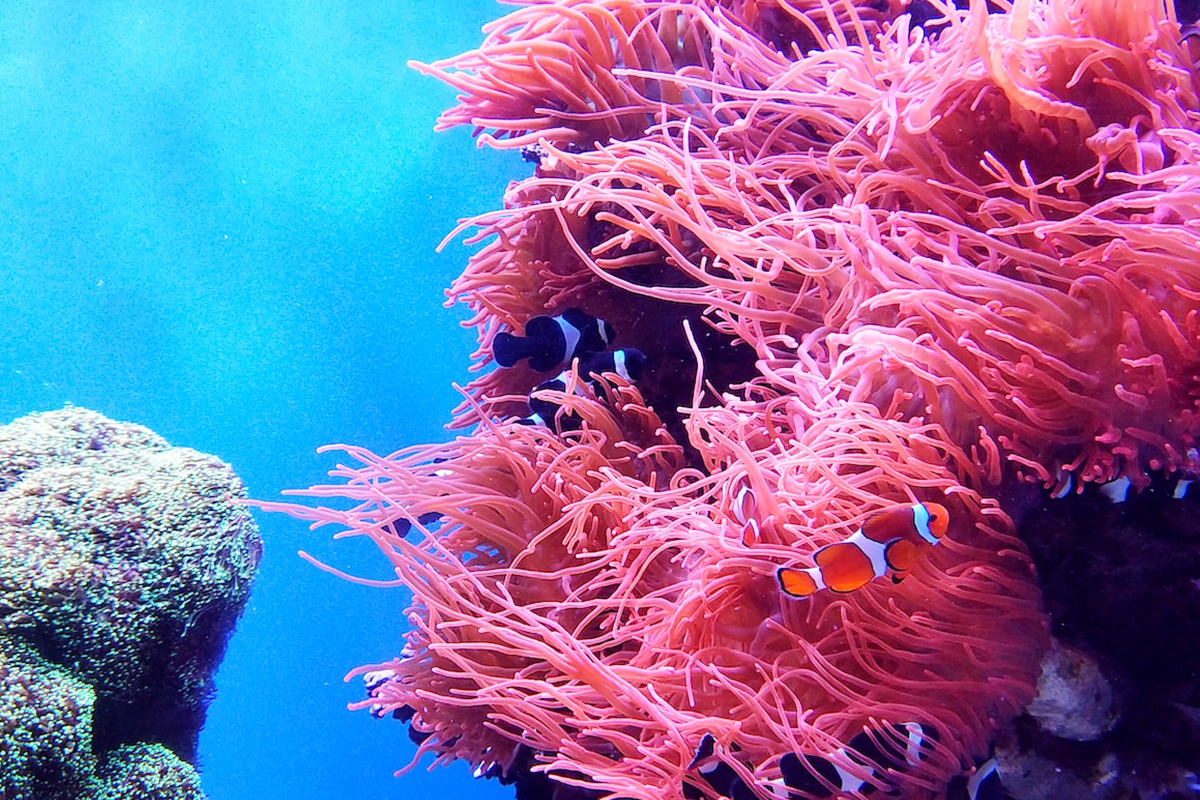
| 9 | Clownfish (subfamily Amphiprioninae) | Warm Indo-Pacific reefs | Lives among the stinging tentacles of sea anemones, protected by a specialised mucus coating and acclimation behaviour |
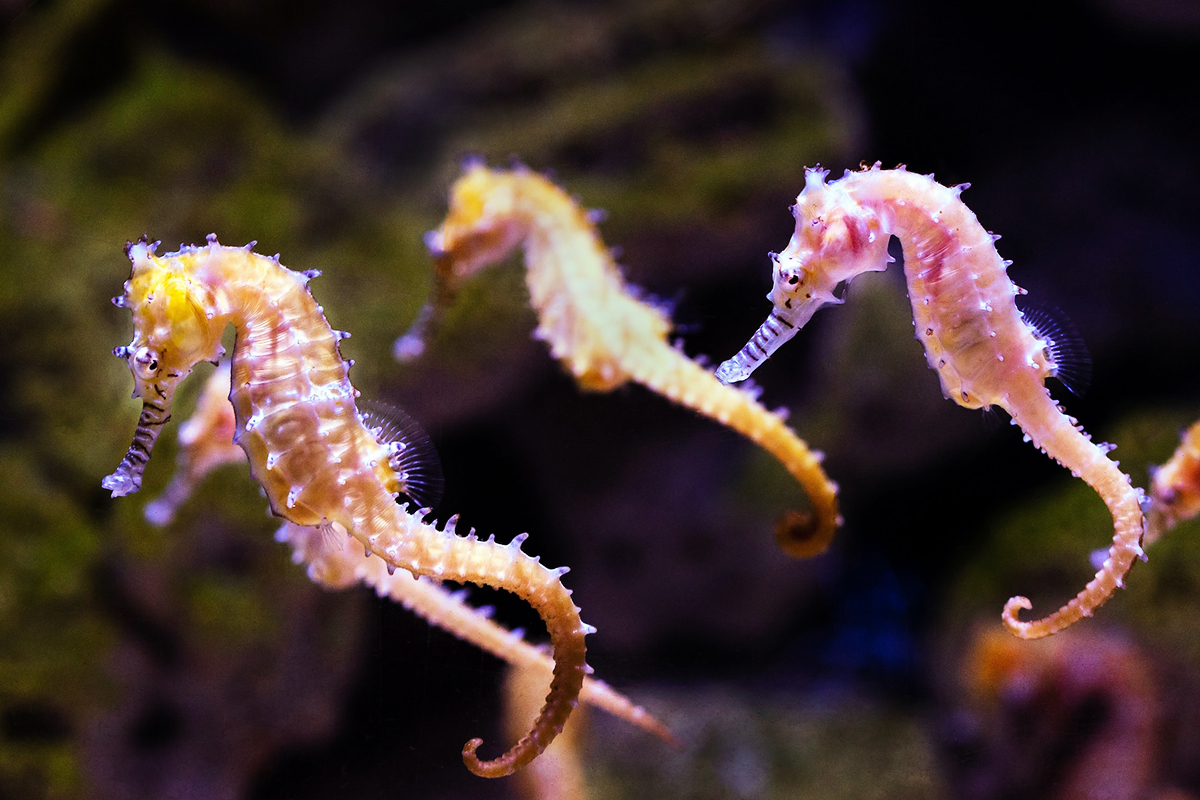
| 10 | Seahorse (genus Hippocampus) | Seagrass, mangroves, reefs and sheltered coastal habitats | Swims upright; the male carries developing embryos in a brood pouch |
| 11 | Tuna (tribe Thunnini) | Open oceans | A fast, muscular predator adapted for constant movement and long-distance travel |
| 12 | Flying fish (family Exocoetidae) | Tropical and subtropical surface waters | Launches from the water and glides on enlarged fins to escape predators |
| 13 | Deep-sea anglerfish (order Lophiiformes) | Deep, dark waters in many oceans | Many species use a lure near the mouth; in some deep-sea lineages, the lure is bioluminescent |
| 14 | Ocean sunfish (Mola mola) | Temperate and tropical oceans | One of the heaviest bony fish, with a flattened body and a shortened tail region |
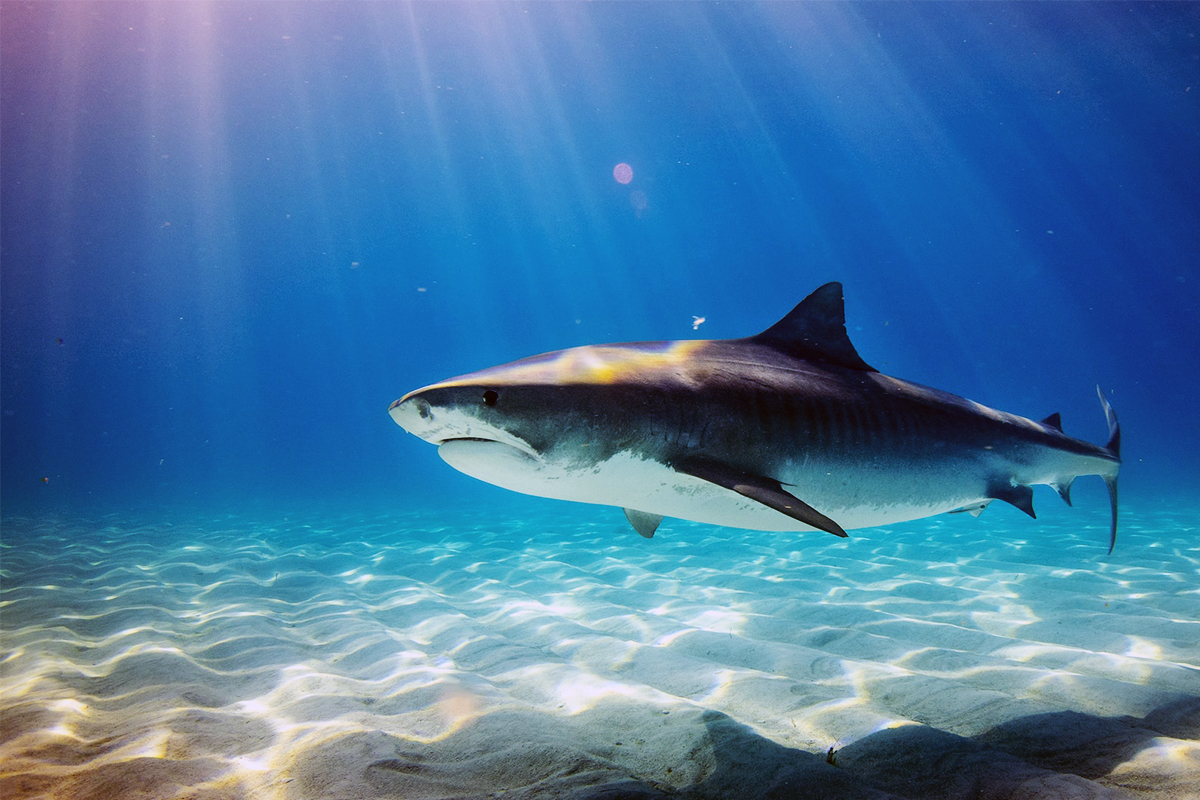
| 15 | Great white shark (Carcharodon carcharias) | Temperate and subtropical coastal and offshore waters | A large predatory shark with excellent sensory systems; not a universal “king of the sea” |
| 16 | Whale shark (Rhincodon typus) | Tropical and warm-temperate seas | The world’s largest fish; a filter feeder that consumes plankton and small nekton |
| 17 | Hammerhead shark (family Sphyrnidae) | Warm coastal and open waters | Its widened, hammer-shaped head carries sensory organs and provides a broad field for detecting prey |
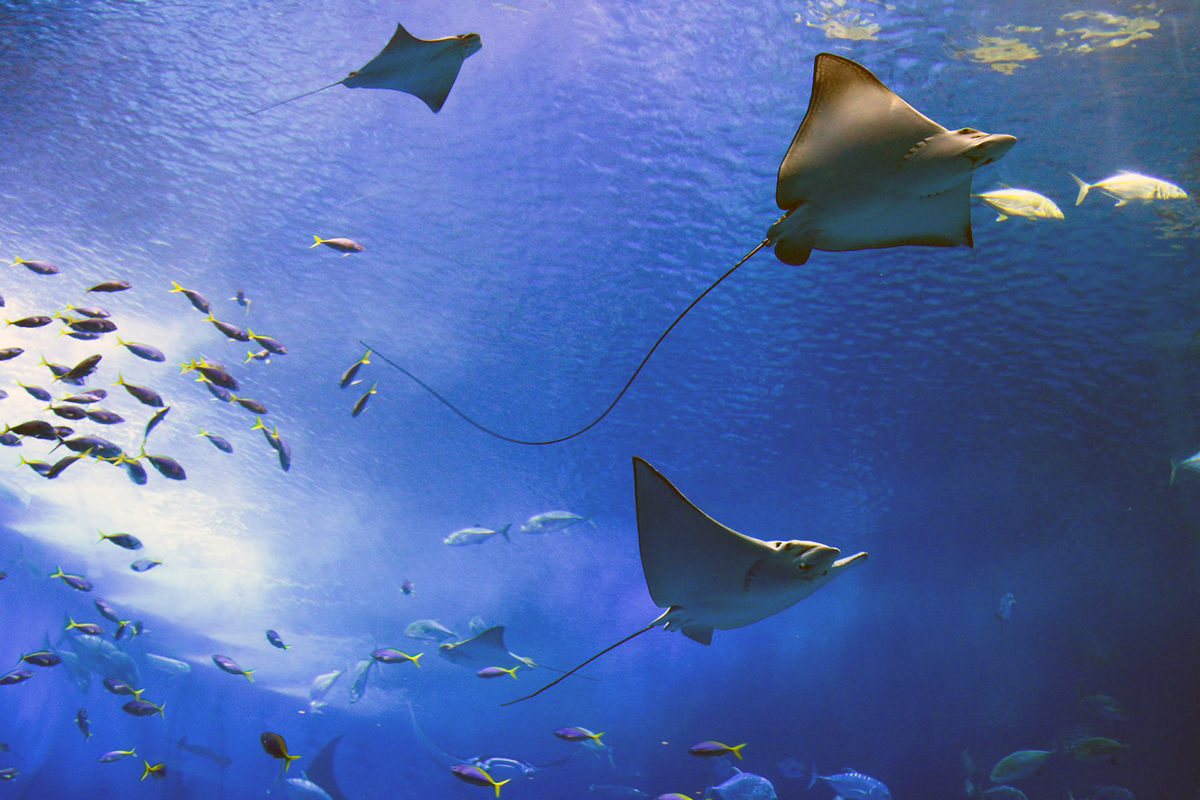
| 18 | Manta ray (genus Mobula) | Tropical, subtropical and some temperate waters | A large, graceful filter-feeding ray; unlike stingrays, mantas do not have a stinging tail spine |
| 19 | Stingray (several families) | Coastal shallows, estuaries, reefs and some deeper habitats | A flattened bottom-oriented fish; many species possess one or more defensive tail spines |
| 20 | Moray eel (family Muraenidae) | Mostly tropical and subtropical reefs and rocky crevices | A true fish with an elongated body and a second set of jaws that helps move prey into the throat |
The shark photographs that dominate popular culture can distort the group. More than 500 shark species are known, ranging from small deep-water animals to the enormous whale shark. Many do not hunt large prey, and relatively few pose a meaningful danger to people. Calling one species the “king of the sea” is storytelling, not science: ocean ecosystems have different top predators in different places, and even apex predators remain vulnerable to fishing, habitat change and shifts in prey.
3. Mollusks
Mollusks are one of the most diverse animal phyla. Their body plans range from a clam protected by two shells to an octopus with eight flexible arms and a highly developed nervous system. Octopuses, squid, cuttlefish and nautiluses are cephalopods, a class within the mollusks.
| # | Animal | Where it lives | What makes it distinctive |
|---|---|---|---|
| 21 | Giant Pacific octopus (Enteroctopus dofleini) | Rocky dens and cold coastal waters of the North Pacific | The largest octopus by mass; capable of complex exploration, camouflage and problem-solving |
| 22 | Common cuttlefish (Sepia officinalis) | Eastern Atlantic and Mediterranean coastal waters | Changes skin colour and pattern rapidly using specialised cells; controls buoyancy with a cuttlebone |
| 23 | Giant squid (Architeuthis dux) | Deep ocean worldwide | An elusive large cephalopod with very large eyes and two long feeding tentacles |
| 24 | Chambered nautilus (family Nautilidae) | Indo-Pacific reef slopes and deeper waters | Lives in an external coiled shell divided into buoyancy-regulating chambers |
| 25 | Blue-ringed octopus (genus Hapalochlaena) | Shallow Indo-Pacific reefs and tide pools | Small but highly venomous; flashes vivid blue rings when disturbed |
| 26 | Sea hare (family Aplysiidae) | Coastal seagrass, rocky reefs and algae-rich habitats | A soft-bodied sea slug; some species release coloured ink when threatened |
| 27 | Giant clam (genus Tridacna) | Shallow Indo-Pacific coral reefs | Large bivalves that host photosynthetic algae in their tissues and gain energy from the partnership |
Cephalopods are especially good examples of intelligence evolving along a path very different from our own. An octopus has a centralised brain, but a large proportion of its neurons are distributed through its arms. Its skin can change appearance without relying on the slow growth of fur or feathers. Cuttlefish combine colour-producing chromatophores with structural reflectors, allowing rapid shifts in pattern, contrast and in some cases iridescence.
Their sophistication does not make them miniature humans. It makes them something more interesting: animals whose perception and control systems evolved for a soft, vulnerable body in a three-dimensional underwater world.
4. Crustaceans
Crustaceans are arthropods, relatives of insects and spiders, characterised by jointed limbs and an external skeleton. As they grow, many must shed that rigid covering in a vulnerable process called moulting. The most visible crustaceans are crabs and lobsters, but tiny copepods and krill are more consequential to the ocean’s food webs than their size suggests.
| # | Animal | Where it lives | What makes it distinctive |
|---|---|---|---|
| 28 | Lobster (several families) | Rocky seabeds and continental shelves | A large decapod with a hard exoskeleton; claw shape and size vary by lineage |
| 29 | Blue crab (Callinectes sapidus) | Western Atlantic estuaries and coastal waters; introduced elsewhere | Uses paddle-shaped rear legs for swimming and tolerates changing salinity |
| 30 | Hermit crab (superfamily Paguroidea) | Intertidal zones, reefs and deeper seabeds | Protects its soft abdomen in an empty shell and changes shelters as it grows |
| 31 | Krill (order Euphausiacea) | Oceans worldwide, especially productive and polar waters | Small schooling crustaceans that transfer energy from plankton to whales, seals, penguins and fish |
| 32 | Mantis shrimp (order Stomatopoda) | Tropical and subtropical burrows and reefs | Has extraordinarily complex eyes and specialised raptorial limbs used to spear or strike prey |
| 33 | Copepod (subclass Copepoda) | Nearly every marine habitat, from surface plankton to the deep sea | Tiny but extremely abundant; many are key grazers and prey in marine food webs |
The scale of a food web can be deceptive. A blue whale may weigh well over 100 tonnes, but its survival depends on dense concentrations of krill. Fish larvae may depend on copepods that are barely visible. If those small animals decline or shift with changing ocean conditions, effects can move upward through the system.
5. Cnidarians and sea sponges
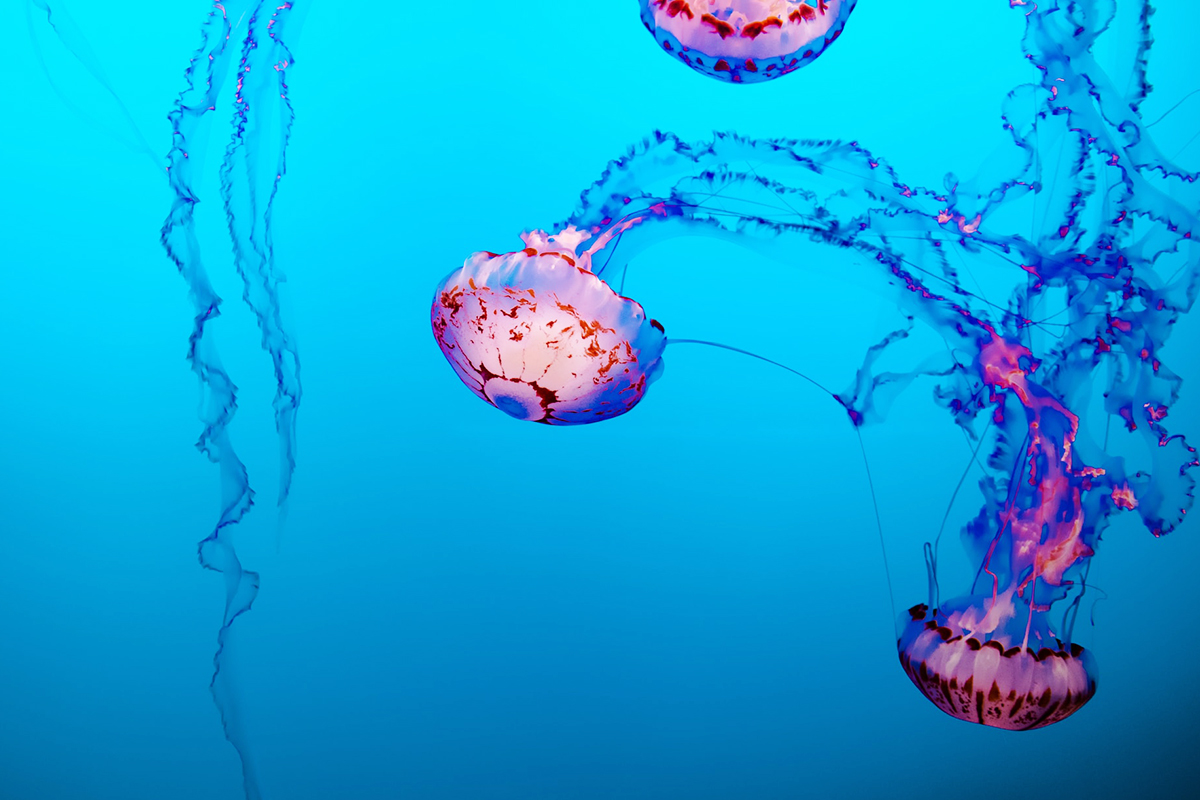
Cnidarians include jellyfish, sea anemones, corals and related animals. Their defining structures include cnidocytes, specialised cells that can contain stinging capsules. Sponges belong to a separate, older animal lineage and do not have true organs like most animals, but they are active filter feeders rather than underwater plants.
| # | Animal | Where it lives | What makes it distinctive |
|---|---|---|---|
| 34 | Moon jelly (genus Aurelia) | Coastal waters in many parts of the world | A translucent true jelly with four often-visible, horseshoe-shaped reproductive structures |
| 35 | Portuguese man o’ war (Physalia physalis) | Mostly tropical and subtropical surface waters | Not a true jellyfish but a siphonophore colony made of specialised zooids working together |
| 36 | Sea anemone (order Actiniaria) | Rocky shores, reefs, sand and deep sea | A stationary or slow-moving polyp with tentacles armed with stinging cells |
| 37 | Stony coral (order Scleractinia) | Tropical reefs and also cold, deep waters | Tiny polyps secrete calcium-carbonate skeletons; colonial reef builders can create vast habitats |
| 38 | Sea fan (several octocoral groups) | Reefs and current-swept seabeds | A soft-coral colony with a branching form positioned to capture food from moving water |
| 39 | Sea sponge (phylum Porifera) | From shallow reefs to the deep ocean | Draws water through pores and filters suspended food; some species host complex microbial communities |
A coral reef may look like geology, but much of its structure is the cumulative work of animals. A reef-building coral is composed of polyps, usually living with photosynthetic algae in a partnership that provides much of the energy needed to grow. When heat or other stress causes corals to expel those algae, bleaching occurs. A bleached coral is not necessarily dead, but it is stressed and may die if adverse conditions continue.
The Portuguese man o’ war is another useful correction to a familiar label. NOAA identifies it as a siphonophore: a floating colony of specialised, genetically identical units called zooids. Different parts handle floating, prey capture, feeding and reproduction. Its detached or stranded tentacles can still sting, so an animal washed onto a beach should never be handled.
6. Echinoderms
Echinoderms are exclusively marine animals. Adults usually show a five-part radial body plan, although that symmetry is modified in some groups. They operate a water vascular system connected to tube feet used for movement, feeding, attachment or gas exchange.
| # | Animal | Where it lives | What makes it distinctive |
|---|---|---|---|
| 40 | Sea star (class Asteroidea) | Intertidal zones to the deep sea | Uses tube feet; many species can regenerate damaged arms, though the extent varies |
| 41 | Brittle star (class Ophiuroidea) | Reefs, sediment, rocky crevices and deep seabeds | Moves mainly by flexing long, slender arms rather than walking on tube feet |
| 42 | Sea urchin (class Echinoidea) | Rocky shores, reefs, kelp forests and deep sea | A grazing or omnivorous animal protected by movable spines |
| 43 | Sand dollar (order Clypeasteroida) | Sandy and muddy seabeds | A flattened burrowing relative of sea urchins; the familiar white “shell” is its internal skeleton, or test |
| 44 | Sea cucumber (class Holothuroidea) | Seafloors from shallow reefs to abyssal plains | Reworks sediment and recycles organic matter; some species expel defensive structures when threatened |
Sea stars are often described as if every species can grow a complete new body from one arm. That is too broad. Regenerative ability varies, and in many species an arm must retain part of the central disc to generate a new animal. The accurate version is still remarkable: many sea stars can repair substantial damage, and some can reproduce through division.
Sea cucumbers are less photogenic than dolphins, but ecologically they can be just as instructive. By ingesting sediment, extracting organic material and returning processed particles to the seabed, they influence nutrient cycling and sediment chemistry. The ocean is maintained not only by hunters but also by grazers, filter feeders, scavengers and animals that process what falls from above.
7. Marine reptiles
Marine reptiles breathe air, regulate body temperature through behaviour and their surroundings, and retain a stronger link to land than fish do. Sea turtles return to beaches to nest. The marine iguana of the Galápagos rests and reproduces on land but enters the sea to graze algae.
| # | Animal | Where it lives | What makes it distinctive |
|---|---|---|---|
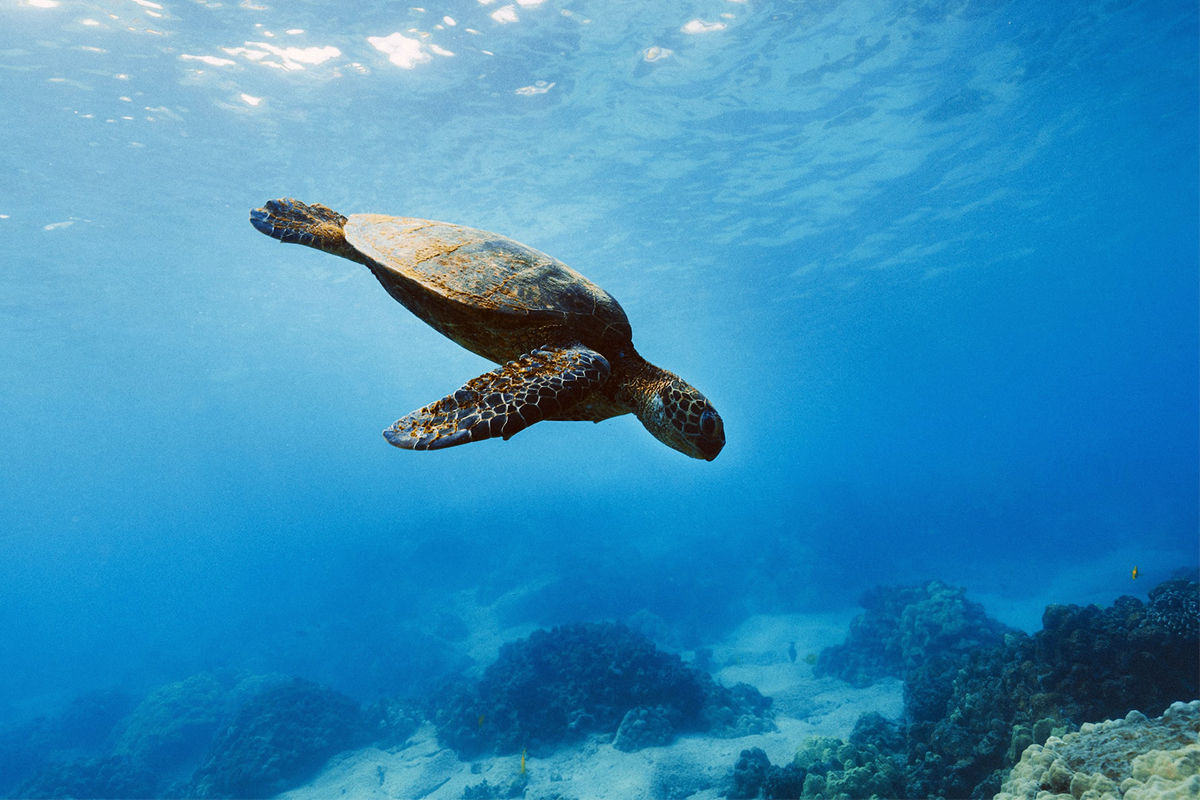
| 45 | Green sea turtle (Chelonia mydas) | Tropical and subtropical oceans | Adults are mainly herbivorous in many populations, grazing seagrass and algae; the name refers to body fat, not shell colour |
| 46 | Leatherback turtle (Dermochelys coriacea) | Widely distributed through tropical, temperate and some cold waters | The largest sea turtle; its flexible, leathery carapace differs from the hard shells of other sea turtles |
| 47 | Marine iguana (Amblyrhynchus cristatus) | Galápagos Islands | The only living lizard that regularly forages in the sea; expels excess salt through nasal glands |
A turtle’s shell is not a portable house. It is living anatomy fused with parts of the spine and ribs. Sea turtles cannot withdraw completely into it, and their streamlined flippers and shells are shaped for long-distance swimming rather than land defence. They must still surface to breathe and return to land for nesting.
8. Seabirds
Seabirds are birds whose lives are closely tied to marine food. They breathe air and nest on land or ice, but some spend months over the open ocean. Their adaptations range from salt-excreting glands to wings transformed into powerful underwater flippers.
| # | Animal | Where it lives | What makes it distinctive |
|---|---|---|---|
| 48 | Emperor penguin (Aptenodytes forsteri) | Antarctic sea ice and surrounding waters | The largest penguin; an exceptional diver that breeds during the Antarctic winter |
| 49 | Wandering albatross (Diomedea exulans) | Southern Ocean | Has one of the largest wingspans of any living bird and uses dynamic soaring to travel efficiently over waves |
| 50 | Atlantic puffin (Fratercula arctica) | North Atlantic and Arctic coasts | Uses its wings to “fly” underwater while pursuing small fish; nests in colonies on islands and cliffs |
Penguins are regularly described as universally monogamous and loyal to one partner for life. Reality depends on the species and the season. Many seabirds form pair bonds and cooperate intensely while breeding, but partner fidelity varies, and divorce or re-pairing occurs. A stronger article does not need to turn animal behaviour into a human romance to make it interesting.
Where sea animals live: from tide pools to trenches
The ocean is not one uniform habitat. Temperature, pressure, light, salinity, oxygen, currents, food and the shape of the seabed create dramatically different living conditions. A crab under a rock at low tide faces heat and drying. An anglerfish in the deep sea faces darkness, cold and scarce meals. Both are marine animals, but their worlds barely resemble one another.
Coastal habitats
Coastal seas contain some of the ocean’s most productive and accessible ecosystems.
- Intertidal shores alternate between submersion and exposure as tides rise and fall. Anemones, crabs, mussels, limpets, sea stars and small fish must tolerate fast changes.
- Estuaries are places where rivers meet the sea. Their changing salinity creates nurseries for fish and crustaceans and feeding grounds for birds.
- Seagrass meadows shelter juvenile animals, stabilise sediment and feed grazers including dugongs and green turtles.
- Mangrove forests provide submerged root systems where young fish and invertebrates can hide.
- Coral reefs are three-dimensional habitats built largely by coral animals. They support dense communities in both tropical shallows and, in different forms, the deep sea.
- Kelp forests are formed by large brown algae, not plants or animals, but they create habitat for fish, sea otters, urchins and many invertebrates.
Pelagic zones by depth and light
| Zone | Approximate depth | Light conditions | Representative animals |
|---|---|---|---|
| Epipelagic / sunlight zone | 0–200 m | Enough light for photosynthesis in much of the zone | Tuna, dolphins, sea turtles, whale sharks, many jellies |
| Mesopelagic / twilight zone | 200–1,000 m | Faint light; not enough for photosynthesis | Lanternfish, hatchetfish, squid, migrating zooplankton |
| Bathypelagic / midnight zone | 1,000–4,000 m | No sunlight | Anglerfish, vampire squid, deep-sea jellies |
| Abyssopelagic / abyss | 4,000–6,000 m | Permanent darkness, near-freezing water, high pressure | Sea cucumbers, brittle stars, specialised fishes and crustaceans |
| Hadal zone | Deeper than 6,000 m | Permanent darkness in trenches | Amphipods, snailfish, sea cucumbers and other pressure-adapted animals |
NOAA notes that significant sunlight rarely penetrates below 200 metres. Between about 200 and 1,000 metres, light fades rapidly and photosynthesis is no longer possible. Below 1,000 metres, the ocean is aphotic: sunlight does not reach it.
The boundaries are useful, but animals do not read charts. Many migrate vertically each day. Vast numbers of fish, crustaceans, jellies and other animals rise toward the surface at night to feed, then descend during daylight, when darkness offers cover from visual predators. This diel vertical migration is one of the largest animal movements on Earth by biomass, even though most participants are small and unseen.
How animals survive in salt water
The central challenge of marine life is not merely learning to swim. An animal must obtain oxygen, balance salt and water, find food, avoid becoming food, reproduce, and sense a world where light and sound behave differently than they do in air.
Gills, lungs and life at the surface
Fish pass oxygen-rich water over gills, where gases move across thin tissues. Many crustaceans and mollusks also use gills, though their structures differ. Jellies and sponges rely largely on diffusion because their tissues are thin or continually exposed to moving water.
Marine mammals, reptiles and birds have lungs. A whale can remain submerged for a long dive, but it cannot extract oxygen from water. Sea turtles and penguins store and use oxygen efficiently, slow some body functions during dives, and still must return to air.
Salt balance
Seawater can pull water from an animal’s body and introduce excess salts. Different groups solve this in different ways. Marine bony fish generally drink seawater and excrete excess salts through specialised cells in their gills and through their kidneys. Sharks and rays retain compounds such as urea to keep their internal chemistry closer to the surrounding water, then use specialised mechanisms to remove excess salt.
Seabirds and marine iguanas have salt glands that excrete concentrated salt. The dramatic “sneeze” of a marine iguana is part of this housekeeping, not a sign that the animal has caught a cold.
Buoyancy without a floor
Many bony fish use a gas-filled swim bladder to control buoyancy. Sharks lack one and instead rely on lift from fins, movement and large oil-rich livers. Nautiluses adjust gas and liquid in shell chambers. Cuttlefish use a porous cuttlebone. Marine mammals manage air in the lungs, body composition and movement.
Neutral buoyancy matters because sinking or rising constantly would waste energy. In the open ocean, there may be no place to rest.
Camouflage, transparency and warning colours
In sunlit water, countershading is common: a dark back blends with the depths when seen from above, while a pale underside matches surface light from below. Some open-water animals are transparent. Others are reflective. Octopuses and cuttlefish actively change skin patterns to disappear, signal or startle.
Colour has a different meaning with depth. Red wavelengths disappear quickly underwater, so a red animal can appear nearly black in deeper blue water. Bright warning colours in the shallows, such as the rings of a blue-ringed octopus, may instead advertise danger.
Pressure, cold and darkness
Pressure increases by roughly one atmosphere for every 10 metres of seawater. Deep-sea animals avoid air-filled spaces that would collapse, and their proteins and cell membranes are adapted to function under pressure and cold.
Many deep-sea species conserve energy with slow metabolisms, soft bodies, expandable stomachs or feeding structures able to seize rare opportunities. Others make light. MBARI research found that about three-quarters of observed animals in the ocean water column can produce bioluminescence. They may use it to lure prey, hide their silhouette, confuse predators or communicate.
The marine food web: who eats whom?
The familiar food chain — small fish, bigger fish, shark — is too simple. Ocean life is a web with loops, seasonal pulses, scavengers, microbes and animals that feed at more than one level.
The foundation
In much of the sunlit ocean, phytoplankton capture solar energy through photosynthesis. These microscopic organisms are eaten by zooplankton, including copepods and larval animals. Krill eat phytoplankton and other small particles. Fish, whales, seabirds, squid and jellies then feed on zooplankton or on one another.
In the deep sea, where sunlight cannot support photosynthesis, communities often depend on organic material sinking from above. This “marine snow” includes dead plankton, waste, mucus and fragments of other organisms. At hydrothermal vents and cold seeps, microbes use chemical energy instead, supporting food webs that do not begin with sunlight.
Predators are only part of the story
An orca may sit near the top of a regional food web, but its role depends on the population. Some specialise in fish; others hunt marine mammals or sharks. A sea otter can affect an entire kelp forest by eating sea urchins. Without enough otters or other predators, urchins may overgraze kelp and transform a forest into an “urchin barren”.
Filter feeders are equally important. Sponges, bivalves, whale sharks, manta rays and baleen whales remove suspended organisms or particles from water. Detritivores and scavengers recycle what remains. The sea is not a ladder of winners and losers; it is a network of energy transfers.
The sea animals closest to home: Piran and the northern Adriatic
When I think about marine animals, I do not first imagine a remote tropical reef. I think about Piran: stone walls meeting the water, sunlight moving across the seabed, and the small details visible when I slowed down in the shallows.
The northern Adriatic is shallow compared with much of the Mediterranean, strongly influenced by rivers and seasonal change, and surrounded by densely used coasts. Its marine life includes seagrass communities, mollusks, crustaceans, fish, jellies, echinoderms and marine mammals. Some are easy to miss because they are small, well camouflaged, buried or active at night.
I do not need to claim a dramatic wildlife encounter to explain why that sea shaped my attention. The lesson was quieter: what appears empty from a promenade is crowded at the scale of a rock, a patch of algae, or a few metres of water.
Common bottlenose dolphins regularly occur in Slovenian waters and the northern Adriatic. Morigenos, the Slovenian Marine Mammal Society, has systematically studied dolphins in Slovenian and adjacent waters since 2002. The Marine Biology Station Piran, part of Slovenia’s National Institute of Biology, is the country’s only institution dedicated to marine research and monitoring sea-water quality.
Those details matter because they replace a postcard view of the Adriatic with a living one. It is not merely scenery. It is a monitored ecosystem in which animal behaviour, shipping, fishing, tourism, pollution and warming water all meet.
Sea life beyond a catalogue
The ocean rarely presents its animals like a catalogue. They appear within water, light, vegetation and movement, which is part of what makes them so compelling to photograph. Two marine scenes shared on Instagram:
The major threats facing marine animals
There is no single “ocean problem”, just as there is no single ocean animal. Threats overlap differently by species and place.
Fishing pressure, bycatch and entanglement
Fishing provides food and livelihoods, but unsustainable harvest can deplete target species and alter food webs. Bycatch captures animals that were not the intended catch, including sea turtles, sharks, seabirds and marine mammals. Lost or abandoned gear can continue “ghost fishing” long after people stop using it.
Entanglement is especially dangerous for air-breathing animals. A whale or turtle caught in line may be injured, exhausted, prevented from feeding or unable to surface. Attempting a rescue without training can also endanger the animal and the person; local wildlife or stranding authorities should be contacted instead.
The vaquita shows how specific and severe one threat can become. This small porpoise lives only in the northern Gulf of California. NOAA describes it as the world’s most endangered marine mammal and says fewer than 20 remain, with illegal gillnet entanglement continuing to drive the species toward extinction. Because estimates for such a tiny population are difficult and change as surveys improve, I would avoid presenting an exact number as permanent fact.
Plastic and other marine debris
Animals can mistake plastic for food or become tangled in bags, straps, fishing line and nets. Debris can also damage habitats as it moves across reefs and shorelines. The visible bottle is only one part of the problem; fibres, fragments and lost fishing gear behave differently and require different solutions.
“Use less plastic” is useful but incomplete advice. Better waste systems, product design, fishing-gear recovery, enforcement, industry responsibility and community cleanup all matter. Individual behaviour helps most when it connects to broader systems.
Climate change, warming and acidification
The ocean absorbs much of the excess heat generated by human-caused climate change. Warming can shift where animals live, change breeding and feeding timing, intensify marine heatwaves, reduce oxygen in some waters and stress coral reefs.
The ocean also absorbs carbon dioxide. This changes seawater chemistry and makes it more difficult for some organisms to build calcium-carbonate shells and skeletons. The effects are not identical for every species, but reef-building corals, some mollusks and some plankton are among the groups of concern.
Habitat loss, noise and vessel strikes
Coastal development can remove wetlands, seagrass, nesting beaches and nursery areas. Anchors and careless boating can damage reefs and seagrass. Artificial light can disorient sea-turtle hatchlings.
Underwater noise from ships, construction, sonar and industrial activity can interfere with communication and behaviour. Vessels can also strike whales, turtles and other animals. NOAA identifies ship strikes and fishing-gear entanglement among the primary current threats to blue whales.
How to photograph and observe sea animals responsibly
The best wildlife photograph is not worth changing an animal’s behaviour. Distance, patience and a longer lens should do the work. The moment an animal stops feeding, turns repeatedly toward the camera, changes direction, flees or abandons a resting place, the photograph has already cost too much.
These principles work across locations:
- Learn the local rules before you arrive. Legal distances and seasonal closures vary by country, species and protected area.
- Never touch, chase, corner, ride or feed a wild animal. Feeding changes behaviour and can make an animal dependent, aggressive or more vulnerable to boats and fishing gear.
- Give resting and breeding animals extra space. A seal on a beach is not necessarily stranded. A nesting turtle should never be lit, blocked or surrounded.
- Control buoyancy while diving. Fins, knees and camera equipment can break coral or stir sediment even when the contact feels minor.
- Do not move animals for a cleaner composition. Tide-pool creatures, shells occupied by hermit crabs, sea stars and octopuses are not props.
- Avoid flash where it is prohibited or likely to disturb wildlife. Follow guidance from the site operator, scientists or protected-area authority.
- Keep location data private when disclosure could harm a rare species. A precise geotag can direct crowds, collectors or poachers to a vulnerable animal.
- Report injured or entangled wildlife to trained responders. Keep the scene calm and do not attempt a dangerous disentanglement yourself.
NOAA’s general U.S. guidance recommends staying at least 100 yards from large whales and at least 50 yards from dolphins, porpoises, seals, sea lions and sea turtles, with stricter legal rules for certain species and locations. Those are not worldwide regulations, but they offer a useful scale: if the animal fills the frame only when you are uncomfortably close, the answer is a longer lens, not a smaller distance.
Frequently asked questions about animals from the sea
What is the largest animal in the sea?
The blue whale is the largest animal in the sea and the largest animal known to have lived on Earth. NOAA reports that the largest Antarctic blue whales can reach about 110 feet (33.5 metres) and weigh more than 330,000 pounds (150,000 kilograms).
What is the largest fish in the ocean?
The whale shark is the largest fish. It is a shark, not a whale, and feeds by filtering plankton and small animals from the water rather than hunting large mammals.
How many animal species live in the ocean?
There is no final number. NOAA cites estimates of roughly 700,000 to one million ocean species, excluding most microorganisms, with perhaps two-thirds or more still undiscovered or not formally described. The number changes as scientists identify new species and revise classifications.
Is a whale a fish?
No. A whale is a mammal. It breathes air with lungs, is warm-blooded, gives birth to live young and nurses them with milk. Fish generally breathe through gills.
Is a shark a mammal?
No. Sharks are fish. More specifically, they are cartilaginous fish, which means their skeletons are made mainly from cartilage rather than bone.
Is coral an animal?
Yes. Corals are animals. Many familiar corals are colonies of tiny polyps that capture food with tentacles and, in reef-building species, secrete calcium-carbonate skeletons. Many also live in partnership with photosynthetic algae.
Is a jellyfish really a fish?
No. True jellyfish are cnidarians, a group that also includes corals and sea anemones. They have no backbone and are not closely related to fish.
Can the “immortal jellyfish” live forever?
Not in the simple sense suggested by the nickname. Turritopsis dohrnii can reverse from its adult medusa stage to an earlier polyp stage through a process associated with transdifferentiation, effectively restarting its life cycle. It can still be eaten, diseased, injured beyond recovery or killed by unsuitable conditions. It is potentially biologically immortal, not invulnerable.
What animals live in the deepest parts of the ocean?
Hadal trenches deeper than 6,000 metres contain specialised amphipods, sea cucumbers, worms, microbes and fishes such as some snailfish. The exact communities vary by trench and depth. They are adapted to darkness, cold, scarce food and extreme pressure.
What is the smallest sea animal?
There is no single stable answer. “Animal” includes microscopic multicellular organisms, larvae, parasitic species and lineages whose boundaries are still studied. The answer changes depending on whether size means length, mass, adult size or smallest known individual. It is more accurate to say that many marine animals are microscopic than to crown one permanent smallest species.
Are sea animals dangerous to people?
Some can injure people through venom, bites, spines, electric organs or sheer size. Risk, however, depends on location and behaviour. Avoid touching unknown animals, obey beach warnings, give wildlife space and learn local first-aid guidance. Most marine animals do not seek conflict with people.
Which marine mammal is most endangered?
The vaquita is widely described by NOAA as the world’s most endangered marine mammal. It lives only in the northern Gulf of California and is threatened primarily by entanglement in illegal gillnets.
Do penguins mate for life?
Not as a universal rule. Pair-bond duration and partner fidelity vary by species, colony, breeding success and year. Many penguins form cooperative seasonal pairs, and some reunite with previous partners, but re-pairing also occurs.
A final thought from the shore
The sea can make distance look like emptiness. From land, the surface smooths everything into colour and weather. But below it are animals that breathe air and animals that pull oxygen from water; animals with bones, cartilage, shells, spines, soft bodies, colonies and no centralised brain at all.
Growing up in Piran gave me an uncomplicated reason to care about that variety before I knew the scientific names. I first noticed movement: a fish disappearing, a shell that was not empty, something translucent passing through sunlit water. Knowledge came later, and it made the scene larger rather than less mysterious.
This list of 50 animals from the sea is therefore not a ranking and not a complete inventory. It is a doorway. The most useful next step is to choose one animal, learn where it truly lives, understand what threatens it, and observe it without asking it to perform. The ocean becomes more interesting the moment we stop treating it as background.
Sources and fact-checking references
The biological and conservation information in this guide was checked against the following research organisations and official sources:
- NOAA Fisheries: blue whale
- NOAA Fisheries: vaquita
- NOAA Ocean Service: how many species live in the ocean?
- NOAA Ocean Service: how far does light travel in the ocean?
- NOAA Ocean Service: are corals animals or plants?
- NOAA Ocean Service: what is a Portuguese man o’ war?
- NOAA Fisheries: guidelines and distances for viewing marine life
- NOAA Fisheries: entanglement of marine life
- NOAA Ocean Service: a guide to plastic in the ocean
- MBARI: animals of the deep
- MBARI: bioluminescence and fluorescence
- Smithsonian Environmental Research Center: Turritopsis dohrnii
- Morigenos: dolphin research in Slovenian waters
- Morigenos: monitoring dolphins in Slovenian waters, 2025–2026
- National Institute of Biology: Marine Biology Station Piran