
The Cathedral of Florence is one of those buildings that seems familiar long before you see it in person. Brunelleschi’s red-tiled dome appears in paintings, films and almost every view of the Florence skyline. Yet none of those images quite prepares you for the scale of the building when it suddenly fills the narrow streets around Piazza del Duomo.
I visited Florence several years ago. I parked outside the centre and walked into the city, which turned out to be the perfect way to arrive. The cathedral was hidden at first by the surrounding buildings. Then the street opened and the marble façade, Giotto’s Bell Tower and the enormous dome appeared almost at once. I had seen many photographs of the Duomo, but standing beneath it was completely different. It felt less like looking at a single church and more like entering a city within the city.
One note before you scroll. The photographs on this page are free stock images from Pexels and Pixabay rather than my own work. The visit and the impressions are mine; the frames belong to other photographers.
The formal name of the Cathedral of Florence is the Cathedral of Santa Maria del Fiore. It is also commonly called the Florence Duomo. The cathedral stands in Piazza del Duomo in the historic centre of Florence, together with the Baptistery of San Giovanni and Giotto’s Bell Tower. This guide brings together the practical information I would have wanted before my own visit: what the different buildings are, what can be visited for free, which parts require a ticket, what deserves the most time and how to photograph the cathedral without reducing it to one predictable view.
Cathedral of Florence: quick facts
| Detail | Information |
|---|---|
| Official name | Cathedral of Santa Maria del Fiore |
| Common names | Florence Cathedral, Florence Duomo, Duomo di Firenze |
| Location | Piazza del Duomo, historic centre of Florence, Italy |
| Construction began | 8 September 1296 |
| Consecrated | 25 March 1436 |
| Original architect | Arnolfo di Cambio |
| Dome designer | Filippo Brunelleschi |
| Cathedral dimensions | Approximately 153 metres long and 90 metres wide at the transept |
| Dome climb | 463 steps, no lift |
| Bell tower climb | 414 steps, no lift |
| Cathedral admission | Free; a ticket is not required for the main cathedral interior |
| Other monuments | Paid passes are required for the Dome, Bell Tower, Baptistery, Santa Reparata and Opera del Duomo Museum |
| UNESCO status | Part of the Historic Centre of Florence, inscribed in 1982 |
Opening hours, access rules and ticket conditions can change for religious services, maintenance and special events. I always check the official Opera di Santa Maria del Fiore visitor information and official ticket website before going.
What does “the Duomo” actually include?
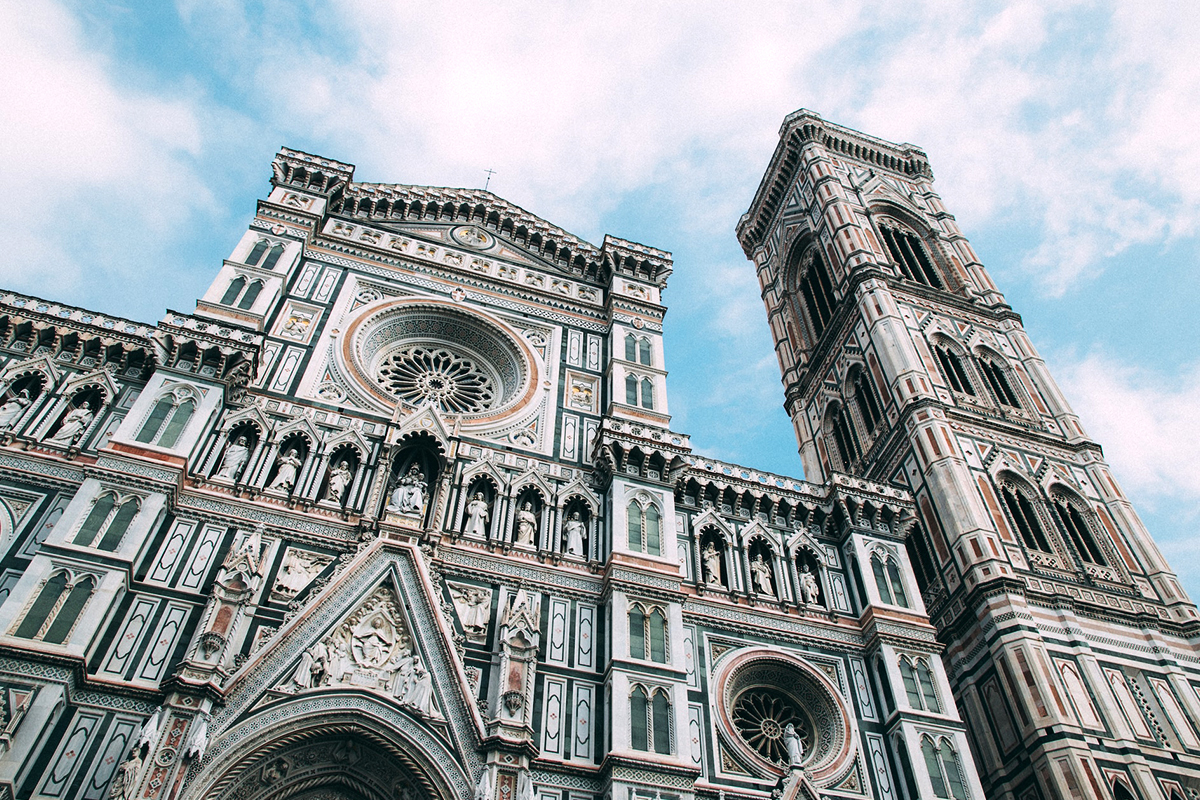
The word duomo is often used as if it refers to the entire group of monuments in Piazza del Duomo. Strictly speaking, it means the cathedral. For a visitor, however, it helps to understand that the experience is divided among several separate sites.
Cathedral of Santa Maria del Fiore
This is the main church. Entry to the cathedral itself is free, although there may be a queue and visitors must follow the dress code. Inside are Paolo Uccello’s unusual clock, stained-glass windows, monumental frescoes, the marble floor and the vast painted interior of the dome.
Brunelleschi’s Dome
The dome is part of the cathedral but has a separate, timed entrance and requires the Brunelleschi Pass. The route climbs 463 steps through narrow passages between the two shells of the dome. There is no lift. This is also where visitors pass close to the fresco of the Last Judgment before reaching the outdoor terrace at the top.
Giotto’s Bell Tower
The freestanding campanile beside the cathedral is Giotto’s Bell Tower. Its climb has 414 steps and several intermediate levels. The top gives a high view over Florence and, importantly, a direct view of Brunelleschi’s dome. The tower and the dome are different climbs with separate entrances.
Baptistery of San Giovanni
The octagonal Baptistery stands opposite the cathedral façade. It is one of the oldest religious buildings in Florence and is known for its mosaics and bronze doors. The celebrated original doors and many sculptures from the cathedral complex are preserved in the museum, while replicas stand outside.
Santa Reparata
The archaeological area beneath the cathedral contains remains of the earlier church of Santa Reparata. It is easy to overlook, but it makes the long history of the site much easier to understand. Florence did not simply build the present cathedral on empty ground; the new church rose around and above an older sacred centre.
Opera del Duomo Museum
The museum is not an optional extra for anyone interested in the building’s art and construction. It holds original works made for the cathedral complex, including pieces by Michelangelo, Donatello, Ghiberti and Brunelleschi. It also protects originals that would be difficult to appreciate properly on the crowded square.
My first impression of the Cathedral of Florence
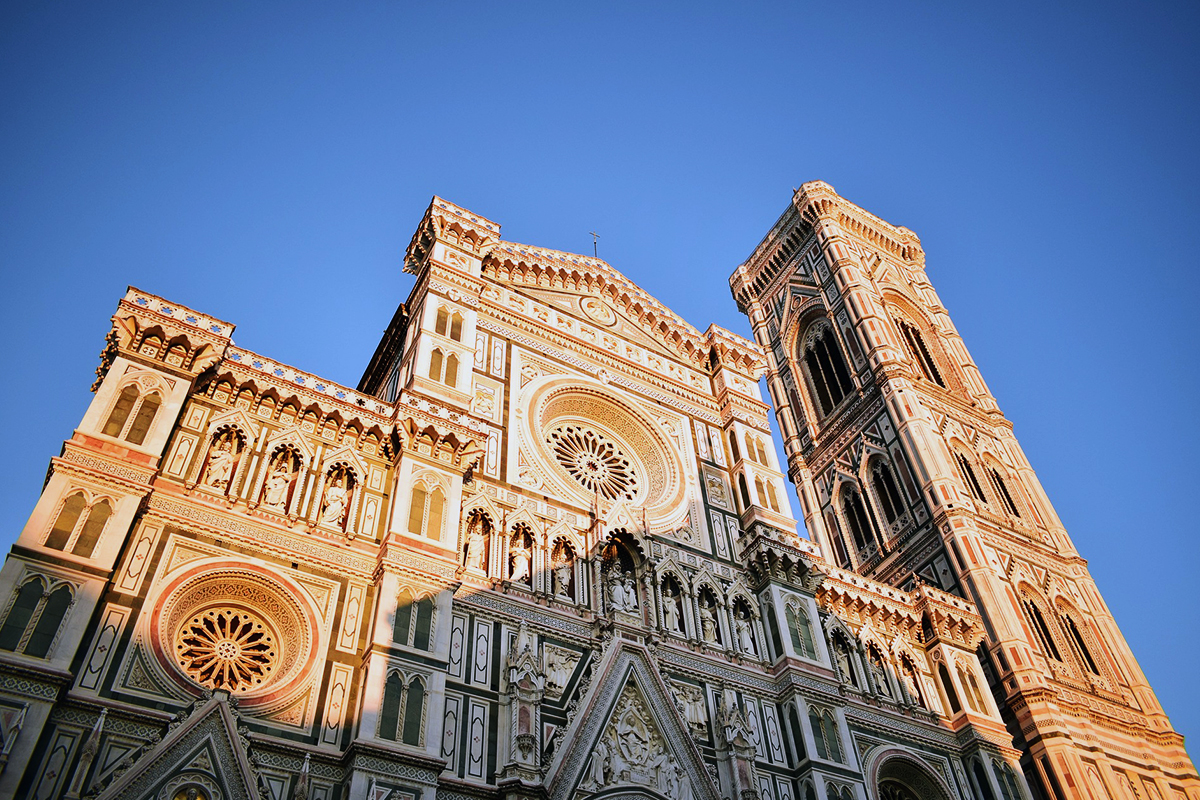
Florence rewards walking. Its historic centre is compact, but the narrow streets control what can be seen and when. The Duomo does not always announce itself from a distance. Depending on the direction of approach, fragments appear first: a strip of coloured marble, the upper section of the bell tower or the terracotta curve of the dome above a roofline.
That gradual reveal was part of what stayed with me. I had parked away from the centre and walked through Florence, so my first encounter was not framed by a bus window or a taxi door. The cathedral arrived in pieces and then, suddenly, as a whole.
Up close, the exterior is much more intricate than the familiar skyline silhouette suggests. White marble provides the lightest surface, green marble defines panels and borders, and red stone adds warmth. Sculptures, arches, geometric decoration and windows cover the façade. The building is enormous, yet the details can make it feel almost delicate.
The square is rarely empty, and I do not think it needs to be. People give the cathedral scale. A wide photograph with visitors crossing the foreground shows something that an isolated architectural study cannot: this is still a living centre of Florence, not a monument separated from daily life.
A brief history of Florence Cathedral
The Cathedral of Santa Maria del Fiore was created over generations. That long construction history explains why its parts feel related without belonging to one single moment.
| Date | What happened |
|---|---|
| 1296 | The first stone was laid and construction began under Arnolfo di Cambio. |
| 1334 | Giotto became master of the works and began the bell tower. |
| 1359 | Francesco Talenti completed the bell tower after work by Andrea Pisano. |
| Mid-14th century | The cathedral plan was enlarged under Francesco Talenti and other master builders. |
| 1420–1436 | Filippo Brunelleschi constructed the great dome. |
| 1436 | Pope Eugene IV consecrated the cathedral. |
| 1572–1579 | Giorgio Vasari, Federico Zuccari and collaborators painted the Last Judgment inside the dome. |
| 1876–1887 | The present Neo-Gothic façade was constructed, principally to Emilio De Fabris’s design. |
| 1903 | The façade programme was fully completed with the final bronze doors. |
From Santa Reparata to Santa Maria del Fiore
The new cathedral was begun at the end of the 13th century on the site of Santa Reparata, Florence’s earlier cathedral. Its name, Santa Maria del Fiore — Saint Mary of the Flower — has long been associated with the lily, the emblem of Florence.
Arnolfo di Cambio designed the first building, but the project evolved after his death. Francesco Talenti’s work in the 14th century helped establish the enlarged form visitors see today. The scale was ambitious even for a wealthy city. Florence was making a statement about religion, civic identity, engineering and artistic power at the same time.
Brunelleschi and the problem of the dome
The crossing remained open because no one had yet solved how to cover such a vast space. The usual wooden centring used to support masonry during construction would have required an extraordinary amount of timber and presented major technical difficulties.
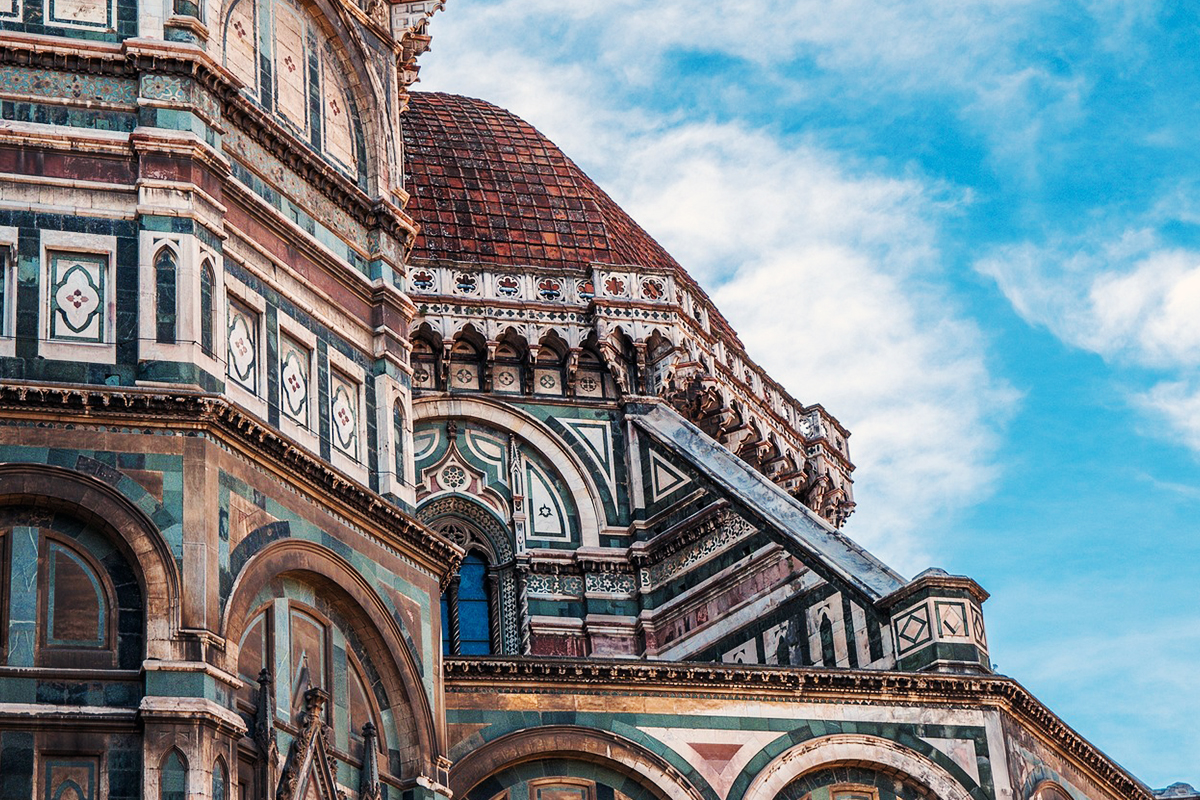
Filippo Brunelleschi’s solution was a double-shell dome built without the conventional full wooden support structure. Its brickwork includes the famous herringbone pattern, which helped control the structure as it rose. Eight major stone ribs define its octagonal form, with smaller ribs contributing to the internal framework.
Completed in 1436, the dome changed the appearance of Florence and became one of the defining achievements of Renaissance architecture. It remains the largest masonry dome ever built. Its importance is not only its size. Brunelleschi managed to make a technical answer into the visual symbol of an entire city.
The façade is younger than it looks
One of the most useful facts to know before studying the cathedral exterior is that the present front façade is not medieval. Arnolfo di Cambio’s original façade was never fully completed and was dismantled in the 16th century. For centuries, the west end remained unfinished.
The façade seen today was begun in 1876 and officially inaugurated in 1887. Emilio De Fabris designed it in a Neo-Gothic style using white, green and red marble so that it would harmonise with the medieval sides of the cathedral, Giotto’s Bell Tower and the Baptistery. Luigi Del Moro continued the work after De Fabris died, and the final bronze doors were completed in the early 20th century.
Knowing this does not diminish the façade. It makes it more interesting. The cathedral exterior is not a perfectly preserved object from one age; it is a conversation between medieval ambition, Renaissance engineering and 19th-century ideas about how Florence should represent its past.
The exterior: colour, geometry and scale
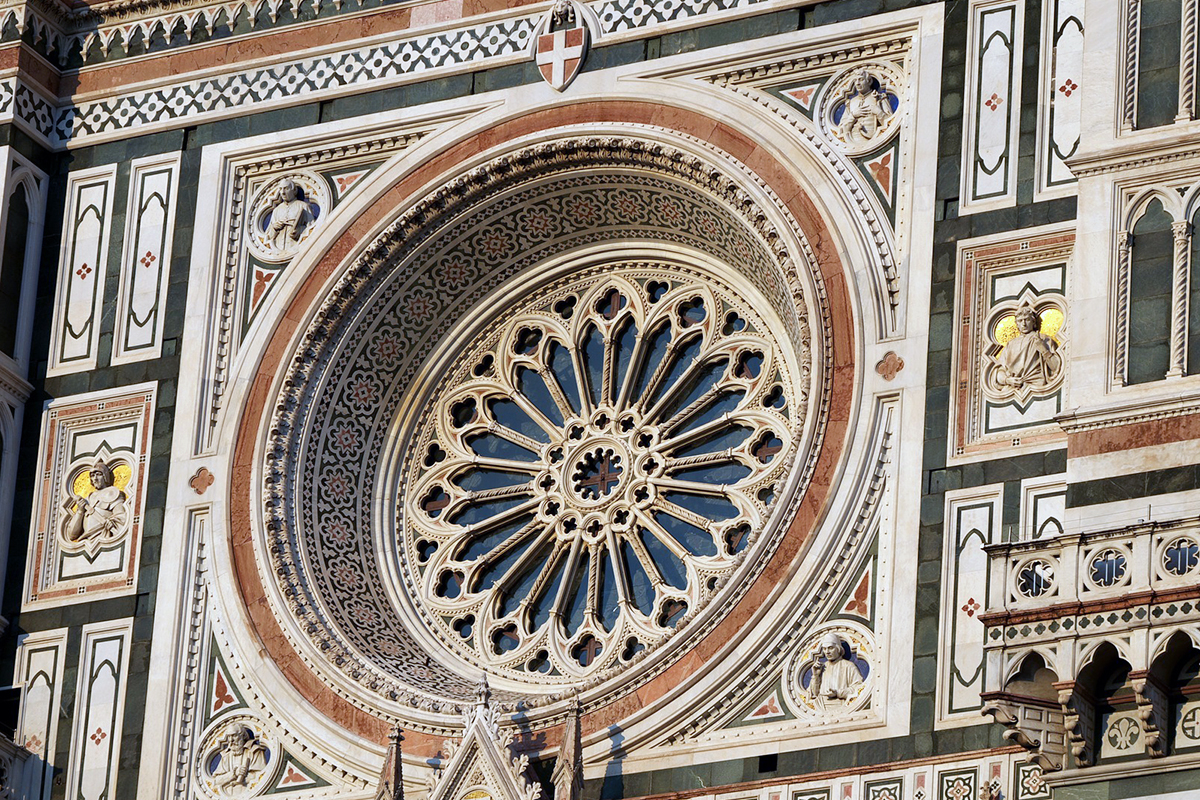
The façade is so detailed that it can overwhelm the eye. From a distance, the strong verticals, pointed gables and large rose window organise the composition. Closer in, the surface breaks into smaller stories: saints in niches, carved borders, floral patterns, coats of arms and geometric bands of coloured marble.
The side walls feel calmer. Their repeating windows and alternating marble panels create a rhythm that leads toward the transept and the dome. Walking around the entire building is worthwhile because the relationship between its components changes continuously. At the west end, the façade dominates. From the side, the nave seems extremely long. Around the apse, the dome becomes the visual centre.
The marble colours
The exterior uses three principal colours of stone: white marble, green marble and red or pink marble. They create the distinctive Tuscan pattern also seen on the Baptistery and bell tower. In bright midday sun, the white areas can appear almost flat, while side light reveals the depth of the carving. After rain or under a darker sky, the green and red sections become more pronounced.
Giotto’s Bell Tower
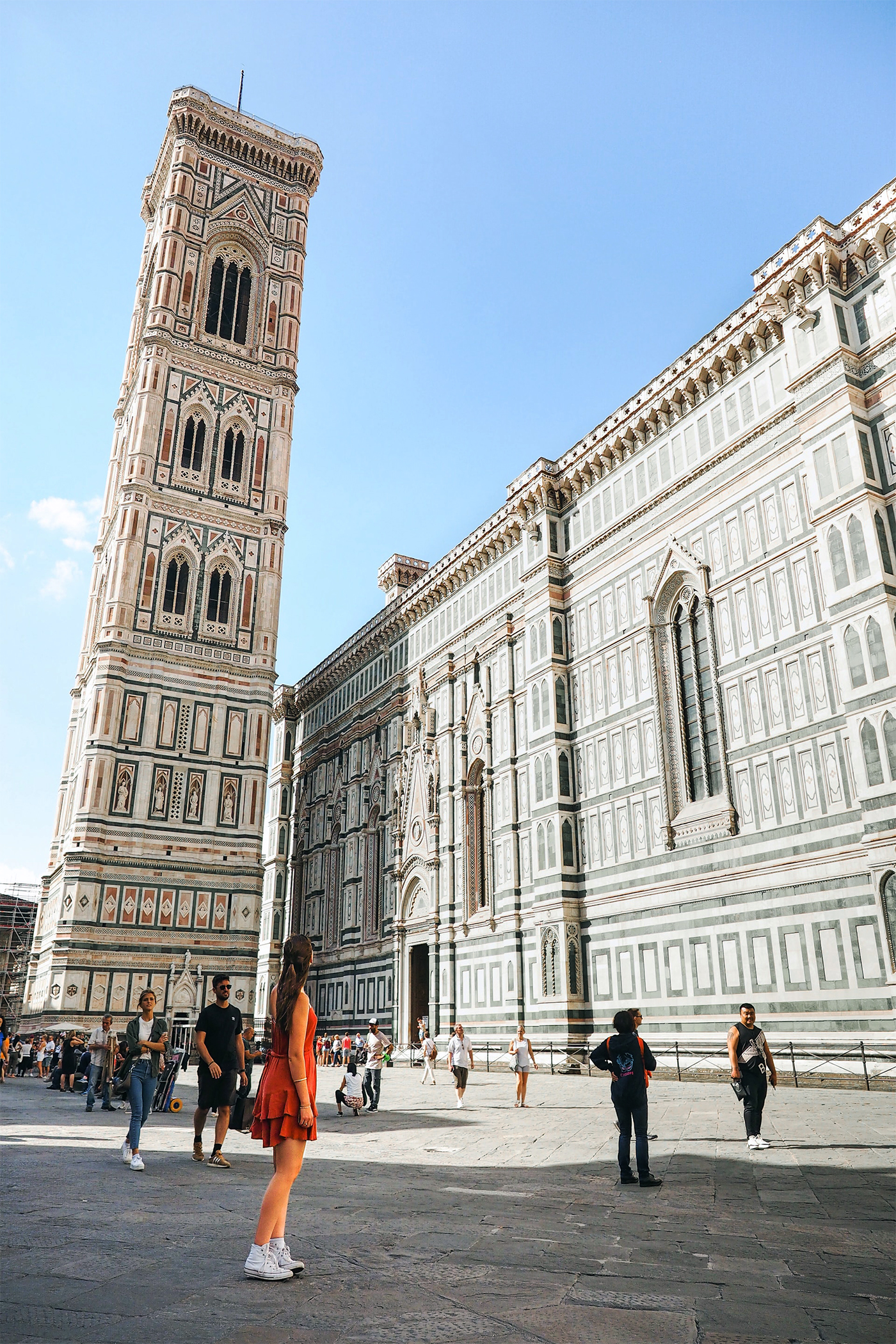
Giotto began the bell tower in 1334, but he did not live to see it completed. Andrea Pisano continued the work, and Francesco Talenti brought it to completion in 1359. The tower rises to 84.7 metres and repeats the cathedral’s polychrome marble, making the two buildings appear inseparable even though the campanile stands independently.
From ground level, its rectangular panels, sculptural reliefs and narrow Gothic windows are easy to miss because the eye is drawn upward. Stepping back and framing the tower with people at its base communicates its height more honestly than pointing a camera straight up and excluding the square.
Inside Florence Cathedral
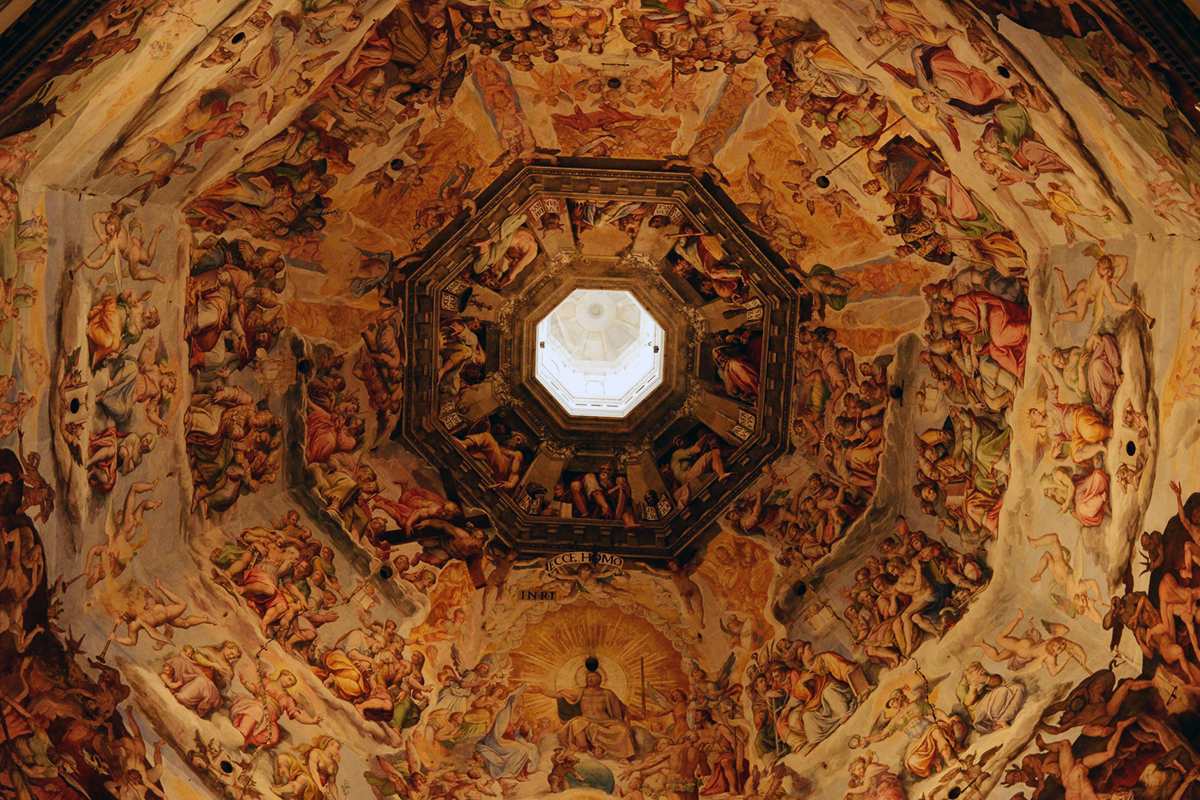
The interior is more restrained than the exterior. After the dense marble decoration outside, the long nave can feel unexpectedly austere. That contrast directs attention toward the architecture: immense arches, stone piers, the patterned marble floor and the octagonal space beneath the dome.
The size is difficult to judge from photographs. The cathedral is approximately 153 metres long, about 90 metres wide at the transept and around 90 metres high from the floor to the base of the lantern. People become small points beneath the vaults.
The Last Judgment
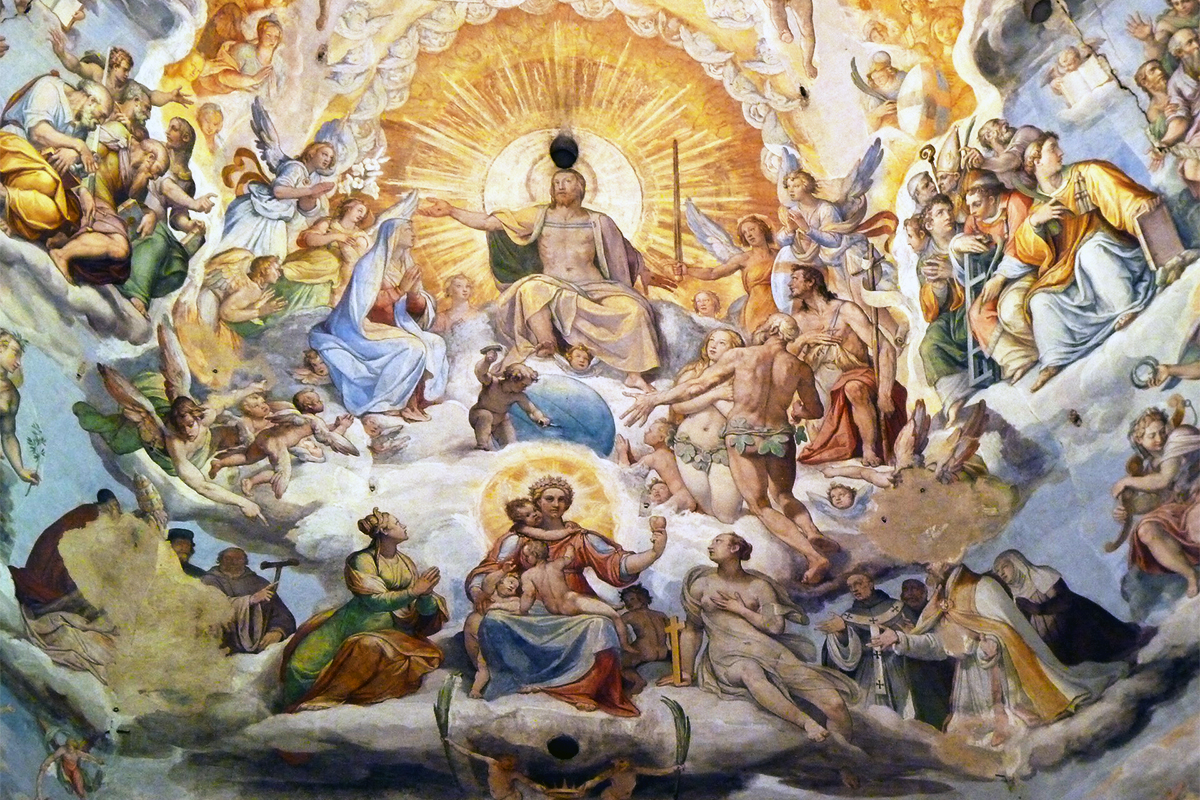
The most visually commanding work inside is the Last Judgment covering the interior of the dome. Giorgio Vasari began the fresco in 1572. After his death, Federico Zuccari continued it with collaborators, completing the work in 1579. The painted surface covers approximately 3,600 square metres and contains hundreds of figures arranged in concentric zones.
From the cathedral floor, the fresco reads as one enormous image. On the dome climb, the experience changes completely. The route passes along an interior gallery where details, figures and expressions that are almost invisible from below suddenly become close and physical.
Other details worth finding
The dome naturally attracts most attention, but several quieter works reward a slower visit:
- Paolo Uccello’s clock above the main entrance uses a 24-hour arrangement and moves counter-clockwise according to the old Italian system of measuring the day.
- Equestrian monuments honour the military leaders John Hawkwood and Niccolò da Tolentino in painted works by Paolo Uccello and Andrea del Castagno.
- Dante Before the City of Florence, painted by Domenico di Michelino, connects the poet with Florence and includes a view of the city and the Divine Comedy’s imagined worlds.
- Stained-glass windows were designed by important early Renaissance artists, including Lorenzo Ghiberti, Donatello, Paolo Uccello and Andrea del Castagno.
- The marble pavement introduces colour and complex geometry at ground level, balancing the broad, relatively plain wall surfaces above.
The cathedral remains an active place of worship. That matters when visiting. Some areas may be restricted during services, and silence is more appropriate than treating the nave as another busy attraction. I find that the interior becomes more powerful when I stop trying to see every detail immediately and allow my eyes to adjust to the darker light.
Visiting the Cathedral of Florence
The main practical question is whether you want only to enter the cathedral or to visit the wider Duomo complex. The cathedral interior is free. The dome, bell tower, Baptistery, Santa Reparata and museum are covered by paid passes.
Cathedral entry and opening hours
According to the official visitor information, tourist access to the cathedral is generally available Monday to Saturday from 10:15 to 15:45. The cathedral is closed to tourist visits on Sundays and during religious celebrations. Access is free and no admission ticket is required.
These hours can change, so they should be checked shortly before a visit. A free entrance does not mean immediate entry: security screening and queues can take time, particularly from late morning onward.
Duomo passes and current prices
The Opera di Santa Maria del Fiore offers three principal passes. At the time of this update, the standard adult prices are:
| Pass | Adult price | Main inclusions |
|---|---|---|
| Brunelleschi Pass | €30 | Dome, Giotto’s Bell Tower, Baptistery, Opera del Duomo Museum and Santa Reparata |
| Giotto Pass | €20 | Giotto’s Bell Tower, Baptistery, museum and Santa Reparata; no Dome |
| Ghiberti Pass | €15 | Baptistery, museum and Santa Reparata; no Dome or Bell Tower |
Reduced prices apply to children aged 7–14, and children aged 0–6 enter free. Passes are generally valid for three calendar days beginning on the selected date, but the dome reservation is tied to a specific time and date. Current prices and inclusions should always be confirmed on the official Duomo ticket portal.
Booking Brunelleschi’s Dome
The dome is the one part I would plan well in advance. A named reservation for a fixed entry time is compulsory. The booking cannot normally be changed or cancelled, identification is required and late arrivals may be refused. The official guidance allows a maximum delay of five minutes.
The climb has 463 steps and no lift. Some passages are narrow, steep and enclosed, and part of the route follows the curve of the dome. It is not suitable for everyone. The official rules advise against the climb for visitors with heart conditions, vertigo, claustrophobia or limited mobility, and children under seven are not permitted.
Dome or Giotto’s Bell Tower?
If time or physical effort makes it sensible to choose only one climb, the difference is simple:
| Experience | Brunelleschi’s Dome | Giotto’s Bell Tower |
|---|---|---|
| Steps | 463 | 414 |
| Lift | No | No |
| Timed reservation | Mandatory | Check current pass conditions |
| Best feature | Moving through the structure of the dome and close to the Last Judgment | Looking directly across at the dome |
| View | Florence from the cathedral’s highest point | Florence with the dome in the view |
| Route | Narrow, curved passages with enclosed sections | Steep staircase with intermediate levels |
The dome climb offers the more unusual architectural experience because visitors move between Brunelleschi’s two shells. The bell tower often gives the more recognisable photograph because the cathedral dome remains visible instead of being beneath your feet.
Essential visitor rules
The Duomo complex is both a major attraction and a group of sacred buildings. A few rules can determine whether entry is straightforward or frustrating.
Dress code
Shoulders and legs must be covered inside the cathedral, Baptistery and Santa Reparata. Hats should be removed. In summer, carrying a light layer is a practical solution, but it should cover the shoulders and knees properly rather than only loosely.
Bags and luggage
Large and medium bags, backpacks and luggage are not allowed in the monuments. The official storage facility is at Piazza Duomo 38/r. It is compulsory for items that exceed the permitted size. Arriving with only a small bag saves time, especially when visiting several parts of the complex.
Photography
Personal photography is generally allowed, but flash, tripods and selfie sticks are prohibited. The interior is dark compared with the square, so a camera or phone with good low-light performance helps. Silence and respect for services remain more important than getting a photograph.
Accessibility
The cathedral has an accessible entrance at Porta dei Canonici on the south side. The dome and bell tower climbs have hundreds of steps and no lift. Visitors with mobility requirements should check current accessibility details with the official site before arrival.
Where is Florence Cathedral?
The cathedral is in Piazza del Duomo, at the heart of Florence’s historic centre. It is about a ten-minute walk from Firenze Santa Maria Novella railway station and within easy walking distance of Piazza della Signoria, the Uffizi Gallery, Ponte Vecchio and the Basilica of Santa Croce.
Arriving on foot or by train
Walking is the easiest way to reach the cathedral from most places in central Florence. From Santa Maria Novella station, the direct route takes roughly ten minutes. The final approach through Via de’ Cerretani gives an increasingly clear view of the Baptistery, cathedral façade and bell tower.
Arriving by car
Central Florence has a restricted traffic zone, known as the ZTL. Cameras monitor entry, and driving into it without authorisation can result in a fine. I parked outside the centre and walked in, which removed the stress of navigating narrow streets and gave me a much better arrival experience.
Travellers using a hotel or private garage within the ZTL should confirm the access procedure directly with the property or garage. Rules and access points can change, so I would never rely on an old map or an informal promise that a route is safe.
How much time should I allow?
How long to spend depends on which parts of the complex you plan to enter.
| Visit plan | Sensible amount of time |
|---|---|
| Walk around the exterior and square | 30–45 minutes |
| Cathedral interior only | About 45–75 minutes, plus queue time |
| Cathedral and museum | 2–3 hours |
| Dome climb and cathedral | At least 2–3 hours |
| Most monuments in the complex | One full day or two half-days |
Trying to complete the entire complex in one rushed sequence can make the individual sites blur together. Because paid passes are generally valid for three calendar days, it can be more enjoyable to split the visit. I would combine the cathedral and museum on one part of the day, then schedule a climb when the light and energy level are better.
What not to miss around Piazza del Duomo
Walk all the way around the cathedral
Many visitors see the façade, photograph the dome and move on. The side and rear views explain the building more clearly. From behind the cathedral, the apses, tribunes and rising dome reveal how Brunelleschi’s structure sits above the crossing.
Look at the Baptistery doors
The east doors facing the cathedral are known as the Gates of Paradise. The doors outside are replicas; Lorenzo Ghiberti’s restored originals are inside the Opera del Duomo Museum, where they can be seen at close range and protected from weather and pollution.
Visit the Opera del Duomo Museum
The museum covers more than 6,000 square metres across 28 rooms on three floors. Its collection makes the square more understandable. Original sculptures and architectural elements are displayed at eye level, and a reconstruction of the cathedral’s first façade shows how dramatically the west end changed.
Among the museum’s major works are Michelangelo’s Bandini Pietà, Donatello’s Penitent Magdalene and Ghiberti’s original Baptistery doors. For me, this is where the Duomo stops being only a famous exterior and becomes a long human project shaped by artists, engineers, patrons and craftspeople.
Descend to Santa Reparata
The archaeological remains beneath the cathedral reveal floor mosaics, walls and tombs from the earlier church. The descent also changes the sense of time: the celebrated Renaissance dome stands above layers that reach much further into Florence’s past.
Photographing the Cathedral of Florence
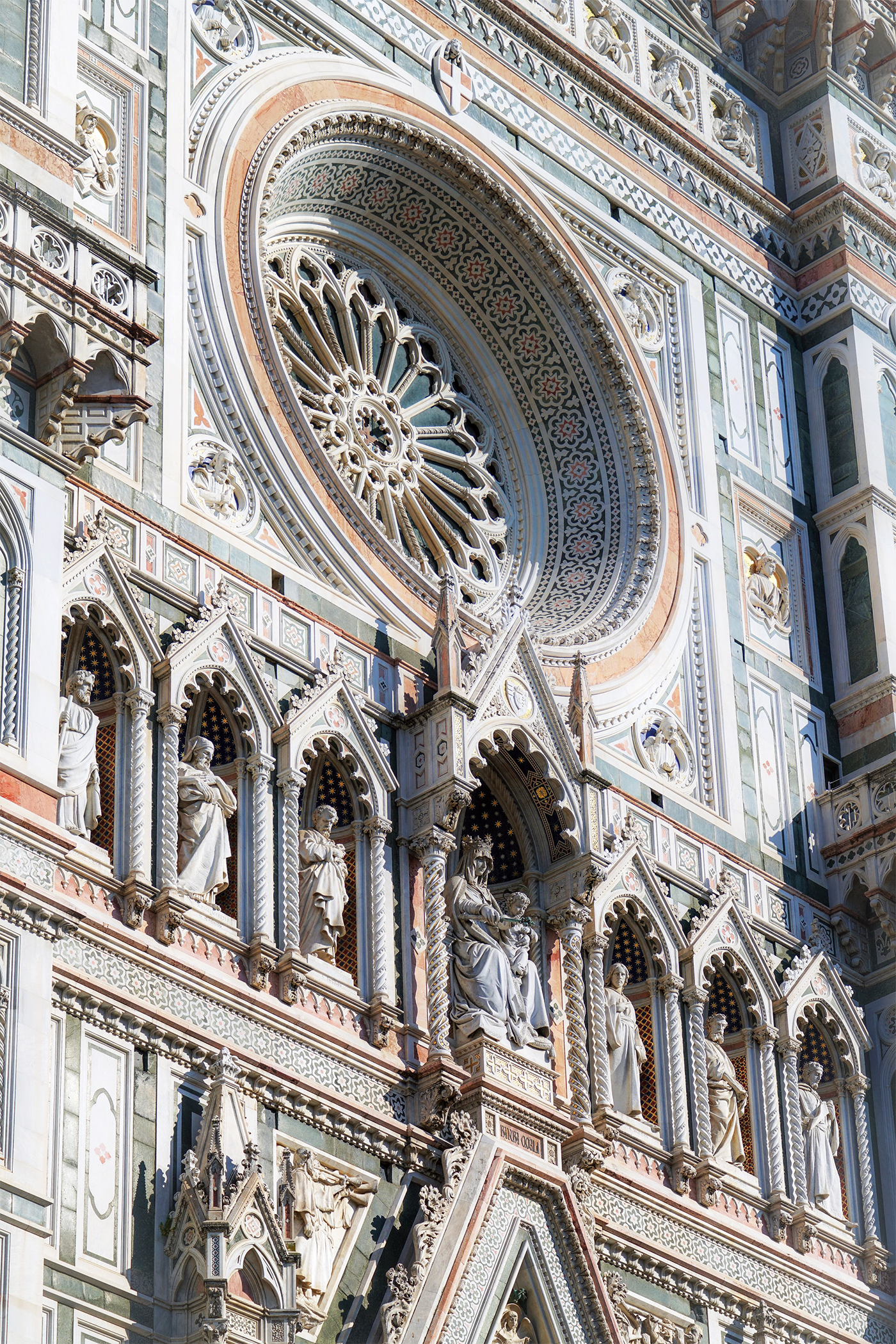
The Cathedral of Florence is easy to photograph and difficult to photograph well. It is visually spectacular, but the surrounding square is tight, the buildings are tall and crowds constantly change the foreground. A single wide shot rarely tells the full story.
The photographs that work best move between three scales: the cathedral in the city skyline, the full exterior from the square and close details of the marble and dome interior. That combination feels more honest than trying to force every element into one frame.
Start with the complete building, then move closer
A wide-angle lens or a phone’s wide camera is useful near the façade, but extreme wide angles can stretch the corners and make the tower lean. I prefer to make the wide establishing image first, then step closer for cleaner compositions of windows, marble panels, sculpture and repeating patterns.
Vertical photographs work particularly well here. The façade and bell tower naturally pull the eye upward, and a portrait frame gives them room without including too much empty pavement or neighbouring building.
Photograph the side and rear, not only the façade
The west façade receives most attention, but the north and south sides often provide better depth. Repeating marble panels lead toward the dome, while the transept and apses create overlapping shapes. These angles also show how the dome relates to the main body of the cathedral.
Use people to show scale
Waiting for an empty square can be pointless. Include people deliberately instead. One or two figures near the lower edge show the extraordinary size of the architecture. A slower shutter can turn moving crowds into a soft layer while the cathedral remains sharp, although camera supports are restricted inside and can be impractical outside in a busy square.
Watch the direction of light
Morning and late-afternoon light usually reveal more texture than the bright middle of the day. The best side depends on the season and time. Walk around the building rather than assuming the main façade must be the photograph. Warm light can make the red marble and terracotta roof more prominent; overcast conditions reduce harsh contrast and preserve detail across the patterned stone.
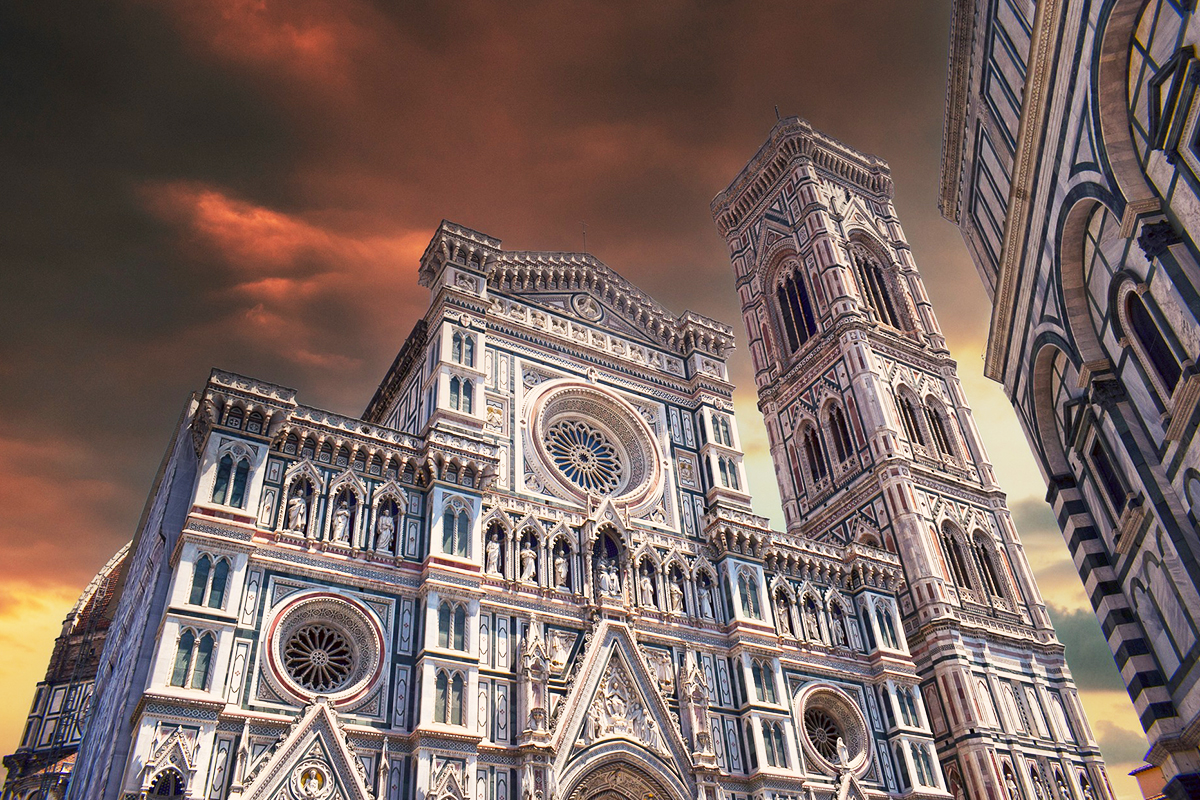
A dark or changeable sky can be more interesting than perfect blue. Against pale marble, clouds give the image depth and separate the tower from the background. The important point is to expose for the bright stone so that its details are not lost.
Photographing inside the cathedral
The interior requires a different approach. Flash is prohibited and would flatten the space anyway. Stabilise the camera against your body, use a wider aperture where practical and accept a higher ISO rather than risk blur. For the dome, a centred composition emphasises the octagonal geometry. A tighter frame isolates the painted figures and makes their scale easier to appreciate.
Visitors who are still learning how lens opening affects exposure and depth of field may find my guide to aperture in photography useful. The cathedral is also a good reminder that sharpness is not the only goal. Light, scale and the relationship between the architecture and the city are what make these photographs memorable.
Finding a wider skyline view
The dome is best understood from a distance as well as from the square. An elevated viewpoint across Florence lets the cathedral rise above the surrounding terracotta roofs. From there, its role in the city becomes obvious: it is not simply another landmark but the visual anchor of the historic centre.
For a closer elevated view that keeps the dome in the frame, Giotto’s Bell Tower is the obvious option. Broader panoramas are also available from viewpoints south of the Arno. The light around sunrise and sunset can be beautiful, but even an ordinary afternoon view explains the scale and position of the building.
The cathedral in Florence’s larger story
Santa Maria del Fiore is part of the UNESCO-listed Historic Centre of Florence. The designation includes far more than the cathedral, but the Duomo is its dominant landmark. From the square, it is possible to walk through several centuries of art and architecture within minutes: medieval streets, Renaissance palaces, churches, civic buildings and bridges all remain part of the functioning city.
The cathedral also belongs to a wider Tuscan tradition of ambitious religious architecture. Florence, Siena and Pisa each developed a monumental cathedral complex with a distinct identity. Pisa’s white marble ensemble sits in a broad green field, while Florence’s Duomo is compressed into the dense urban centre. I explore another of Tuscany’s most recognisable monuments in my guide to the Leaning Tower of Pisa.
What makes Florence different is the way the cathedral remains visible from so many parts of the city. The dome appears at the end of streets, above courtyards and between rooftops. It constantly disappears and returns.
Florence Cathedral on Instagram
The two posts below show how different the square can look with a change in weather, light or position, which is why the Duomo is rarely a one-photograph subject.
If you publish your own photographs, a simple location and a short observation usually say more than a list of generic phrases. My collections of cute Instagram captions and research on the best time to post on Instagram may help with the final post.
Frequently asked questions
Is Florence Cathedral the same as the Duomo?
Yes. The formal name is the Cathedral of Santa Maria del Fiore, while Florence Cathedral and the Florence Duomo are common English names. In everyday travel language, “the Duomo” may also refer to the wider group of monuments in Piazza del Duomo.
Is entry to Florence Cathedral free?
Entry to the main cathedral interior is free and does not require a ticket. The dome, Giotto’s Bell Tower, Baptistery, Santa Reparata and Opera del Duomo Museum require a paid pass.
Do I need to book the cathedral in advance?
You do not book ordinary free entry to the cathedral. Brunelleschi’s Dome is different: it requires a named ticket and a mandatory timed reservation. Popular dates can sell out, so advance booking through the official website is sensible.
How many steps are there to the top of the Duomo?
The climb to Brunelleschi’s Dome has 463 steps and no lift. The climb inside Giotto’s Bell Tower has 414 steps and no lift.
Is the dome climb difficult?
The climb is physically demanding and includes narrow, steep and enclosed sections. Heat and crowds can make it harder. It is not suitable for some visitors with heart conditions, vertigo, claustrophobia or mobility limitations. Always read the official health and access guidance before booking.
Which climb has the better view?
The dome gives the highest and most architecturally unusual experience. Giotto’s Bell Tower gives a direct view of the dome, so it often produces the classic Florence photograph. The better choice depends on whether you value the climb through Brunelleschi’s structure or want the dome in your skyline view.
Can I take photographs inside Florence Cathedral?
Personal photography is generally permitted, but flash, tripods and selfie sticks are not allowed. Photography may also be restricted during services or in particular areas. Visitors should remain quiet and avoid obstructing worshippers or other guests.
What should I wear to the Duomo?
Clothing must cover shoulders and legs in the cathedral and other sacred spaces. Hats should be removed. The rule applies even in hot weather, so it is worth planning clothing before joining the queue.
When is the best time to visit?
Early in the day is generally more comfortable for the square and exterior photographs, but the cathedral’s tourist opening begins later than some other monuments. A practical plan is to photograph the exterior in the morning, visit a ticketed monument, then enter the cathedral near the start of its visitor hours. Always check that day’s official schedule, because services and events can alter access.
How far is the cathedral from Florence train station?
The walk from Firenze Santa Maria Novella station is roughly ten minutes, depending on the route and pace. The historic centre is compact, and walking is usually easier than trying to approach Piazza del Duomo by car.
Is the Opera del Duomo Museum worth visiting?
Yes, especially if the history, sculpture or construction of the cathedral interests you. It contains original works removed from the outdoor monuments for conservation and explains how the cathedral complex changed over time. It also provides context that is difficult to gain from the crowded square alone.
Final thoughts
The Cathedral of Florence is famous for a reason, but fame can flatten a place into one familiar image. The red dome above the skyline is only the beginning. At street level, the cathedral is coloured marble, deep carving, crowded pavement and sudden vertical scale. Inside, the long nave leads toward an enormous painted world. Beneath it are the remains of an earlier church; beside it stand a bell tower, Baptistery and museum that complete the story.