
Las Vegas asks the camera to solve several problems at once. A sign may be brighter than the street beneath it. A fountain rises for only a few seconds. A pedestrian bridge shakes under passing feet. A desert road that appears empty on a map may be crowded, exposed and brutally hot by late morning.
That is why I do not think a useful list of Las Vegas photo spots can stop at place names. “The Strip” is not a location; it is several miles of changing sightlines, private properties, public sidewalks, road works and light sources. “Red Rock Canyon” is not one viewpoint; it is a one-way scenic drive with seasonal hours and a reservation system. A good photograph begins with the view, but a workable plan also needs access, timing and an honest understanding of the rules.
I have built this as a researched field guide rather than a first-hand trip diary. I compared current information from the venues and public agencies responsible for each place, then organised the locations around what a photographer actually needs: the picture available there, the most useful light, a sensible lens, the likely access problem and the restriction most easily missed.
If I had only one evening, I would stay in the city and work from the Bellagio fountains through the centre of the Strip before moving to Fremont Street. If I had a second day and a car, I would choose one major desert location—Red Rock Canyon or Valley of Fire—rather than race through several landscapes without waiting for the light.
My short answer: For the classic Las Vegas photograph, start at the Welcome to Fabulous Las Vegas sign early in the morning. For city lights, choose Bellagio at blue hour and Fremont Street after dark. For a landscape, choose Red Rock Canyon when time is limited and Valley of Fire when I can give the desert most of a day. The Neon Museum is the strongest historical location, but ordinary admission does not allow a dedicated camera.
The best Las Vegas photo spots at a glance
| Photo spot | The picture I would make | Best time | Useful lens | Access and main restriction |
|---|---|---|---|---|
| Welcome to Fabulous Las Vegas sign | Clean front view, environmental portrait, illuminated sign | Early morning or blue hour | 24–70mm; phone works well | Free, dedicated parking; stay inside the visitor area |
| Bellagio fountains | Water against Bellagio or the Eiffel Tower replica | Blue hour into night | 24–70mm | Free; show times vary and wind can cancel displays |
| Central Strip pedestrian bridges | Layered hotels, traffic and light trails | Blue hour and night | 24–70mm, optional 70–200mm | Free; tripods obstruct traffic and private-property rules vary |
| Sphere | Exosphere graphics with city context | Blue hour and night | 35–85mm | Exterior views are free; use legal pedestrian areas and respect artwork rights |
| Fremont Street Experience | Viva Vision canopy, crowds, performers and old neon | After dark | 16–35mm or 24–70mm | Free; commercial filming requires approvals |
| 18b Arts District | Murals, vintage storefronts, street details and portraits | Morning or late afternoon | 35mm or 50mm | Free public streets; ask before using private interiors or directing a shoot |
| Neon Museum | Historic signs, colour and typographic details | Sunset or night photo session | 24–70mm, 50mm | Ticketed; regular visits allow phone/tablet photos only |
| Red Rock Canyon | Red sandstone, desert scale and winding Scenic Drive | Morning or late afternoon within gate hours | 16–35mm and 70–200mm | Fee; timed entry Oct–May from 8 a.m.–5 p.m. |
| Valley of Fire | Red-rock roads, arches and graphic geology | Early morning and late afternoon | 16–35mm and 70–200mm | Fee; sunrise–sunset, seasonal trail closures, no drones |
| Hoover Dam | Full dam from Memorial Bridge, concrete geometry and intake towers | Morning or late afternoon | 24–70mm and 70–200mm | Dam open 5 a.m.–9 p.m.; security checks; no drones |
| Seven Magic Mountains | Coloured boulders isolated against the Mojave Desert | Early morning or late afternoon | 24–70mm | Free; private noncommercial photography only; no tripods/pro gear |
| Bellagio Conservatory | Dense floral installations and symmetrical interiors | Early morning | 16–35mm or phone | Free, but it is private resort property; displays close on dark dates |
Access, admission prices and event schedules can change faster than an article. I would always open the official page linked in the relevant section before leaving the hotel, especially for the Neon Museum, Red Rock Canyon and Valley of Fire.
1. Welcome to Fabulous Las Vegas sign
The Welcome to Fabulous Las Vegas sign is the cleanest answer to the keyword because it gives the viewer the location before they inspect anything else in the frame. Designed by Betty Willis and installed in 1959, it sits in the median at the southern end of Las Vegas Boulevard. The image works as a record, a portrait background and a piece of roadside design.
The most obvious composition is also the one I would make first: a centred vertical frame from inside the visitor area, with enough foreground to keep the sign from feeling cramped. After that, I would step slightly to one side and use a longer focal length to compress the sign against the palm trees, traffic and hotels beyond it. A lower angle can separate the starburst from the supporting poles, but I would keep other visitors out of the bottom edge rather than crop them awkwardly at the knees.
Best time and lens
Early morning is the practical choice. The official Las Vegas tourism site recommends around 7 a.m. to avoid the longest queues, and the dedicated parking and crosswalks make access far safer than it once was. At that hour, the air is usually clearer, the temperature is less severe and there is more room to try a few compositions. Blue hour gives the sign a richer glow, but it also introduces more visitors and moving traffic.
A 24–70mm zoom covers the location. At the wide end, I can include the setting; around 50–70mm, I can simplify the frame. A phone is entirely adequate because the subject is flat, bright and relatively close. For a portrait, I would expose for the illuminated face of the sign and add only enough light to the person to keep the result natural.
Access note
The official listing gives the address as 5200 Las Vegas Boulevard South and confirms a dedicated parking area. I would never stop in a traffic lane or cross the boulevard outside the marked route for a “better” angle. The whole point of this photo spot is that a safe visitor area now exists.
Official information: Welcome to Fabulous Las Vegas sign
2. Bellagio fountains and the Eiffel Tower replica
The pavement in front of Bellagio is one of the most productive small areas in Las Vegas photography. I can frame the water against Bellagio itself, turn across the lake toward the Eiffel Tower replica at Paris Las Vegas, isolate individual jets with a longer lens or include the crowd to show the scale of the display.
The important decision is whether the photograph is about water or place. A fast shutter speed—roughly 1/500 second or faster—freezes the jets into graphic shapes. A slower exposure makes the water softer, but it also records moving spectators and magnifies every vibration. On a crowded public pavement, I would normally choose a high ISO and handhold rather than build the entire plan around a tripod.
The view I would prioritise
I would arrive before sunset, find a position along Las Vegas Boulevard and make the first frames while there is still detail in the sky. During blue hour, the warm hotel lights and cool sky balance one another; fifteen or twenty minutes later, the same composition can become a dark background with isolated highlights.
For the classic Paris-in-Las-Vegas frame, I would photograph across the lake toward the Eiffel Tower replica and allow the fountain to occupy the lower third. A 35–50mm equivalent keeps the tower recognisable without pulling in too much visual clutter. A longer focal length can place a single fountain jet against the tower, but it requires careful timing.
Current fountain schedule
Bellagio currently lists shows every 30 minutes from 3:00–7:30 p.m. Monday to Friday, then every 15 minutes from 8:00 p.m. to midnight. On Saturdays, Sundays and holidays, the 30-minute schedule begins at noon. The late schedule remains every 15 minutes from 8:00 p.m. to midnight. The resort notes that times can vary and wind or weather can cancel an outdoor display.
That frequency is useful because the first show becomes a rehearsal. I would check focus and exposure, notice where the tallest jets appear, then refine the composition for the next performance rather than spray hundreds of frames without a plan.
Official information: Fountains of Bellagio schedule
3. Central Strip pedestrian bridges and hotel façades
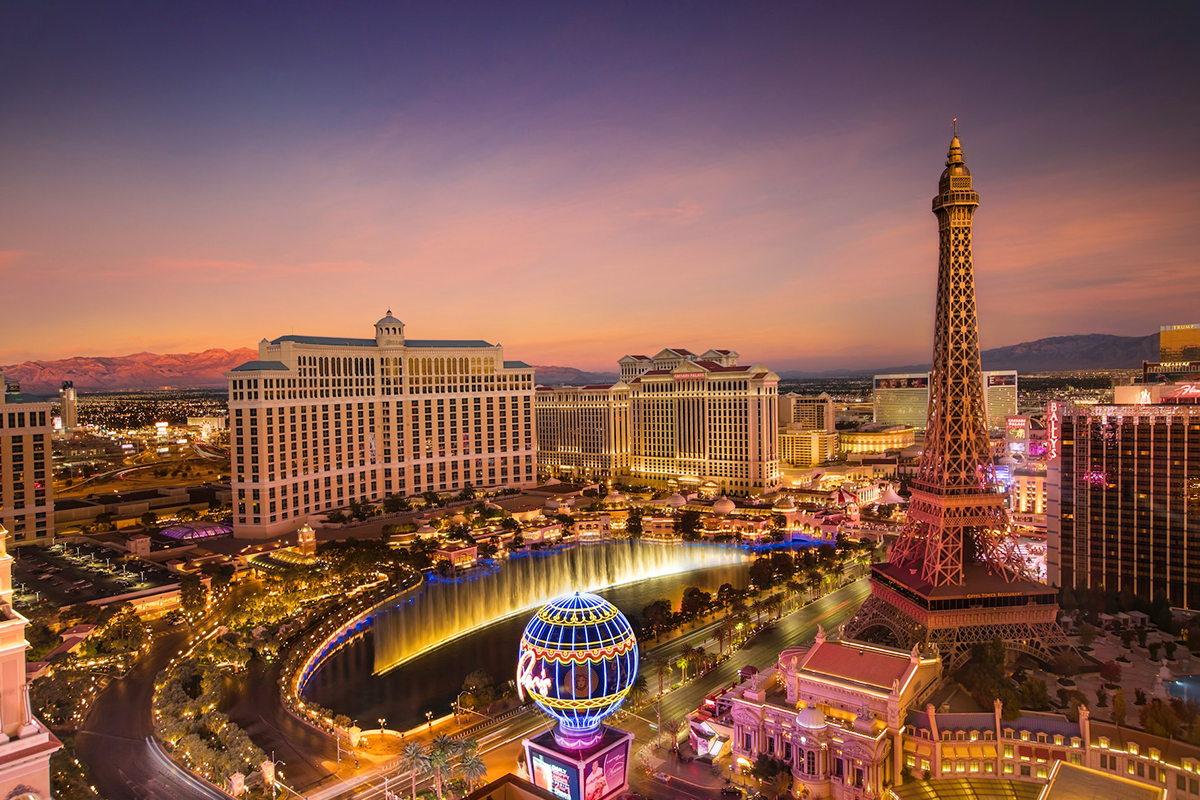
The centre of the Strip is best understood as a network of elevated crossings, not a single viewpoint. Pedestrian bridges lift the camera above parked cars and place traffic beneath the hotels, creating the layered urban image that ground level often cannot provide.
I would work around the Bellagio, Paris Las Vegas, Caesars Palace, Flamingo and The LINQ section rather than try to walk the entire Strip in one session. From one corner, the subject may be the Eiffel Tower replica; from another, a line of headlights leading toward the hotels. The bridges are also useful for abstract details: repeated windows, illuminated signs and the contrast between themed façades and ordinary infrastructure.
How I would photograph the Strip at night
At blue hour, I would begin with straightforward handheld frames around 1/125 second, f/4 and Auto ISO, then adjust for the brightness of the signs. After dark, I would protect the highlights rather than trust the camera's average exposure. A histogram pressed hard against the right edge is a warning: clipped letters and white LED panels are difficult to recover.
For light trails, a stable support and a shutter speed between roughly one and five seconds can work, but the practical issue is space. These bridges carry constant pedestrian traffic. I would not spread tripod legs across a walkway, block an escalator landing or lean equipment over a barrier. A compact camera placed securely against a solid rail—without creating a hazard—is often more realistic, and private-property security may still ask a photographer to move.
A useful lens pairing
A 24–70mm zoom is more useful here than an ultra-wide lens. It can include a full façade, then isolate a sign without changing position. If I wanted the city to look dense rather than broad, I would add a 70–200mm lens and compress several blocks into one frame.
The old version of this article called the High Roller the world's largest observation wheel. That claim is no longer current, so I would avoid building the section around a superlative. The wheel remains a recognisable part of the skyline, but the stronger photographic idea is the relationship between several pieces of the Strip.
4. Sphere and the Exosphere
Sphere changed the contemporary Las Vegas skyline because it is not merely a lit building. Its exterior is a programmable image surface. Sphere states that the Exosphere contains 580,000 square feet of LEDs, which means the subject can change between two exposures even when the camera does not move.
I would not photograph it as a detached circle floating in a black sky unless the displayed artwork alone is the point. A more informative frame includes something that gives it scale: pedestrians, a road, a hotel edge or part of the Venetian complex. The contrast between an immense digital image and an ordinary street is more specific to Las Vegas than a tightly cropped screen.
Where and when to photograph Sphere
The venue is at 255 Sands Avenue. The Venetian pedestrian bridge is an official accessible route to Sphere, making it a more defensible starting point than the many online “hacks” involving parking structures, loading areas or roadside stops. I would remain in areas open to pedestrians, obey venue and resort staff, and never stop a car on Sands Avenue or Koval Lane for a photograph.
Blue hour preserves the curve of the building and some detail in the surrounding city. Full night makes the Exosphere dominant but can reduce everything else to black. A 35–85mm equivalent is a sensible range: wide enough for context, long enough to avoid excessive empty pavement.
Avoiding LED banding
Large LED displays can produce dark bands or incomplete patterns, especially with an electronic shutter. I would begin with the mechanical shutter and test 1/60 or 1/125 second under the U.S. 60 Hz electrical system. If bands remain, I would change the shutter speed in small steps and inspect the file at full size. Anti-flicker settings can help, but they do not replace a test frame because the content and refresh behaviour may change.
The Exosphere also displays commissioned and branded artwork. A tourist photograph and a commercial campaign are not the same use. I would treat the visible content as somebody else's creative work and obtain advice or permission before licensing an image in which that content is the primary commercial subject.
Official information: Sphere science and Exosphere and Sphere transportation
5. Fremont Street Experience
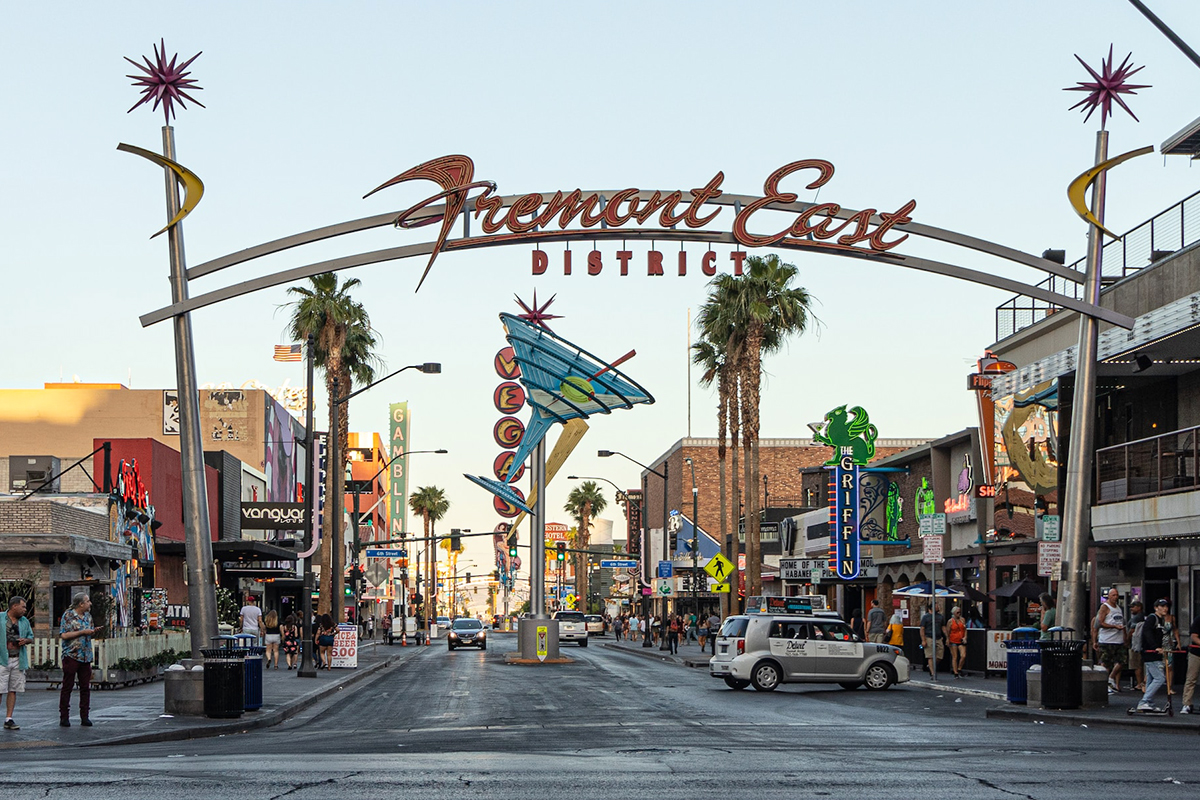
Fremont Street gives the camera two versions of Las Vegas at once. At eye level are old casino façades, performers, visitors, signs and the movement of a downtown street. Overhead is Viva Vision, a screen extending above the pedestrian mall. The best frames make those two layers interact.
The official Fremont Street Experience information describes the canopy as approximately 1,375 feet long and 90 feet wide. Viva Vision shows currently run nightly at the top of each hour from 6:00 p.m. to 2:00 a.m. Because the programme can change, I would use the schedule to decide when to be in position rather than rely on an old list of artists.
Three photographs I would look for
First, I would use an ultra-wide lens to place the canopy above a stream of people. This establishes the place but needs strong edge control; a 16mm frame filled with half-people and tilted signposts becomes chaotic quickly.
Second, I would use 35–50mm for street photographs in which the canopy becomes coloured light rather than the whole subject. Reflections on glasses, metallic clothing and wet-looking polished surfaces can carry the atmosphere without showing every sign.
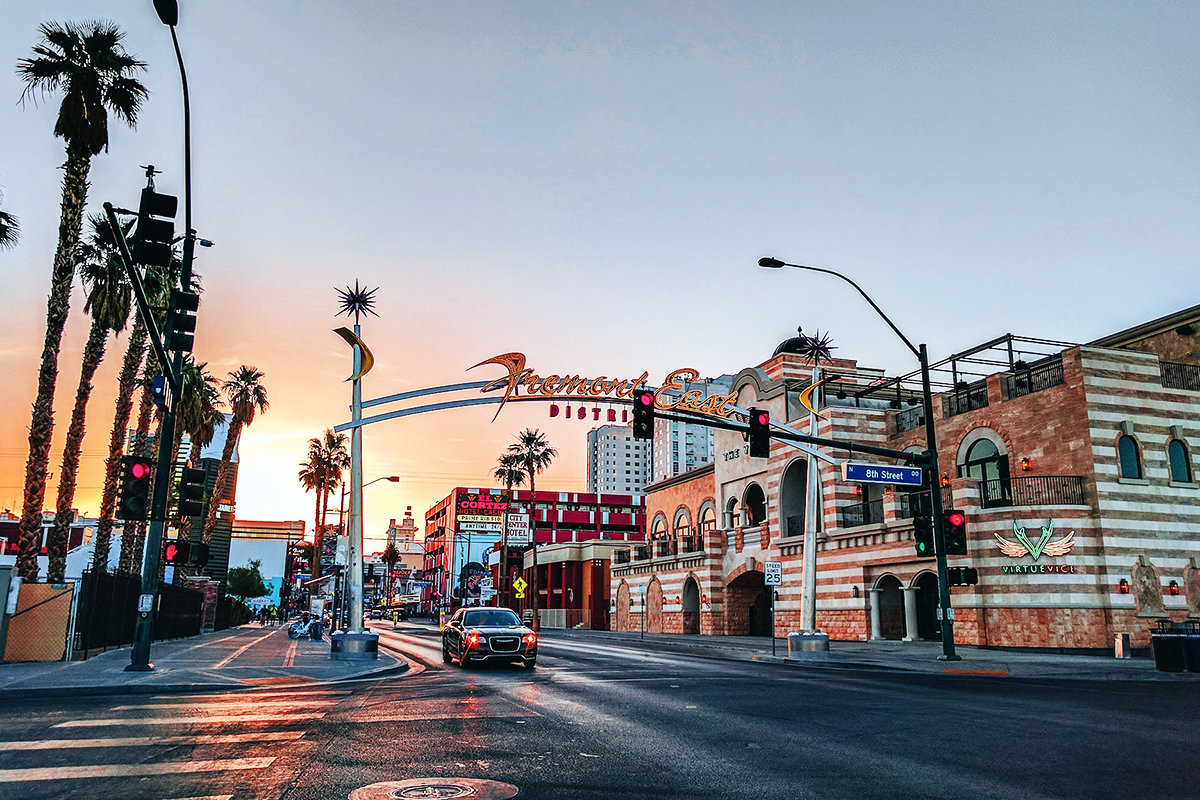
Third, I would step outside the covered core and photograph the older Fremont East signs in the changing light around dusk. The existing article already contains a photograph of the Fremont East gateway, and this is a better use of it than presenting all of downtown as one interchangeable neon corridor.
Camera and rights note
LED banding is again possible, so I would test the mechanical shutter around 1/60–1/125 second. For moving people, 1/250 second is a safer starting point; for deliberate blur, I might work around 1/8–1/2 second while holding the camera close to the body.
Casual photography in a public visitor environment is different from a directed commercial production. Fremont Street Experience says commercial filming projects require approval from Fremont Street Experience, the City of Las Vegas and the Nevada Film Office. Its own light shows may also contain separately licensed creative content. A brand shoot, music video or advertisement therefore needs planning beyond simply owning a camera.
Official information: Viva Vision schedule and filming at Fremont Street Experience
6. The 18b Las Vegas Arts District
The Arts District is the useful counterweight to the casino corridor. Along Main Street and the surrounding blocks, the subjects are smaller: murals, independent storefronts, old signs, vintage objects, façades, pedestrians and the marks of a neighbourhood that continues to change.
I would begin on Main Street between Charleston Boulevard and Wyoming Avenue, a stretch the City of Las Vegas identifies for its dense line of vintage and independent shops. From there, I would move slowly through nearby side streets rather than chase a fixed mural checklist. Murals change, businesses repaint walls and construction can alter the cleanest viewpoint. The change is part of the subject.
Best light and approach
Morning light is practical for empty storefronts and graphic shadows. Late afternoon brings more people and warmer colour. A 35mm or 50mm equivalent encourages me to solve one relationship at a time instead of standing across the road with an ultra-wide lens.
This is also the strongest location on the list for ordinary street photography. I would photograph gestures, layers and small signs of daily life, not treat every person as decoration for a Las Vegas backdrop. For a close, identifiable portrait, I would ask. For a directed commercial portrait session, I would verify permits and property permission.
First Friday can add artists, crowds and live activity, but it changes parking, traffic and the visual rhythm of the district. The City currently notes temporary route adjustments due to construction. If the goal is architecture and murals, I would choose a normal morning; if the goal is people and local culture, I would check the current First Friday plan.
Official information: City guide to First Friday and Arts District overview
7. The Neon Museum
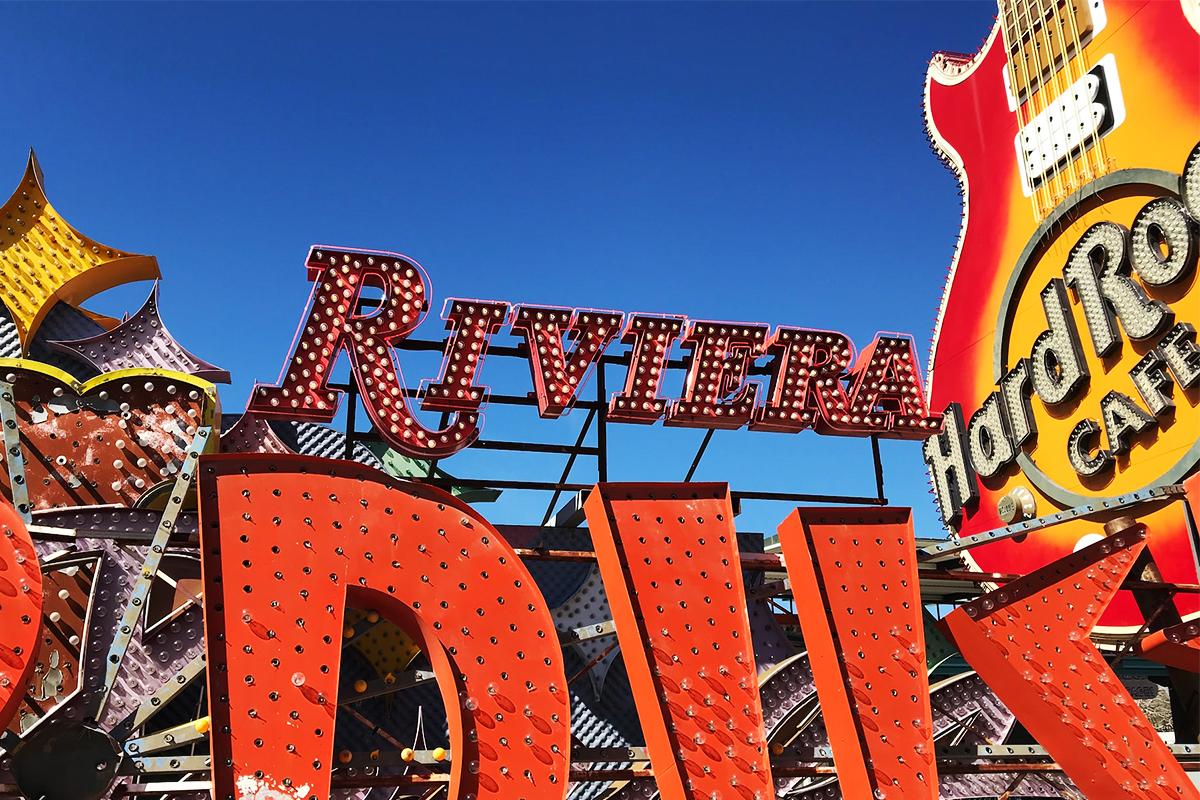
The Neon Museum is the most concentrated photographic archive of old Las Vegas, but it is also the location where a careless guide can give the worst advice. The old article told readers to bring a tripod during a normal visit. Under the museum's current rules, that is wrong.
During regular daytime or evening admission, personal-use photographs are encouraged on phones and tablets only. Cameras and other photographic equipment are not allowed. A photographer who wants to use a mirrorless or DSLR camera must book one of the museum's dedicated photography options, such as a scheduled Photo Walk or Photo Hour. Editorial, commercial, fine-art, posed and directed sessions have separate conditions.
Choosing the correct session
A regular visit works for a traveller who wants phone photographs and the museum experience. A Photo Walk is the relevant product for a hobby photographer who wants to study the signs with multiple lenses and a tripod. The museum describes it as a one-hour session in the Neon Boneyard and allows tripods, multiple cameras and extra lenses for personal photography. Portraiture is not allowed during a Photo Walk; it requires an appropriate Portrait Hour or private booking.
The distinction matters because the wrong ticket can leave expensive equipment in a hotel room or car. I would read the policy before purchasing, not after arriving at 770 Las Vegas Boulevard North.
What I would photograph
The obvious subject is colour, but I would also look for typography, rust, broken bulbs and the physical depth of the signs. A 24–70mm lens is flexible in a shared space. A 50mm prime can isolate layers of letters and produce cleaner edges. At dusk, I would expose for the brightest working tubes and accept that unlit metal will fall into shadow; lifting every dark area can flatten the atmosphere.
The museum's collection is historically rich and visually dense. One complete sign, one cropped typographic detail and one frame showing several signs at different distances would form a stronger short sequence than twenty similar close-ups.
Official information: Neon Museum film and photography policy and Neon Museum Photo Walk
8. Red Rock Canyon National Conservation Area
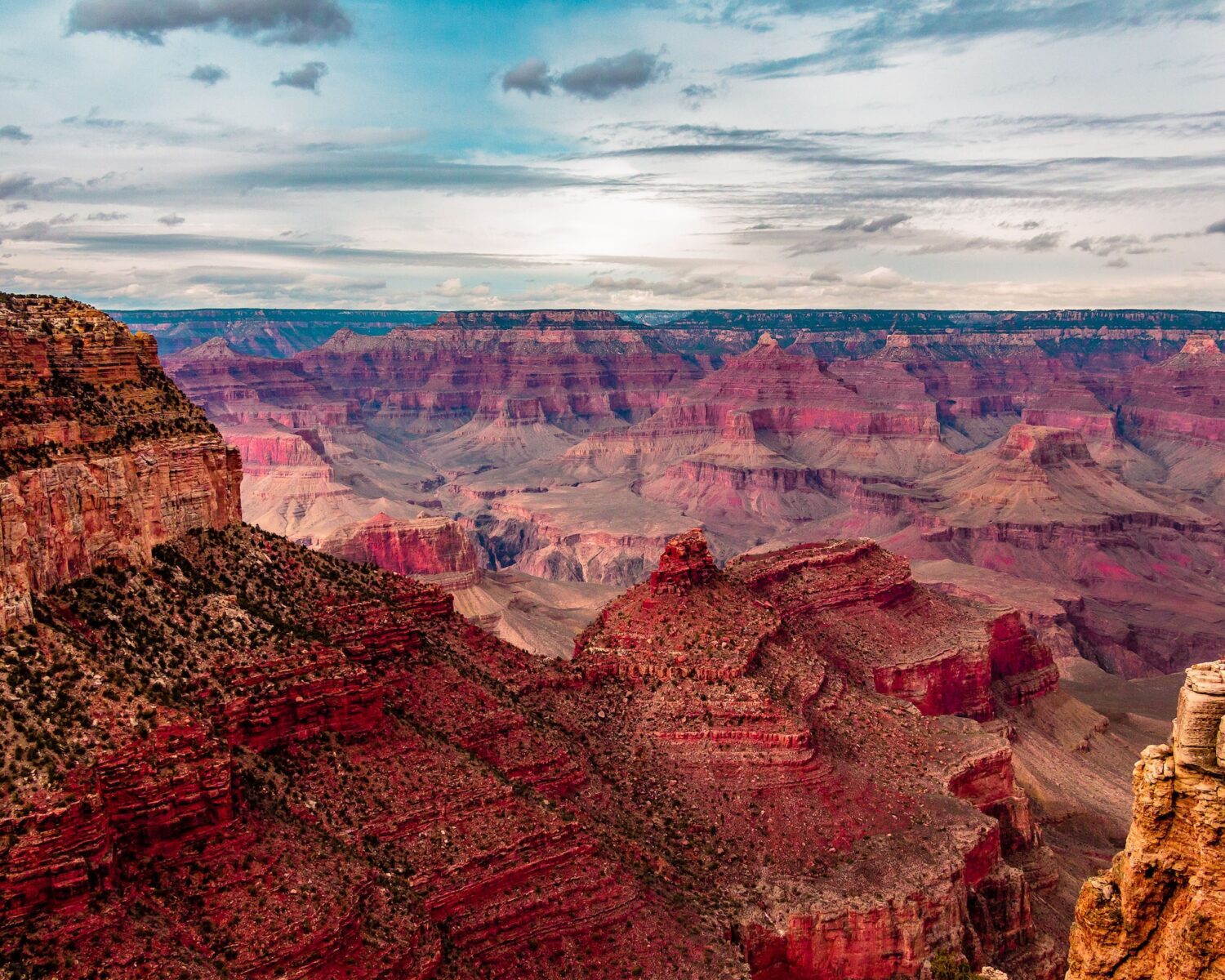
Red Rock Canyon is the most efficient landscape photo spot near Las Vegas. The Bureau of Land Management places it 17 miles west of the Strip, and its 13-mile Scenic Drive connects the visitor centre, overlooks, red sandstone and trailheads without requiring a remote expedition.
It is a National Conservation Area managed by the Bureau of Land Management, not a Nevada state park. That correction matters because reservations, passes and permits come from different authorities.
The photographs available from the Scenic Drive
At Calico I and Calico II, the red and cream sandstone provides the immediate colour contrast most visitors expect. High Point Overlook offers a broader sense of scale. Willow Spring introduces vegetation and cultural features. The Red Rock Overlook on State Route 159 is useful when I want an open view without entering the Scenic Drive; BLM says no reservation or fee is required there, although parking can fill.
I would carry both a wide-angle and a telephoto lens. The wide lens records the relationship between rock, sky and road. The telephoto lens is often more distinctive because it separates ridges, climbers, shadow lines and patches of vegetation. A polariser can deepen the sky and reduce glare, but on an ultra-wide lens it may darken the blue unevenly. I would rotate it while watching the whole frame, not automatically use the maximum effect.
Reservations and gate hours
Timed-entry reservations are required for the Scenic Drive from October 1 through May 31 for entry between 8:00 a.m. and 5:00 p.m. BLM lists seasonal Scenic Drive hours:
| Period | Scenic Drive hours |
|---|---|
| November–February | 6:00 a.m.–5:00 p.m. |
| March | 6:00 a.m.–7:00 p.m. |
| April–September | 6:00 a.m.–8:00 p.m. |
| October | 6:00 a.m.–7:00 p.m. |
Those hours shape photography. Sunrise may be accessible before the reservation window, but sunset can fall after the gate closes. A backcountry late-exit pass is a separate product and should not be assumed. The Scenic Drive is one way, so I would not pass a viewpoint expecting to return later.
Commercial photography and paid portrait work can require authorisation. BLM's general still-photography rules depend on factors such as models, sets, restricted areas and on-site management, while Red Rock has location-specific commercial guidance. I would contact the Red Rock/Sloan Field Office for any paid or organised shoot.
Official information: Red Rock Canyon visitor information and hours and timed-entry reservations
9. Valley of Fire State Park
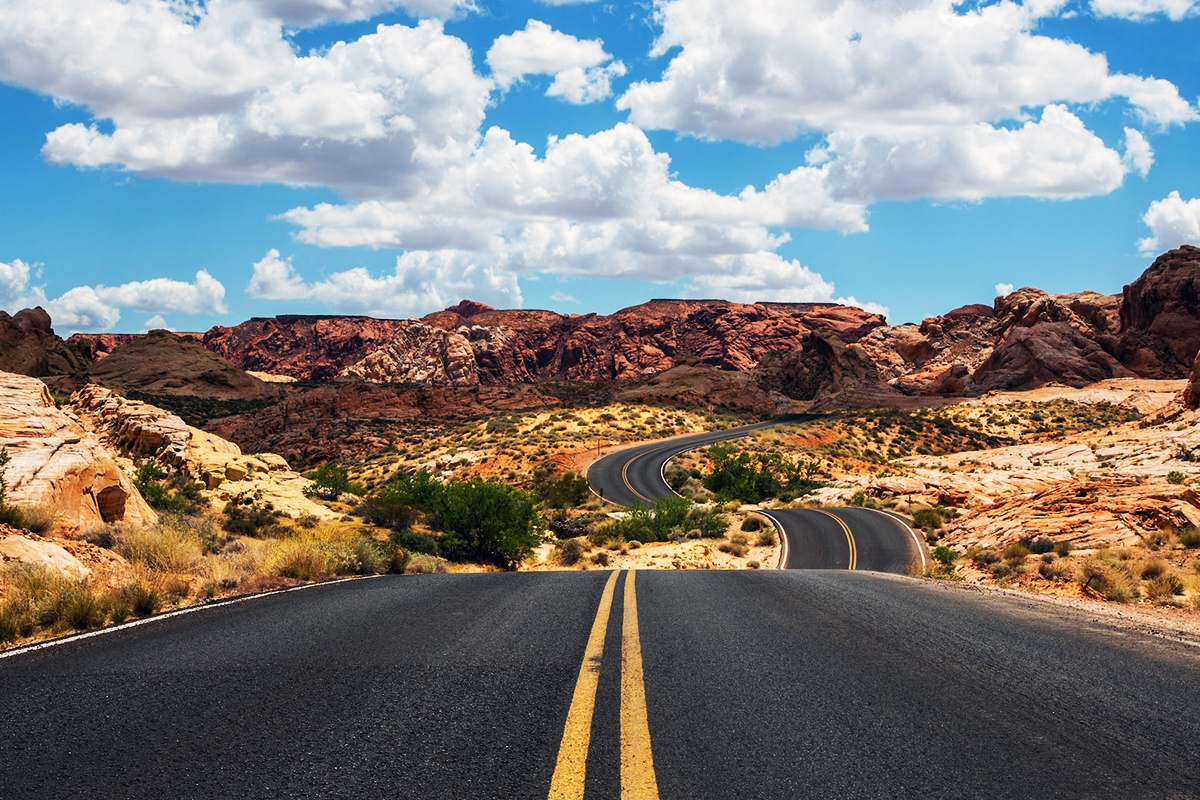
Valley of Fire is farther from the Strip and deserves more time. Its photographs are less about a distant skyline and more about moving through rock: red Aztec sandstone, pale limestone, narrow forms, desert roads and petroglyph sites protected by law.
The old article called it a national park. It is a Nevada state park, open for day use from sunrise to sunset. The current day-use fee is $10 per Nevada vehicle and $15 per non-Nevada vehicle. Reservations are not required for an ordinary day visit.
What I would photograph
The road itself can be the strongest subject when it is treated as a leading line rather than a place to stand. I would use designated pullouts, walk away from the vehicle only where allowed and never set up in a traffic lane. A telephoto lens can compress bends in the road against sandstone ridges; a wide lens works better when a close rock or desert plant anchors the foreground.
Atlatl Rock, the Cabins, Seven Sisters and roadside formations remain useful during periods when hiking routes are closed. Petroglyphs need restraint: I would photograph without touching, tracing, wetting or climbing near the panels.
Closures that affect a 2026 photo plan
Nevada State Parks closes multiple trails every year from May 15 through September 30 because of extreme heat. The list includes White Domes, Fire Wave, Seven Wonders Loop, Pastel Canyon, Pinnacles, Prospect, Arrowhead, Natural Arch and Charlie's Spring. The park also closes completely each year from December 1 through December 14 for maintenance.
There is an additional temporary change in 2026: the west entrance is closed Monday through Thursday from August 3 through the end of the year, while construction is under way. The east entrance remains the route for weekday visits. I would check the park alert again immediately before departure, because construction dates can move.
Drones and remote-controlled aircraft are not allowed. Commercial photography has a permit system and separate fees. The park explicitly warns that relying on Uber or Lyft can leave visitors stranded, so I would use my own vehicle or a reputable organised tour.
Official information: Valley of Fire State Park, 2026 seasonal trail closures and temporary west-entrance closure
10. Hoover Dam and the Memorial Bridge
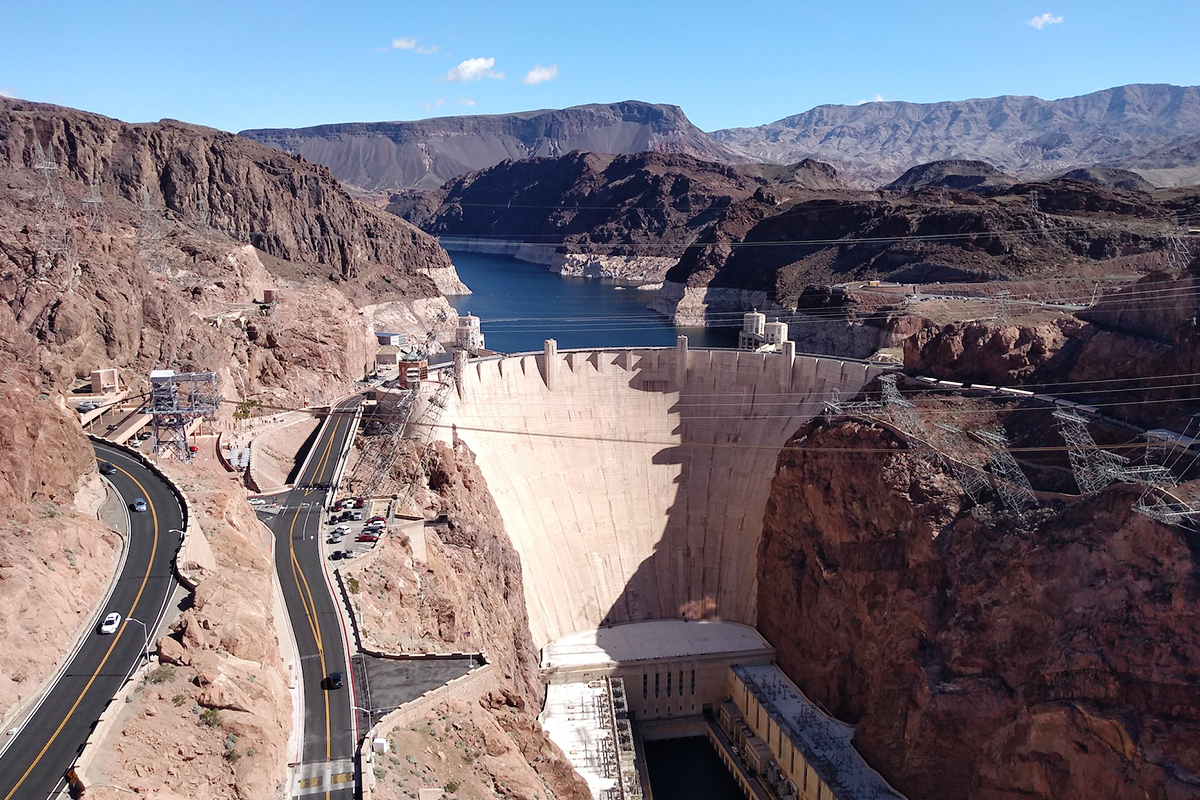
The best complete photograph of Hoover Dam is not made from the top of the dam. It is made from the pedestrian walkway on the Mike O'Callaghan–Pat Tillman Memorial Bridge, where the curved concrete face, intake towers, Colorado River and canyon walls can share one frame.
I would begin with a 24–70mm lens for the establishing view, then use a 70–200mm lens to isolate the intake towers, roads and the relationship between engineering and geology. The strongest compositions are often geometric: repeated verticals, curved concrete, a thin road and the blue-green water.
Access and security
The Bureau of Reclamation states that Hoover Dam is open daily from 5:00 a.m. to 9:00 p.m. Pacific Time. The visitor centre and tours operate from 9:00 a.m. to 5:00 p.m., with doors closing at 4:15 p.m. The Nevada-side parking garage currently costs $10 per vehicle. Vehicles are subject to inspection, and stopping on top of the dam to load or unload passengers is prohibited.
That makes the old recommendation to photograph the dam “at night” weak and potentially impractical. Daylight and late-afternoon geometry are the real strengths. On the Memorial Bridge, wind can also be severe; I would secure straps and lens hoods and avoid placing loose equipment on the barrier.
Drones are prohibited on Hoover Dam property. Security screening applies inside the visitor centre and on tours, and knives of any size are not allowed inside buildings. A photographer carrying a multi-tool should leave it behind rather than discover the rule at the entrance.
Official information: Hoover Dam hours, security and visitor rules and parking and directions
11. Seven Magic Mountains
Ugo Rondinone's Seven Magic Mountains places seven stacks of fluorescent boulders in the Ivanpah Valley south of Las Vegas. The tension between artificial colour and the Mojave landscape is the photograph. I would resist filling the frame with one tower immediately; the surrounding desert and the distant ranges explain why the installation feels improbable.
Early morning gives cleaner light and fewer visitors. Late afternoon can add warmer ground and longer shadows. Around 35–70mm, I can keep the towers upright without the exaggerated lean of an ultra-wide lens. A longer lens can align several stacks, but it also makes other visitors harder to exclude.
The restriction that matters
The installation is free, open without reservations and lists sunrise to sunset as the preferred visiting period. Its photography terms are unusually strict: visitor photography is permitted only for private, noncommercial use. Professional photography equipment—including tripods and lighting umbrellas—may not be brought onto the premises, and photographs may not be sold, licensed, distributed or commercially exploited.
For that reason, I would not treat Seven Magic Mountains as a convenient commercial photoshoot set. A phone or small handheld camera for a private travel photograph fits the stated visitor policy; a client session, stock shoot or image intended for sale does not.
Official information: Seven Magic Mountains visitor rules
12. Bellagio Conservatory and Botanical Gardens
The Bellagio Conservatory is the indoor option I would keep for hard midday light, wind or extreme heat. Its seasonal installations offer colour, symmetry, scale and dense detail in a relatively compact space. The challenge is not finding a subject; it is separating one subject from everything around it.
I would begin with a complete symmetrical frame, then move closer for patterns, flowers, constructed animals and the relationship between visitors and the installation. An ultra-wide lens can show the room but easily stretches people near the edges. A phone or a 24–35mm equivalent is often more controlled.
The conservatory is free, but it remains inside private resort property. I would keep equipment compact, avoid blocking circulation and follow staff instructions. Early morning is preferable to a busy evening.
Displays change and the conservatory closes on “dark dates” between installations. For 2026, Bellagio currently lists Summer through September 12, Harvest from September 19 to November 7, and Holiday from November 14 to January 2, 2027. Dark dates are September 13–18 and November 8–13. Those dates are far more useful to a photographer than a generic promise that the attraction is always ready for pictures.
Official information: Bellagio Conservatory show dates
How I would arrange the photo spots into an efficient route
A list becomes useful only when the locations can be combined without wasting the best light. I would keep the urban and desert plans separate.
One-day Las Vegas city photo route
| Approximate period | Location | Goal |
|---|---|---|
| Early morning | Welcome sign | Clean sign, portraits and low traffic |
| Late morning | Arts District | Storefronts, murals and street details |
| Midday | Bellagio Conservatory or rest/edit break | Indoor colour; avoid harsh heat |
| Late afternoon | Central Strip | Architecture while the sky still holds detail |
| Blue hour | Bellagio fountains | Balanced sky, signs and water |
| Night | Sphere | Exosphere with city context |
| Late night | Fremont Street | Viva Vision, crowds and older neon |
This is already a long day. I would not add the Neon Museum unless I had a reserved photography session that justified reorganising the evening around it.
Two-day route with one desert location
On the second day, I would choose Red Rock Canyon for proximity and an efficient Scenic Drive, or Valley of Fire for a more immersive landscape day. Seven Magic Mountains can work on the way south from Las Vegas; Hoover Dam lies southeast and needs its own half-day. Combining Red Rock, Valley of Fire and Hoover Dam in one day may look possible on a map, but it turns the day into driving between midday arrivals—the opposite of a photography plan.
The best season for photographing Las Vegas
| Season | What works | Main problem |
|---|---|---|
| Winter | Comfortable urban walks, low sun, easier desert days | Short gate hours at Red Rock; cold and wind after dark |
| Spring | Mild temperatures, longer light, possible desert colour | Popular parks and timed-entry demand |
| Summer | Long blue hours and fewer cool-season park crowds | Dangerous heat, haze and Valley of Fire trail closures |
| Autumn | Warm evenings and improving desert conditions | Major events and construction can alter Strip access |
For most photographers, late autumn through early spring is the most forgiving period. In summer, I would treat outdoor desert photography as a sunrise or roadside activity and abandon a hike rather than negotiate with extreme heat. Water, electrolytes, sun protection and a reliable vehicle are camera equipment in the Mojave, not optional travel extras.
Las Vegas is also an event city. Formula 1 infrastructure, conventions, concerts and road works can add fencing, temporary lighting and closed viewpoints. Those elements may become subjects in their own right, but they can also erase a composition that looked permanent online. I would check the venue or public-agency page close to the date.
My practical camera kit for Las Vegas
I would not carry every lens all day. Heat, crowds and security checks reward a smaller kit.
| Item | Why I would carry it |
|---|---|
| 24–70mm zoom | Covers signs, façades, fountains, street scenes and most desert overlooks |
| 16–35mm zoom | Useful for Fremont's canopy, interiors and close sandstone formations |
| 70–200mm zoom | Compresses the Strip and isolates desert geology or Hoover Dam details |
| Fast 35mm or 50mm prime | Small night kit for street scenes and the Arts District |
| Lens cloth and blower | Dust, spray and fingerprints are constant problems |
| Spare battery | Heat and long night sessions shorten practical battery life |
| Water and sun protection | Essential at every desert location |
| Compact support | Only where rules and pedestrian space clearly allow it |
A tripod is not a universal recommendation. It is forbidden or impractical at several locations in this guide, including normal Neon Museum visits and Seven Magic Mountains. On crowded bridges and resort property, it can become an obstruction even when no sign explicitly mentions it.
Starting settings for common Las Vegas photographs
These are starting points, not recipes. Sign brightness, wind, crowd movement and the specific camera matter more than a memorised number.
| Subject | Starting point | What I would watch |
|---|---|---|
| Neon street scene | 1/125 sec, f/2.8–f/4, Auto ISO | Protect bright letters; use mechanical shutter if LEDs band |
| Sphere or Viva Vision | 1/60 or 1/125 sec, f/4, adjust ISO | Flicker, banding and changing display brightness |
| Bellagio water frozen | 1/500–1/1000 sec, f/4–f/5.6 | Peak jet height and clipped hotel lights |
| Bellagio water blurred | 1/4–1 sec, f/8, low ISO, stable camera | Pedestrian movement and vibration |
| Night portrait | 1/160 sec, wide aperture, Auto ISO | Face exposure without destroying the ambient colour |
| Desert landscape | ISO 100, f/8, shutter as needed | Highlight detail, wind and depth of field |
| Road or compressed ridge | 1/250 sec or faster, f/5.6–f/8 | Heat shimmer and traffic safety |
| Hoover Dam detail | 1/250 sec, f/5.6, moderate ISO | Wind on the bridge and haze |
Las Vegas rewards exposure for highlights. I would use the histogram and highlight warning, photograph Raw files when possible and avoid lifting shadows so aggressively that a night scene starts to resemble flat daylight. For a refresher, my guides to shutter speed and aperture explain the controls in more detail.
Photographing with a phone
A phone is not a compromise at many of these places; at the Neon Museum during normal admission, it is the permitted tool.
I would clean the lens before every night session. A small fingerprint turns each point light into a soft flare and can make the whole city look foggy. I would tap the brightest important sign, lower exposure slightly and use the standard camera rather than digital zoom. Night mode helps with static architecture, but it can smear fountains, screens and moving people. For those subjects, a normal exposure with a steady grip often looks more convincing.
At Seven Magic Mountains and the Welcome sign, the phone's main lens is preferable to an extreme ultra-wide camera because it keeps verticals natural. At Fremont Street, ultra-wide can work if I keep people away from the stretched corners. For Sphere, I would take several short bursts or single frames at slightly different exposures because the display changes faster than a phone's processing may reveal.
Photography rules, permits and image rights
Las Vegas is a patchwork of jurisdictions and ownership. The Strip is largely in unincorporated Clark County, downtown lies in the City of Las Vegas, federal agencies manage Red Rock Canyon and Hoover Dam, Nevada manages Valley of Fire, and resorts control their interiors and much of their property.
For ordinary travel photography, the practical rule is simple: keep the setup small, remain in areas open to the public, do not obstruct movement and follow staff instructions. A paid portrait session, advertising campaign, music video or production with lights, assistants, props and talent is a different activity.
Clark County says a permit is necessary for commercial photography and filming in unincorporated Clark County. The City of Las Vegas and Fremont Street Experience have their own production processes. Public-land agencies and individual venues add location-specific conditions. Before a commercial shoot, I would identify the exact jurisdiction and property owner rather than assume one Las Vegas permit covers everything.
Drones
I would leave the drone out of a normal Las Vegas photo itinerary. Drones are prohibited at Hoover Dam and Valley of Fire, not allowed at the Neon Museum, and the airspace around Harry Reid International Airport and the dense Strip requires more than a quick app check. Wilderness and venue restrictions can add further limits around public lands. A legal flight requires current airspace, land-manager and local-rule research for the exact launch point.
Photographing people and artwork
Crowds are part of Fremont Street and the Strip, but a recognisable person should not automatically become an advertising asset. Directed portraits, releases and commercial use need a more careful process. Murals, the Sphere's Exosphere content, Viva Vision shows and Seven Magic Mountains are creative works with their own rights and policies. Being able to see an artwork from a public place does not grant unlimited commercial use of its image.
Safety and practical movement between locations
Distances on the Strip are deceptive. A hotel can look close while entrances, bridges and barriers turn the walk into several blocks. I would plan fewer positions and wait for better light rather than drag equipment through the full corridor.
The local airport is Harry Reid International Airport (LAS), not McCarran International Airport as the old article stated. A car is unnecessary for a focused Strip and downtown session but close to essential for Red Rock Canyon, Valley of Fire, Hoover Dam and Seven Magic Mountains. The Deuce bus and rideshare services can connect urban areas, while the City of Las Vegas runs the Downtown Loop on a limited schedule. I would verify current transit times rather than build a blue-hour plan around a timetable copied months earlier.
I would keep the camera bag closed when not changing lenses, use a cross-body strap in crowds and never leave visible equipment in a parked vehicle. At desert stops, I would download an offline map, keep fuel above the level needed for the return journey and tell someone where I am going. On roads, I would use only marked crossings and designated pullouts. No photograph requires standing in a traffic lane.
Frequently asked questions
What is the most iconic Las Vegas photo spot?
The Welcome to Fabulous Las Vegas sign is the clearest single icon. For a broader city image, the Bellagio fountains with the Eiffel Tower replica or surrounding hotels provide more layers and a stronger sense of the Strip.
Where can I take the best photos of the Las Vegas Strip?
Pedestrian bridges around the central Strip provide elevated views of hotels, traffic and signs. The Bellagio lake edge is strongest for fountains and the Paris Las Vegas replica. I would use several nearby viewpoints rather than search for one “secret” location.
What is the best Las Vegas photo spot at night?
Fremont Street is the most varied night location because the canopy, crowds, old signs and street activity can all appear in one sequence. Bellagio is better for a controlled landmark photograph, while Sphere is the strongest contemporary subject.
What is the best free photo spot in Las Vegas?
The Welcome sign, Bellagio fountains, Strip pedestrian bridges, Fremont Street, the Arts District and exterior views of Sphere can all be photographed without admission. Parking and transport may still cost money, and commercial use has separate rules.
Where can I photograph Las Vegas away from casinos?
The 18b Arts District is the best urban alternative. Red Rock Canyon, Valley of Fire, Hoover Dam and Seven Magic Mountains provide landscape, engineering or public-art subjects outside the casino corridor.
Is Red Rock Canyon or Valley of Fire better for photography?
Red Rock Canyon is closer and easier to combine with a Las Vegas evening. Valley of Fire is farther but offers a more immersive red-rock landscape and deserves most of a day. In summer, Valley of Fire's major trail closures can make Red Rock's drive-based overlooks more practical, although both require serious heat precautions.
Do I need a tripod for Las Vegas night photography?
No. Modern stabilisation and higher ISO settings make handheld work practical, and tripods are forbidden, restricted or obstructive at several locations. A tripod is most useful only for a permitted Neon Museum photo session, a quiet legal overlook or a planned landscape exposure where it does not interfere with others.
Can I bring a camera to the Neon Museum?
Not during a normal visit. Regular admission allows personal photos on a phone or tablet. A dedicated camera requires a scheduled Photo Walk, Photo Hour, Portrait Hour or appropriate private booking under the museum's current policy.
Can I use a tripod at Seven Magic Mountains?
No. The official visitor rules prohibit professional photography equipment such as tripods and lighting umbrellas. Visitor photographs are for private noncommercial use only.
When do the Bellagio fountains run?
Bellagio currently schedules weekday shows every 30 minutes from 3:00–7:30 p.m. and every 15 minutes from 8:00 p.m. to midnight. Weekend and holiday shows begin at noon on the 30-minute schedule. Weather and operations can change this, so I would check the official page on the day.
When does Viva Vision run at Fremont Street?
The current official schedule lists shows at the top of every hour from 6:00 p.m. to 2:00 a.m. The creative programme changes, so the live schedule is more reliable than an old artist list.
Is Valley of Fire open all year?
The park normally operates year-round for day use, but many trails close annually from May 15 through September 30. The entire park also closes for maintenance from December 1 through December 14. Additional construction or weather closures may apply.
Can I fly a drone at Hoover Dam or Valley of Fire?
No. Both authorities prohibit drone operations on those properties. Other Las Vegas locations also have airspace, property and land-manager restrictions, so I would research any proposed flight independently.
What lens is best for Las Vegas photography?
A 24–70mm equivalent is the most useful single lens. It is wide enough for buildings and flexible enough for signs, people and details. I would add an ultra-wide lens for interiors and Fremont Street, or a telephoto lens for compressed Strip and desert landscapes.
How many days do I need for Las Vegas photo spots?
One full day can cover the Welcome sign, Arts District, central Strip and Fremont Street. Two or three days are better if I also want a reserved Neon Museum session and one major landscape destination without photographing it in harsh midday light.
Final thoughts
Las Vegas is often described as a city that never turns its lights off. For a photographer, the more useful truth is that the subject keeps changing: the display on Sphere, the sequence of a Bellagio fountain show, the people beneath the Fremont canopy, a temporary mural, a desert road moving from shadow into heat.
I would not try to collect every landmark. I would choose one clean icon, one crowded night scene, one quieter neighbourhood and one landscape. That produces a more complete account of Las Vegas than twelve hurried proof photographs.
The strongest plan remains simple: arrive before the best light, know where I am allowed to stand, carry less equipment than I think I need and give the scene enough time to become more than a location name.