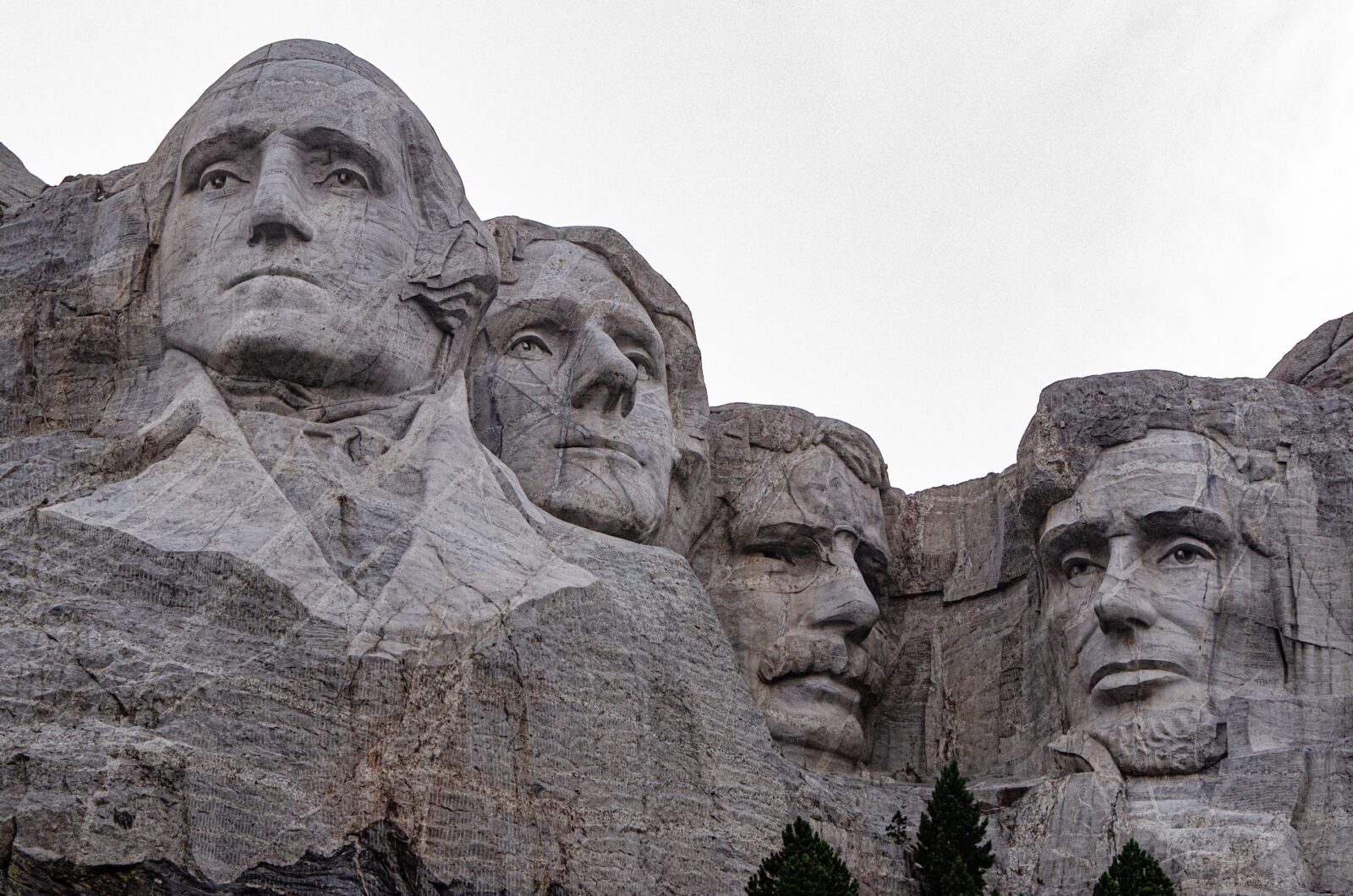
Mount Rushmore looks simple from memory: four pale faces in a granite mountain, instantly recognisable and apparently fixed. The photographs tell a more complicated story. Distance can reduce the sculpture to a small band of light above the trees. A telephoto view reveals drilled texture and deep shadows around the eyes. Flags can turn the scene into a statement about national identity, while snow, cloud or a black-and-white conversion changes its emotional register completely.
That is why this page begins with photos of Mount Rushmore, not a long preamble about camera settings. The eleven photographs show the memorial from wide and close viewpoints, in warm and cool light, with forest, stone and flags used as foregrounds. Together they explain more than a single postcard view can.
I approached Mount Rushmore through photographs and research rather than through a set of field notes from a documented visit. I will not invent a first-person journey to make the guide sound more intimate, and these are not my photographs. What I can do honestly is read the images as a photographer: examine why one frame has depth, why another feels monumental and how the same four faces change when the surroundings are allowed into the picture.
Mount Rushmore photos at a glance
| Photograph | View | What makes it distinctive |
|---|---|---|
| Opening image | Wide landscape beneath a dramatic sky | The sculpture remains part of the Black Hills rather than filling the frame |
| Warm close view | Tight crop across the four portraits | Low light emphasises modelling, shadow and granite colour |
| Pine-framed group | Medium view through branches | Natural foreground gives the sculpture depth and scale |
| Roosevelt detail | Tight individual portrait | Facial texture and the depth of the carving become visible |
| Black-and-white view | Formal frontal composition | Tone and shape replace the distraction of colour |
| Distant mountain view | Wide contextual landscape | Granite ridge, talus slope and forest explain the setting |
| Clear frontal portrait | Full group under a blue sky | A direct record of all four faces and the carved surface |
| Avenue of Flags | Symmetrical approach in winter | Architecture and flags create a strong central axis |
| Washington profile | Side view through granite and trees | The familiar front view becomes an unexpected silhouette |
| Bright scenic view | Full ridge with blue sky and cloud | Landscape colour and rock texture share equal weight |
| Flags in the foreground | Layered national-symbol composition | Flags create movement, colour and a clear cultural reading |
A closer look at the eleven photographs
The collection works because it does not repeat one focal length eleven times. Some images describe the sculpture; others describe the act of approaching and looking at it. That distinction matters. A monument photograph can be technically exact and still feel empty if it excludes every clue about distance, landscape and human meaning.
The opening photograph: the monument inside the landscape
The hero image gives the sky almost half of the frame. Mount Rushmore sits low, surrounded by ponderosa pine and broken granite, while cloud and blue colour carry much of the visual energy. The sculpture is small enough to require attention but clear enough to be immediately recognised.
I prefer this restraint to a frame that always pushes the faces to the edges. The photograph reminds me that Mount Rushmore is not a freestanding object. It is cut into a mountain in the Black Hills, and the setting is not decorative background. It determines the light, weather, access and historical meaning of the site.
Warm light across the four faces
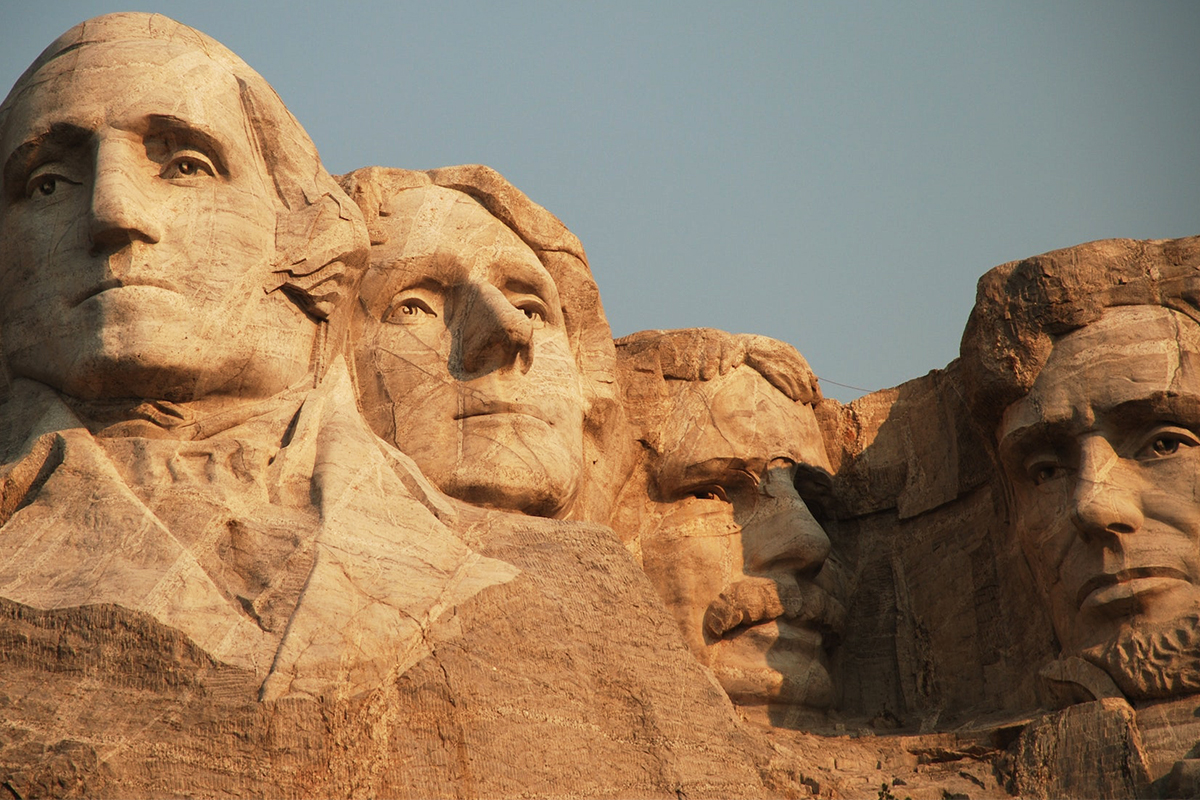
This close photograph is built from light rather than scenery. The faces fill the frame, and the warmer colour separates the smooth carved planes from the rougher rock around them. Washington catches the strongest light; Roosevelt, set deeper into the mountain, remains partly shaded.
The uneven illumination is useful. A completely flat frontal light would record more detail but less volume. Here, shadow makes the noses, brows and mouths read as three-dimensional forms. The faces are approximately 60 feet tall, yet the crop temporarily removes scale. They could almost be smaller stone portraits until the surrounding fractures return the viewer to the mountain.
Ponderosa branches as a natural frame
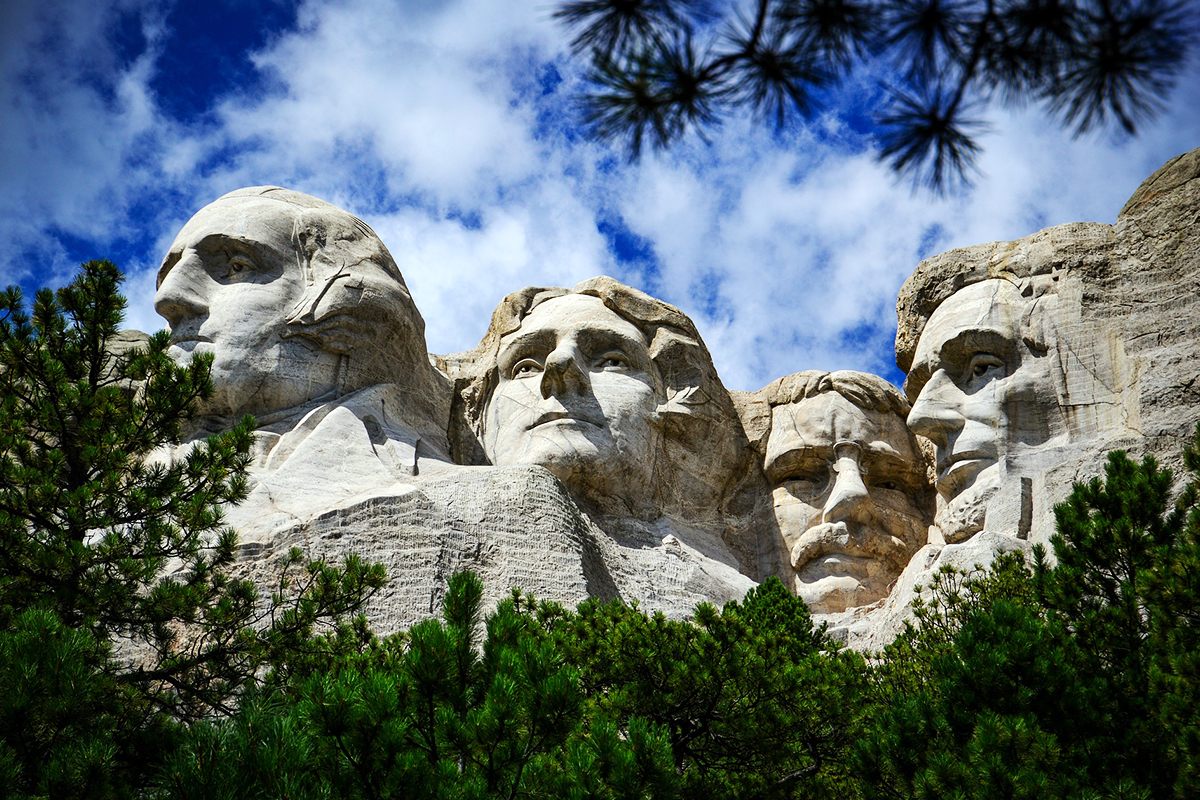
The pine branch at the upper edge performs a simple but important job: it creates a near layer. The trees below form a second layer, the sculpture a third and the clouds a fourth. Without those separations, a medium-distance image can feel like a flat record of a faraway subject.
Foreground framing works best when it looks discovered rather than placed. I would leave enough irregularity for the branch to remain recognisably natural and avoid letting a twig cross an eye or mouth. A few centimetres of movement can decide whether the tree supports the composition or becomes clutter.
Roosevelt in close detail
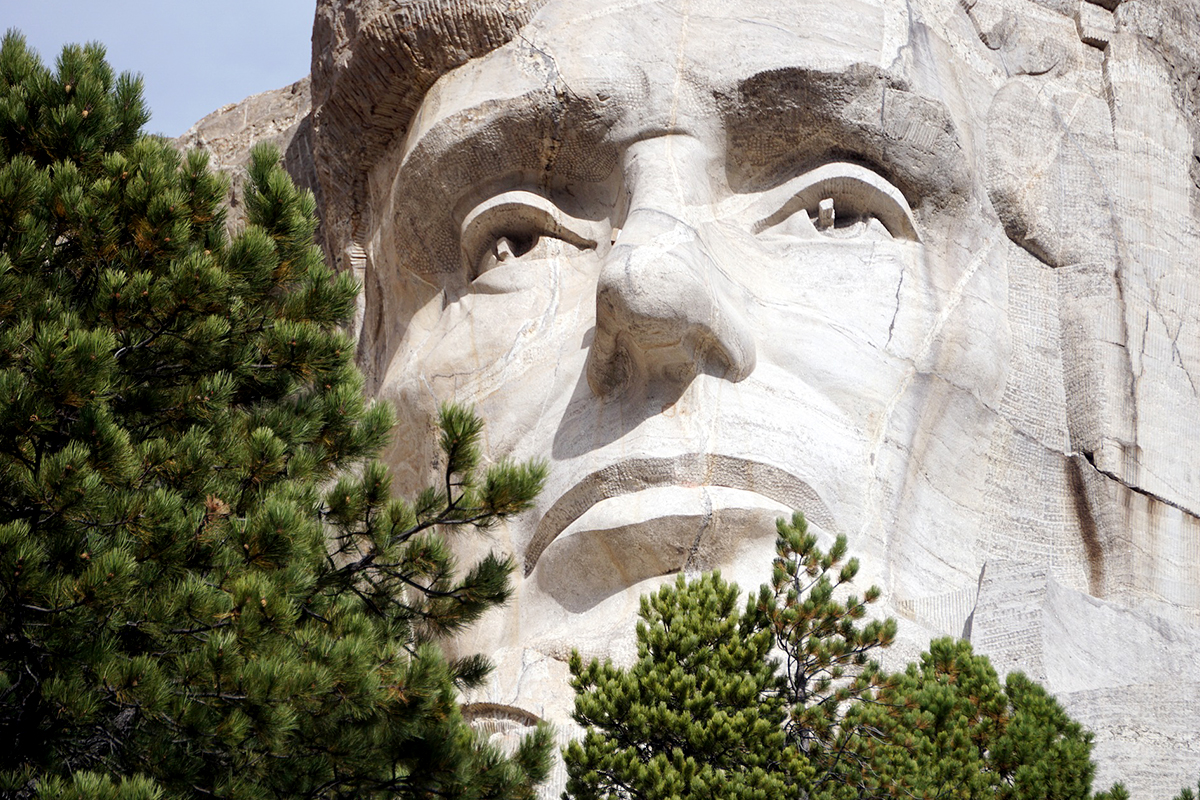
Theodore Roosevelt’s face sits farther back than the other portraits, which gives it stronger natural shadow and a more enclosed appearance. In this photograph, the large mouth, moustache and deeply cut eye sockets become abstract pieces of light and dark. The pine at the left prevents the frame from becoming a stone study with no sense of place.
A telephoto detail like this benefits from clear air and a fast enough shutter speed. At long focal lengths, small movements are magnified, and afternoon wind around the terraces can make a nominally sharp setup unreliable. The photograph does not need extreme enlargement; the important point is to isolate a structure the wide view cannot show.
Black and white shifts the image toward history
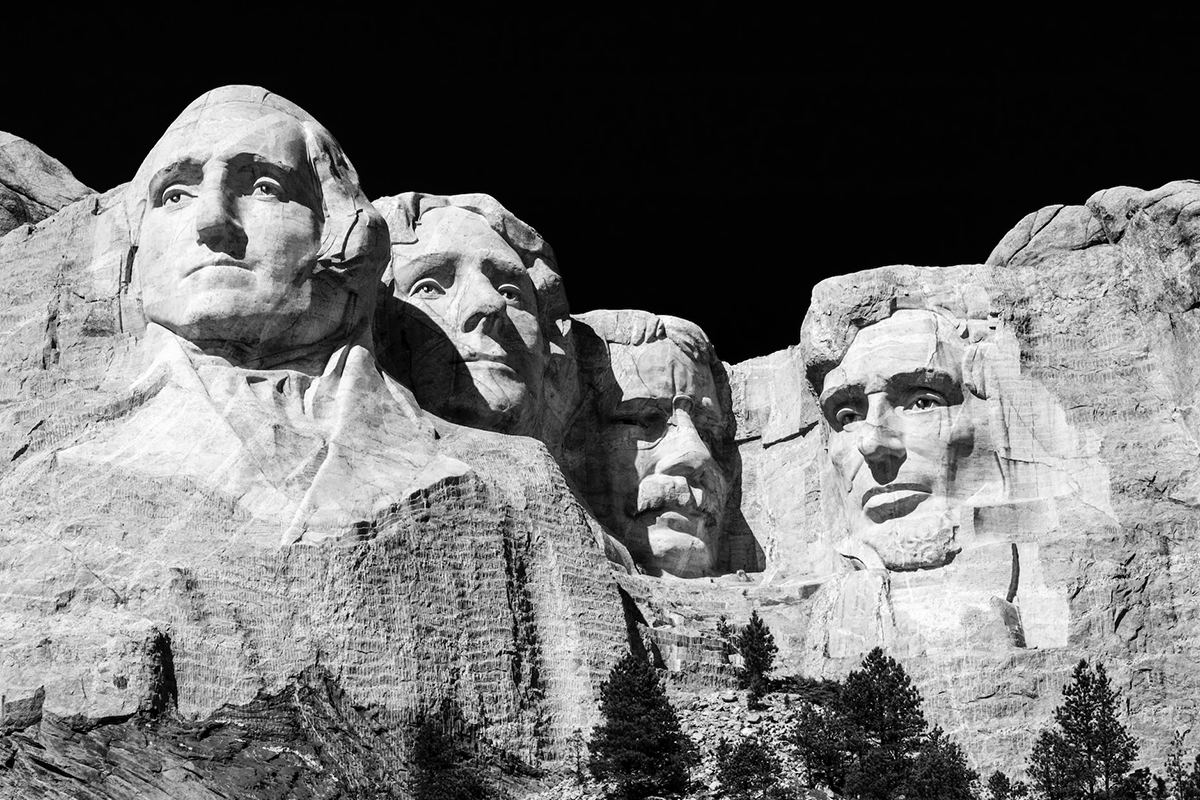
Black and white is an obvious choice for a monument completed in 1941, but historical association alone is not enough. The conversion works because the scene has a strong tonal structure. Pale faces rise from a nearly black background, and the irregular rock between them breaks the symmetry.
I would keep a conversion like this relatively neutral. Artificial scratches, sepia colour and exaggerated grain would try too hard to manufacture age. The carved surface already contains all the texture the photograph needs. Careful control of highlights is more important than a nostalgic effect.
Distance restores the scale of the mountain
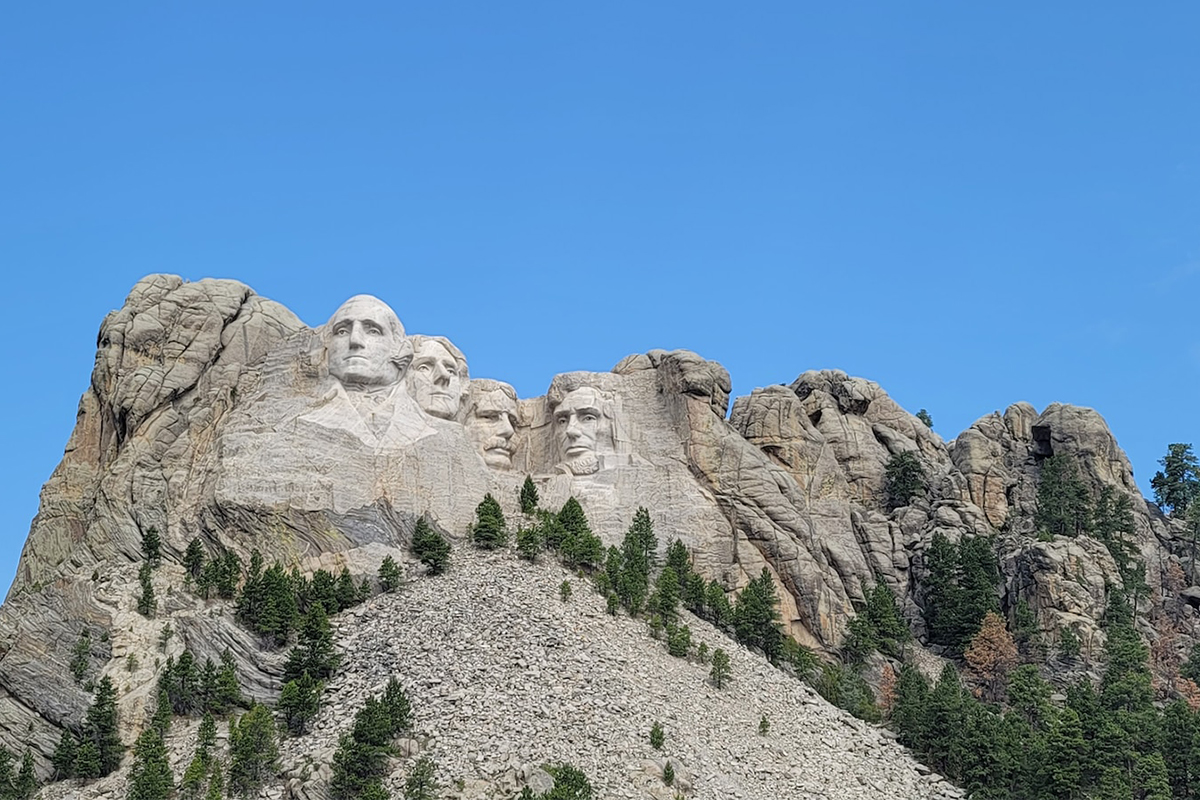
This is one of the most informative photographs in the collection. The four faces are clearly visible, but so are the natural cliffs, loose rock and trees below them. The frame explains the physical intervention: a precisely organised band of portraiture set into a much larger, irregular mountain.
The open blue sky is visually quiet, which helps the eye read the line of the ridge. A tighter crop would make the faces more impressive, but it would remove the evidence of how they belong to the terrain. For a visual guide, both versions are necessary.
A direct frontal view of all four presidents
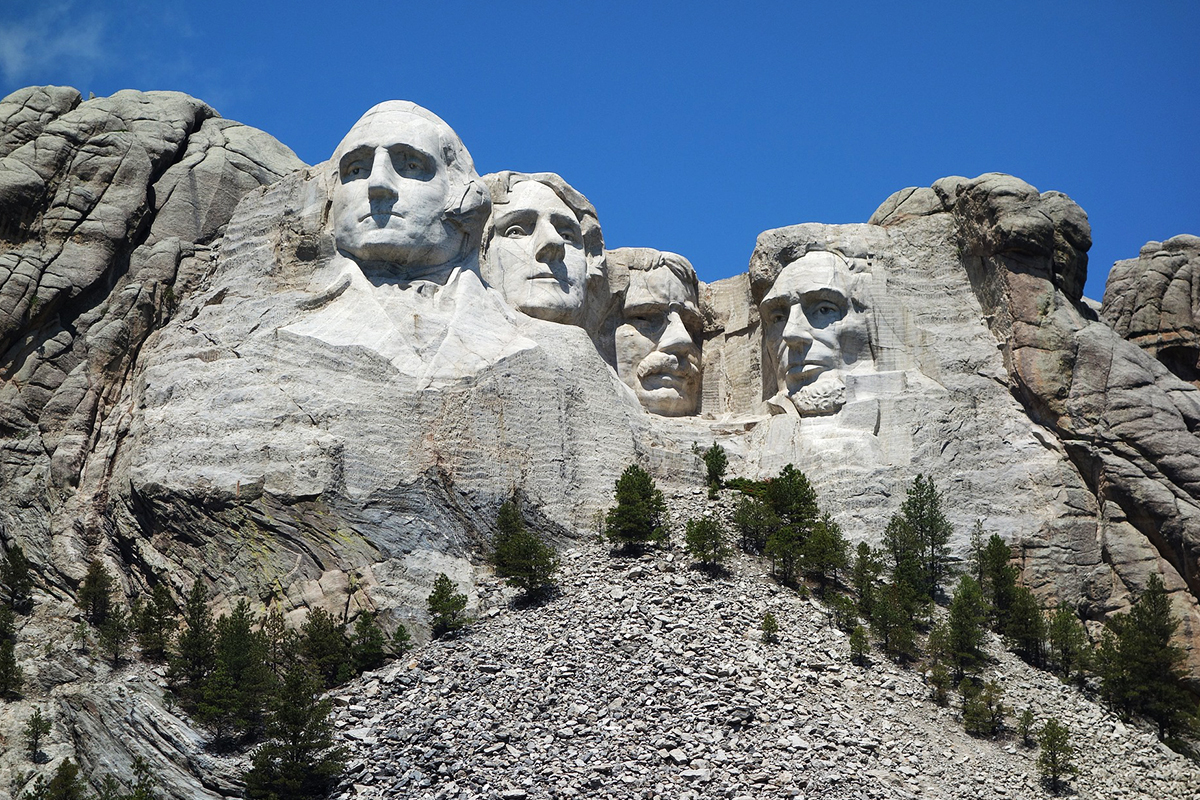
This is the closest photograph to the familiar public image of Mount Rushmore. All four portraits are visible, the sky is clean and the granite is bright. Its value is clarity. A gallery needs at least one image that simply shows the subject before every photograph begins to reinterpret it.
The composition also settles the persistent “fifth face” question: there is no official fifth portrait hidden in the sculpture. Natural rock shapes can suggest profiles when viewed from certain angles, but the completed monument contains the four selected presidents.
Winter on the Avenue of Flags
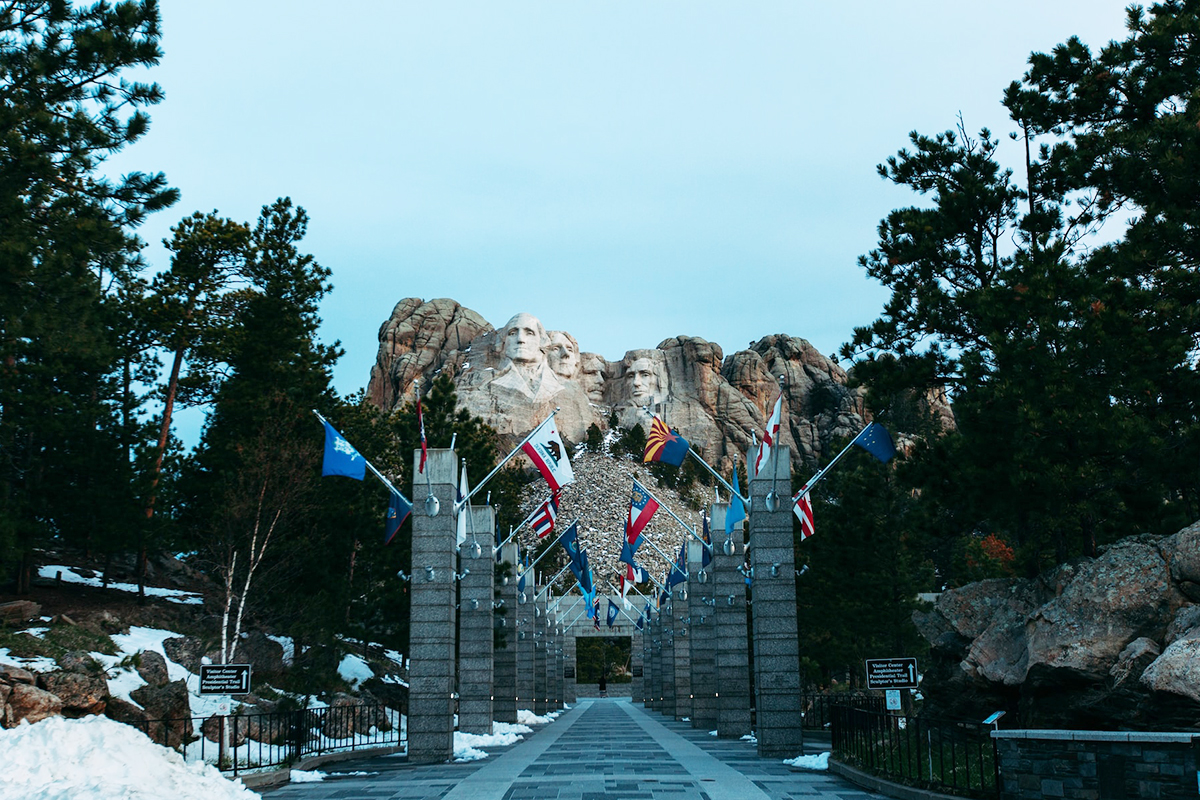
The Avenue of Flags creates one of the site’s most controlled compositions. The path is centred, vertical columns repeat on both sides and the sculpture closes the axis. In winter, snow and lower visitor numbers can make that geometry easier to see.
Symmetry is appropriate here because the space was designed around a formal approach. I would stand precisely on the centre line and check the gaps between columns rather than relying on a later crop. The monument is relatively small in the frame, but every architectural element points toward it.
Washington from the side
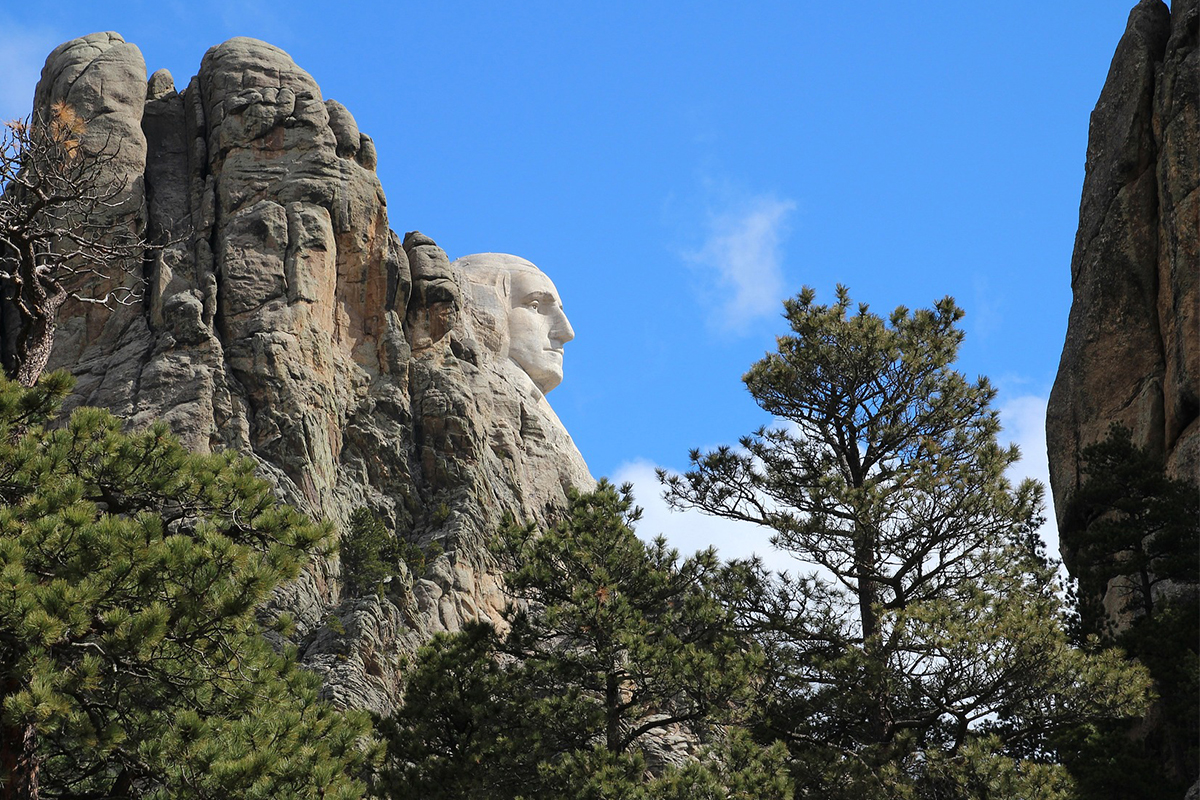
This is the collection’s most unexpected viewpoint. From the front, Washington is the dominant face; from the side, his nose and forehead become a narrow silhouette. The granite wall on the left and pine on the right form a natural corridor around it.
Side views are useful because they reveal depth that a frontal photograph compresses. The sculpture is not a flat relief painted onto the mountain. The heads project, recede and overlap. Changing position makes those decisions legible.
Bright granite beneath a blue sky
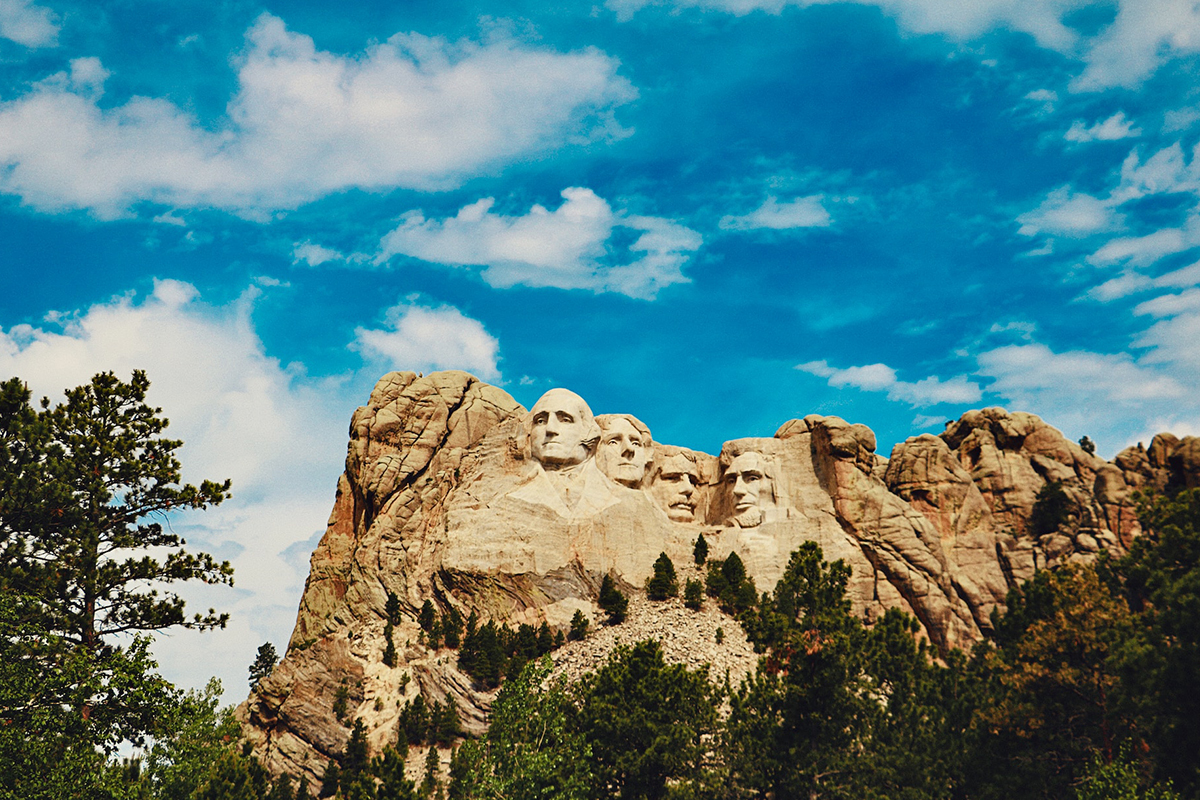
Midday light is often dismissed in travel photography, but this image shows what it can do well. It gives clean colour, short shadows and enough brightness for a fast shutter speed. Clouds interrupt the blue sky, while warm vegetation and rock prevent the scene from becoming a simple blue-and-grey postcard.
The main technical risk is overexposure in the pale granite. A camera meter may try to brighten the darker trees and sacrifice highlight detail in the faces. I would expose for the sculpture first, then lift the forest carefully if the file allows it.
Flags turn the photograph into a cultural statement
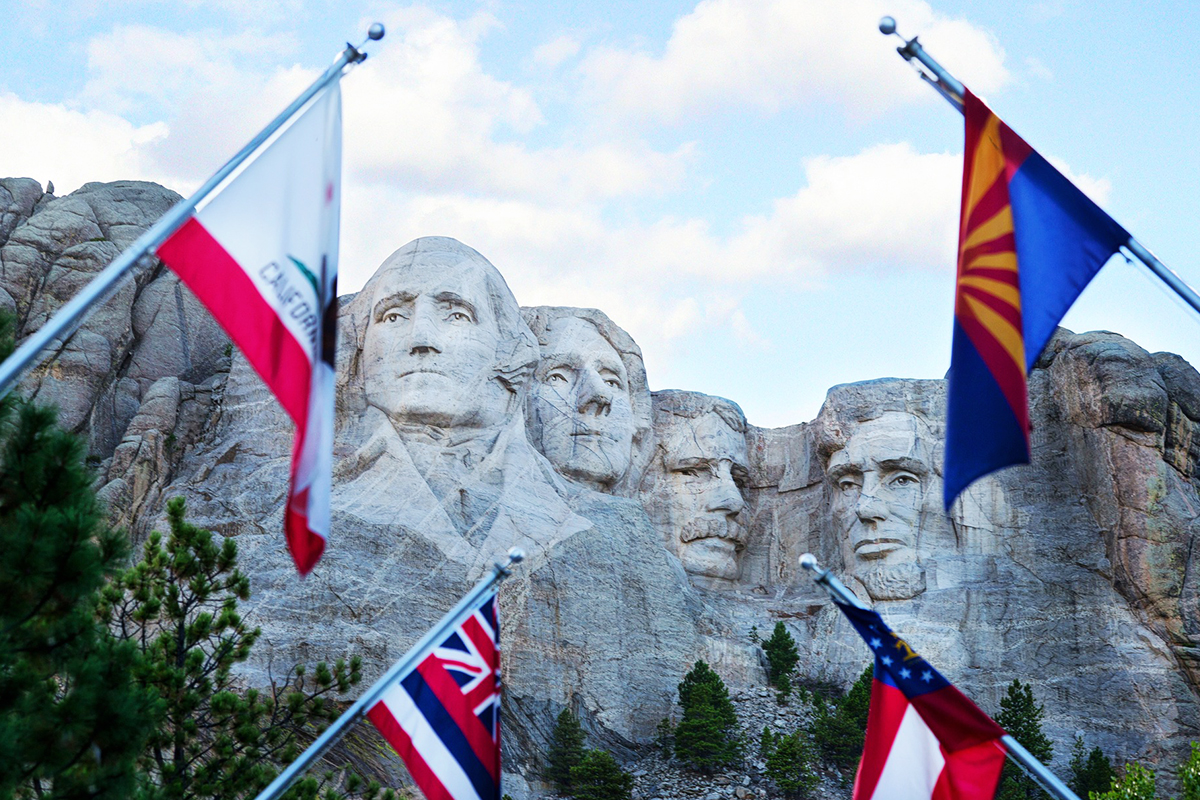
Flags change the meaning of the frame. Without them, the image can be read as monumental sculpture in a mountain landscape. With them, national identity becomes explicit. The photograph is visually busier, but that busyness is the point: moving fabric, coloured diagonals and four motionless granite faces occupy different layers.
Wind determines whether this composition works. A flag hanging straight down can hide its design and become a heavy strip of colour. A short burst, made when several flags open at once, gives better odds than attempting to time one exposure perfectly.
What the photographs reveal about Mount Rushmore
The images make the sculpture appear to change size, but the physical measurements are fixed. The National Park Service’s measurements put the presidential heads at roughly 60 feet, or 18.3 metres, tall. George Washington’s nose is about 21 feet long; each eye is approximately 11 feet wide, and each mouth about 18 feet across. Those numbers are difficult to feel in a tight image because the surrounding rock offers no familiar human scale.
| Detail | Current fact |
|---|---|
| Location | Black Hills, near Keystone, South Dakota |
| National Park Service address | 13000 Highway 244, Keystone, SD 57751 |
| Elevation at the mountain summit | 5,725 ft / 1,745 m |
| Portraits | George Washington, Thomas Jefferson, Theodore Roosevelt and Abraham Lincoln |
| Approximate head height | 60 ft / 18.3 m |
| Approximate eye width | 11 ft / 3.4 m |
| Approximate mouth width | 18 ft / 5.5 m |
| Carving period | 1927–1941 |
| Workforce | Nearly 400 workers |
| Work done with dynamite | About 90 per cent |
| Fatalities during carving | None recorded by the National Park Service |
The photographs also show why one lens cannot describe the memorial completely. A wide view preserves the mountain and forest but makes the faces small. A telephoto lens reveals eyes, tool marks and overlapping profiles but can turn the sculpture into an object without a place. The useful collection moves between those two truths.
Best places to photograph Mount Rushmore
The strongest location depends on the photograph you want. Grand View Terrace gives the direct public view; the Presidential Trail changes the angle below the faces; Iron Mountain Road turns distance and tunnels into a frame. I would choose the intended relationship before choosing the lens.
| Location | View | Best for | Limitation |
|---|---|---|---|
| Grand View Terrace | Direct frontal view beyond the Avenue of Flags | The complete group, symmetry and changing light | Popular and often crowded in summer |
| Avenue of Flags | Long central approach | Flags, leading lines and formal symmetry | Wind and foot traffic are difficult to control |
| Presidential Trail | Closer, changing angles below the mountain | Individual faces, side profiles, rock and pine frames | Full loop includes 422 stairs |
| Sculptor’s Studio area | Oblique view with interpretive context | Side lighting, a less familiar angle and understanding the carving | Seasonal hours differ from the grounds |
| Highway 244 pullouts | Distant roadside views | Mountain-in-landscape compositions | Stop only in designated pullouts; traffic safety comes first |
| Iron Mountain Road tunnels | Long framed view from the south | The classic monument-through-a-tunnel composition | Narrow road, traffic, limited stopping space and possible winter closures |
Grand View Terrace and the Avenue of Flags
Grand View Terrace is the dependable starting point. It presents all four faces from the front and offers enough room to move laterally, compare foregrounds and change focal length. The Avenue of Flags creates a centred approach before the terrace, while the amphitheatre below provides another formal relationship to the sculpture.
For a clean group portrait, a normal lens or short telephoto is often more useful than an ultra-wide lens. A wide lens includes the architecture and crowd; a longer lens gives the faces more weight. Both are valid, but they answer different questions.
Presidential Trail
The Presidential Trail is a 0.6-mile loop that moves closer to the base of the mountain and changes the relationship between the four portraits. Washington becomes more dominant from some points; Roosevelt recedes; trees and granite begin to overlap the faces. The side-profile photograph in this gallery is the kind of image made possible by leaving the single frontal viewpoint.
The first 0.2 mile from Grand View Terrace is surfaced for wheelchair access to viewing areas near the base. The remaining 0.4 mile toward the Sculptor’s Studio is not mobility-accessible and includes 422 stairs. The distance is modest, but stairs, altitude, summer heat, ice and camera weight can make it more demanding than the number suggests.
Iron Mountain Road
Iron Mountain Road is a 17-mile scenic route between Custer State Park and the Mount Rushmore area. Its three tunnels were aligned to frame the monument in the distance, making the road itself part of the composition. Pigtail bridges and forested slopes add further context.
This is not a place to stop impulsively in the traffic lane. Use legal pullouts, remain alert to vehicles and do not block a tunnel for a photograph. The road can close temporarily in winter, and its narrow tunnels have vehicle-size limits. A moderate telephoto lens helps the distant sculpture remain visible within the dark tunnel opening.
Highway 244 and the wider Black Hills landscape
Designated pullouts along Highway 244 can produce the broad views that the main terrace cannot. From farther away, the sculpture becomes part of a ridge rather than the whole subject. Trees, weather and exposed granite begin to matter as much as the faces.
This is where clear air is valuable. A long lens compresses atmospheric haze, and a small amount of moisture can reduce contrast around the pale stone. Cold, dry mornings often give more precise distance detail than warm summer afternoons.
Best light, weather and season for Mount Rushmore photos
The carved surface faces generally southeast and receives sun through much of the day. That orientation makes morning light especially useful, but weather and the intended viewpoint matter more than a universal “best hour”.
From sunrise to evening illumination
| Time | Likely visual result | Best use |
|---|---|---|
| Sunrise and early morning | Lower, directional light; fewer visitors; cooler surroundings | Texture in the faces, clean terrace views and long landscape frames |
| Late morning | Bright frontal detail and stronger colour | Direct documentary photographs and telephoto details |
| Midday | Harder contrast and short shadows | Clear records, black-and-white studies and fast handheld work |
| Late afternoon | Softer atmosphere, but less direct light on a southeast-facing surface | Wider landscape, forest and weather-led compositions |
| Blue hour | Cool sky before or during illumination | Balanced photographs of the lit sculpture and remaining sky colour |
| Full night | Bright sculpture against a dark background | Graphic telephoto frames; careful highlight exposure required |
Golden hour is not automatically ideal. The warm close view in this gallery works because low light models the granite, but late-day sun may no longer strike the entire southeast-facing sculpture directly. A sunrise photograph can provide better surface light; a sunset photograph may provide a more interesting sky. The decision is whether the subject is the carving or the atmosphere around it.
Photographing the evening illumination
The sculpture is illuminated nightly throughout the year. From late May through September, the National Park Service also runs a 45-minute Evening Lighting Program, weather and staffing permitting. The program schedule changes during the season, and illumination hours are not identical to visitor-centre hours. Check the official operating-hours page on the day of a visit.
For the photograph, begin before the sky becomes black. Blue hour reduces the contrast between the bright stone and the surrounding landscape. Meter for the faces, watch the red channel in the warmer lights and bracket a short sequence. Once the sky is fully dark, the sculpture can appear detached from the mountain unless the exposure retains a little texture in the ridge.
Seasons in the Black Hills
- Spring is variable. The official climate guide shows that snow is still possible and March and April are often among the snowier months. Cloud and rapidly changing light can be more productive than a predictable blue sky.
- Summer brings the longest facility hours, the full schedule of ranger programs and the largest crowds. July and August can be hot, and afternoon thunderstorms require attention.
- Autumn offers cooler temperatures and changing vegetation. The predominantly evergreen forest means the colour is subtler than in a deciduous eastern landscape.
- Winter can give snow, quiet terraces and graphic contrast between dark trees and pale stone. Some facilities close earlier, trails can be icy and Iron Mountain Road can close temporarily.
I would not plan around fireworks unless an official event has been announced for the exact year. Special anniversary events do occur, but they are not a dependable annual July 4 photography program.
Camera and phone guidance
Mount Rushmore is distant from every ordinary public viewpoint. The main equipment decision is therefore not whether to bring the widest lens, but how much of the surrounding mountain to retain.
Lens choice by photograph
| Photograph | Useful full-frame starting range | Effect |
|---|---|---|
| Avenue of Flags and architecture | 24–50 mm | Keeps the approach, columns and sculpture together |
| Full group from Grand View Terrace | 70–200 mm | Makes the four faces dominant without losing all surrounding granite |
| Individual face detail | 200–400 mm | Isolates eyes, profiles and carved texture |
| Wide mountain landscape | 24–85 mm | Preserves forest, ridge, sky and scale |
| Iron Mountain Road tunnel frame | 70–200 mm | Enlarges the distant memorial inside the tunnel opening |
| Phone photography | Main camera for landscape; optical telephoto for faces | Avoids the quality loss of extreme digital zoom |
A tripod can help at blue hour, but it should not become an obstacle in a crowded public space. The current NPS rules generally allow small groups of eight or fewer to photograph without a permit when they remain in public areas, use qualifying hand-carried equipment, avoid exclusive use and do not disrupt resources or visitors. Larger groups and more involved setups may need a permit. Read the current filming and photography rules before bringing more than a normal travel kit.
Exposure starting points
| Situation | Starting point | Main priority |
|---|---|---|
| Bright daytime full view | ISO 100, f/5.6–f/8, 1/500 sec or faster | Preserve highlight texture in pale granite |
| Telephoto face detail | ISO 100–400, f/5.6–f/8, 1/500–1/1000 sec | Control camera shake and wind vibration |
| Forest-framed view | ISO 100–400, f/5.6–f/11 | Keep foreground branches intentional, not accidentally soft |
| Blue-hour handheld | ISO 800–3200, widest useful aperture, 1/125 sec or faster | Sharpness before low noise |
| Illuminated sculpture on a tripod | ISO 100–400, f/5.6–f/8, bracketed shutter speeds | Protect detail in the bright faces |
| Flags in wind | ISO 200–800, 1/500 sec or faster, short burst | Shape and readable fabric rather than motion blur |
These are starting points rather than recipes. A stabilised lens cannot stop a flag, a moving person or a swaying branch. At long focal lengths, I would raise ISO before accepting a shutter speed that makes every frame slightly soft.
Composition without turning every image into a postcard
The direct four-face view is unavoidable and worth making. The more personal photographs come after it. Move to the side for Washington’s profile. Let a pine branch occupy the foreground. Include the Avenue of Flags when the subject is national symbolism, or exclude it when the subject is carved form. Use the exposed talus slope to explain scale.
The most common compositional mistake is to place a branch, flagpole or rock edge through an eye. Check the border of the frame and the negative spaces between faces. A telephoto view magnifies small overlaps, so a step sideways can improve the photograph more than changing lenses.
Photographing with a phone
Use the phone’s main camera for the landscape and a true optical telephoto module, if available, for the faces. Extreme digital zoom invents detail and often produces a waxy granite surface. A moderately cropped file from the optical lens is usually stronger than a maximum-zoom capture.
Tap the sculpture and lower exposure slightly when the sky and rock are bright. For the illuminated memorial, brace the phone against a stable surface, use a short self-timer and avoid night modes that turn moving flags and visitors into transparent smears. Clean the lens before sunset; a fingerprint creates large halos around every bright light.
A restrained edit for granite, sky and forest
The Mount Rushmore files contain three competing surfaces: pale granite, dark ponderosa forest and bright sky. Editing one aggressively can damage the other two.
I would begin by protecting detail in the faces, then lift forest shadows only enough to keep them from becoming featureless. Strong clarity can make drilled stone look brittle and produce halos along the ridge. Heavy dehaze can turn a natural blue sky cyan and force warm granite toward orange. The aim is to preserve differences between carved planes and natural rock, not to make every crack equally loud.
For black and white, control the blue channel carefully so the sky does not become an artificial black wall. Keep enough midtone separation between the four faces to retain their different depth. A useful monochrome image still needs air around the sculpture.
Sharing Mount Rushmore photographs
The existing Instagram example shows how a familiar monument can circulate in a different visual context. When sharing a photograph, a concise caption about the actual light, viewpoint or weather is more useful than a pile of generic superlatives.
Relevant tags can help identify the place — #MountRushmore, #BlackHills, #SouthDakota and #MountRushmoreNationalMemorial are clearer than dozens of unrelated travel tags. I would keep the caption honest about authorship and location, especially when a post uses an archival, licensed or otherwise sourced image rather than a photograph made personally.
The history behind the photographs
Mount Rushmore is both a feat of large-scale carving and a contested cultural landscape. Treating it only as a technical achievement leaves out the land on which it was made; treating it only as a political symbol leaves out the labour, design and physical difficulty visible in the photographs.
From a tourism idea to four presidents
South Dakota historian Doane Robinson proposed a large Black Hills sculpture in the 1920s partly to attract visitors. His early idea involved figures from regional history in the Needles. Sculptor Gutzon Borglum rejected that site and expanded the subject to four United States presidents, selecting Washington, Jefferson, Theodore Roosevelt and Lincoln to represent, from his perspective, the nation’s birth, expansion, development and preservation.
Work began in 1927 and ended in 1941. Nearly 400 workers participated, often suspended in bosun chairs high above the talus slope. Approximately 90 per cent of the carving was done with dynamite, followed by drilling and a “bumping” process that smoothed the granite. The National Park Service records no deaths during construction.
Gutzon Borglum died in March 1941. His son Lincoln supervised the final period, and the project was declared complete on October 31 that year. The original vision of showing the presidents farther down the torso was never realised.
The Black Hills before Mount Rushmore
The history begins long before 1927. The Black Hills, or Paha Sapa, hold longstanding cultural and religious importance for Indigenous nations. The National Park Service’s cultural-landscape history notes that the United States recognised the Black Hills as Lakota territory in the 1868 Treaty of Fort Laramie. Gold discovery and settlement violated that agreement, and the land was taken after conflict in the 1870s.
The mountain has been translated from a Lakota name as Six Grandfathers. Choosing it for the presidential sculpture disregarded an existing cultural significance. That does not make the engineering invisible, nor does admiration for the carving erase the earlier history. The photographs become more accurate records when both layers remain present.
The memorial itself now includes seasonal Lakota, Nakota and Dakota programming. The official summer schedule has included a Heritage Village and hoop-dance performances, but program dates can change and should be checked before a visit.
Why these four faces?
| President | Meaning assigned by Borglum |
|---|---|
| George Washington | Birth of the United States |
| Thomas Jefferson | Territorial expansion |
| Theodore Roosevelt | Development of the nation |
| Abraham Lincoln | Preservation of the union |
These meanings reflect Borglum’s design argument, not an uncontested summary of American history. The order of the faces also shapes every photograph: Washington projects most strongly at the left, Jefferson sits close behind, Roosevelt is recessed and Lincoln closes the group at the right.
The unfinished Hall of Records
Borglum planned a large chamber behind the sculpture to preserve documents and explain the monument to future generations. Congress directed funds back to the faces, and construction of the hall stopped in 1939. The unfinished chamber is not accessible to visitors.
In 1998, a repository was placed there with sixteen porcelain-enamel panels describing the carving, the selected presidents, Borglum and a short history of the United States. It is a record rather than a hidden public room, and it does not constitute a fifth face.
Mount Rushmore map and practical location
Mount Rushmore National Memorial lies in the Black Hills near Keystone, South Dakota. Rapid City is the main regional gateway. The National Park Service states in its transportation guidance that no public transportation serves the memorial; private vehicles and commercial tours are the normal options.
GPS can select impractical routes in the Black Hills, particularly for large vehicles. Follow current road signs and official directions. Iron Mountain Road is scenic but narrow and slow; it should be treated as a photographic drive, not the quickest route to a timed plan.
Planning a visit in 2026
The memorial grounds, buildings, programs and illumination do not all share one schedule. The clearest approach is to decide whether the priority is daylight photography, the Presidential Trail, museums or the evening program, then check the relevant official hours.
Fees, reservations and parking
Mount Rushmore charges no entrance fee, and an ordinary visit does not require a reservation. Parking is concession-operated. When this article was updated on 13 August 2026, the official standard fee was $10 per non-commercial vehicle, with the ticket providing unlimited re-entry for one year from purchase.
National park passes do not cover this parking charge because it is a concession fee rather than a federal entrance fee. Large-vehicle spaces are limited, overnight parking is prohibited and summer visitors are advised to arrive earlier in the day. Verify the current parking page before travel because prices and procedures can change.
Current seasonal hours
| Facility or program | Schedule listed when checked 13 August 2026 |
|---|---|
| Grounds and parking, March 10 – September 30 | 5 a.m. – 11 p.m. |
| Grounds and parking, October | 5 a.m. – 9 p.m. |
| Grounds and parking, November 1 – March 9 | 6 a.m. – 9 p.m. |
| Visitor and Information Centers, August 10 – September 30 | 8 a.m. – 9 p.m. |
| Evening Lighting Program, August 10 – September 30 | Begins 8 p.m. |
| Sculpture illumination, August 10 – September 30 | 8:30 – 11 p.m. |
Visitor facilities operate year-round except December 25. On Christmas Day, weather permitting, the grounds and parking may remain open while buildings are closed. Hours vary across the year, so this table is a dated snapshot rather than a permanent promise.
Accessibility, pets and drones
Parking garages have elevators and accessible spaces, and elevators connect Grand View Terrace with the visitor centre and amphitheatre. Manual wheelchairs are available free at the Information Center on a first-come basis. The first 0.2 mile of the Presidential Trail is surfaced for wheelchair access; the remaining loop is not accessible and includes 422 stairs.
Pets are restricted to specified areas around the parking complex, the pet exercise area, the Blackberry Trail and areas outside the developed visitor core. They are not permitted on the Presidential Trail, Avenue of Flags or Grand View Terrace; service animals are excepted under applicable rules.
Launching, landing or operating a drone within Mount Rushmore National Memorial is prohibited. A distant aerial-looking composition must therefore come from a legal ground viewpoint, not from an uncrewed aircraft over the memorial.
A realistic photography visit
For a concise daylight visit, I would allow two to three hours: Avenue of Flags, Grand View Terrace, the accessible section or full Presidential Trail according to mobility, and the museum or Sculptor’s Studio if open. A photography-focused visit can take longer because the light changes slowly and crowds move through formal compositions.
For evening work, arrive while there is still daylight. Make the direct view first, choose a stable position before the program begins and remain after illumination long enough for the sky to deepen. Trying to arrive at the exact lighting time leaves no room for parking, walking, security conditions or exposure tests.
Frequently asked questions
Where can I see the best photos of Mount Rushmore?
This page contains eleven Mount Rushmore photographs: wide landscapes, direct frontal views, close facial details, a side profile, an Avenue of Flags composition, winter scenery, warm light and flag-framed views. The gallery appears before the practical guide because the primary purpose of the page is visual discovery.
What is the best place to photograph Mount Rushmore?
Grand View Terrace is best for a clear frontal image of all four presidents. The Presidential Trail is better for close details and changing profiles. Iron Mountain Road offers the most distinctive distant framing, with tunnels aligned toward the memorial.
What is the best time of day for Mount Rushmore photos?
Early morning usually gives useful directional light on the southeast-facing sculpture and fewer visitors. Blue hour is best for balancing the illuminated faces with colour in the sky. Midday remains useful for sharp telephoto details if highlights are protected.
Can I photograph Mount Rushmore at night?
Yes. The sculpture is illuminated nightly, though hours change seasonally. An Evening Lighting Program runs from late May through September. Check the official schedule because the program, illumination and grounds follow separate times.
Is Mount Rushmore free to visit?
There is no entrance fee. Parking is paid and concession-operated. The standard non-commercial vehicle fee was $10 when checked in August 2026, and national park passes did not cover it.
Do I need a reservation?
No reservation is required for an ordinary visit or for National Park Service programs, including the Evening Lighting Ceremony. Special events, large organised photography and other activities may have separate permit requirements.
Can I use a tripod?
The current NPS photography guidance generally allows small, non-disruptive setups that meet all stated conditions, and specifically distinguishes ordinary handheld or tripod use from more involved equipment. Crowds, closures and other rules still apply. Check the official page before a professional or organised shoot.
Can I fly a drone at Mount Rushmore?
No. Launching, landing or operating unmanned or remote-controlled aircraft inside Mount Rushmore National Memorial is prohibited.
How long is the Presidential Trail?
The loop is 0.6 mile. About 0.2 mile from Grand View Terrace to viewing areas near the mountain is surfaced for wheelchair access. The remaining 0.4 mile includes 422 stairs and is not mobility-accessible.
How large are the faces?
The heads are approximately 60 feet, or 18.3 metres, tall. Each eye is about 11 feet wide, and each mouth around 18 feet wide. Washington’s nose measures approximately 21 feet.
Who are the four presidents?
From left to right, the sculpture shows George Washington, Thomas Jefferson, Theodore Roosevelt and Abraham Lincoln.
Is there a fifth face?
No. Natural rock formations can resemble faces from certain viewpoints, but the official sculpture contains four portraits. The unfinished Hall of Records behind the faces is a chamber, not another portrait.
Why was Mount Rushmore never finished as originally planned?
Borglum’s larger concept included more of each president’s body and a substantial Hall of Records. Funding restrictions redirected work to the faces, Borglum died in 1941 and the approaching United States involvement in World War II helped bring work to an end. The memorial was declared complete on October 31, 1941.
What else should I photograph in the region?
The Black Hills offer granite landscapes, forest, scenic roads and other National Park Service sites. For another photo-led American landscape, see my photos of Petrified Forest National Park and photos of Bryce Canyon National Park collections. For a very different kind of American landmark photography, continue with my Brooklyn Bridge photo spots guide.
Final thoughts
The most useful photos of Mount Rushmore do not all make the sculpture look enormous. Some hold it at a distance and allow cloud, pine and exposed granite to explain where it is. Others move close enough for a single eye or profile to become a landscape of drilled stone. Flags make one interpretation explicit; black and white opens another.
What matters is not finding a secret viewpoint that no one has used. Mount Rushmore has been photographed too often for that promise to be credible. The more interesting task is to decide what the picture is about: four portraits, a worked mountain, a national symbol, a contested landscape or the visual experience of approaching it through the Black Hills. Once that choice is clear, the lens and the frame become much easier decisions.