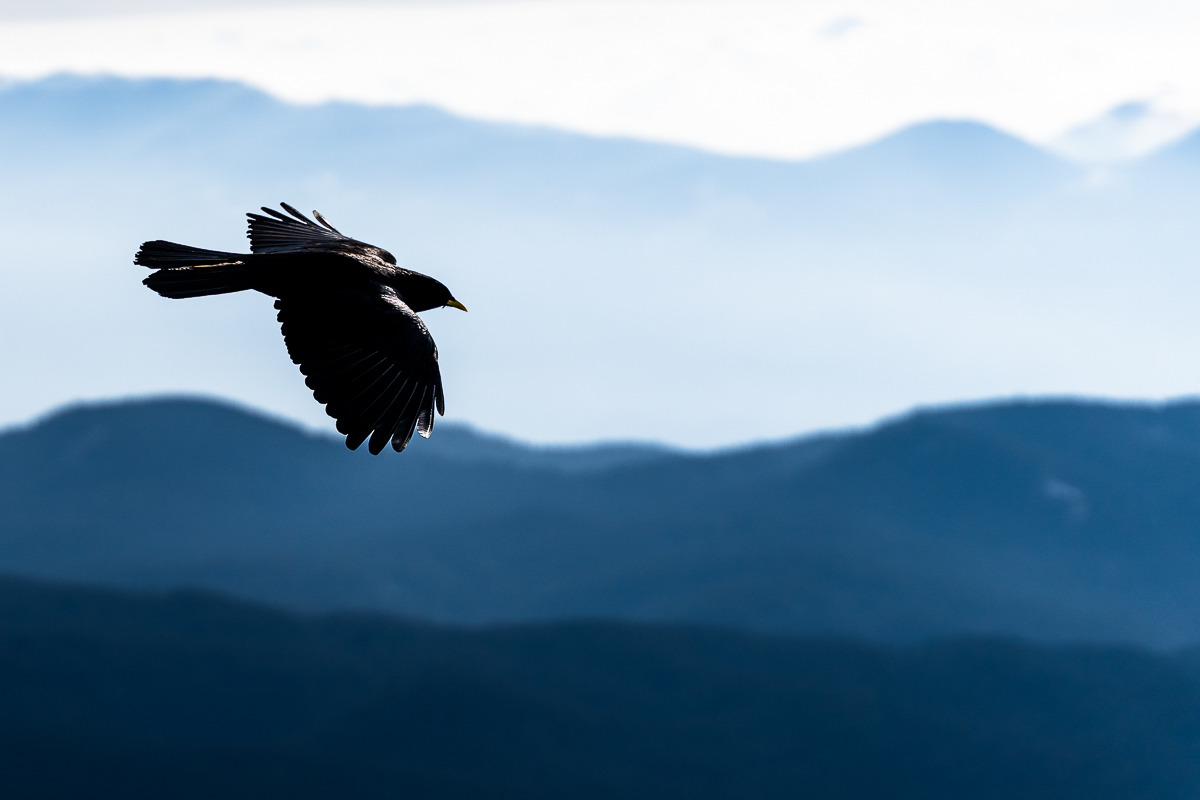
High above the forest, where the path has narrowed into rock and open grass, a black bird crosses the sky with barely a wingbeat. It turns on the air, drops below the ridge and rises again. Then the light catches two details that settle the identification: a yellow bill and red legs. This is an Alpine chough.
I photographed these birds around Viševnik in the Julian Alps, one of the mountain locations I return to with a camera. The images show two sides of the species: the poised bird on a rock and the seemingly effortless flier using the slope’s rising air. Both are characteristic. Alpine choughs are high-mountain corvids — relatives of crows, ravens and jackdaws — but their lives are unusually closely tied to cliffs, alpine grasslands and the thin air above them.
Their English names can cause confusion. Alpine chough and yellow-billed chough refer to the same species, Pyrrhocorax graculus. The yellow bill is the fastest field mark; the word “Alpine” describes the habitat in which many European observers meet it.
Alpine chough quick facts
| Feature | Alpine chough |
|---|---|
| Scientific name | Pyrrhocorax graculus |
| Other English name | Yellow-billed chough |
| Family | Corvidae — the crow family |
| Appearance | Glossy black plumage, yellow bill and red legs |
| Approximate size | About 38 centimetres long, with a wingspan of roughly 75–85 centimetres |
| Typical habitat | High mountain grasslands, rocky slopes, ravines and cliffs |
| Diet | Mainly invertebrates in warmer months; fruit, seeds and other available food become more important in colder months |
| Social life | Highly social; often seen in pairs, family parties or flocks |
| Nest | Usually in a protected cliff cavity, fissure or similar rocky site |
| Global conservation status | Least Concern |
| Best identification clue | A yellow bill on an otherwise black bird, usually accompanied by red legs |
What is an Alpine chough?
An Alpine chough is a medium-sized member of the crow family adapted to life in mountainous country. In Europe, it is associated particularly strongly with the Alps and other major ranges, but the species extends much farther east through mountain systems across Asia and into North Africa. Its distribution is not a continuous blanket. It follows suitable high, rocky landscapes.
That geography explains why the bird can feel both familiar and rare. At a busy Alpine summit, a flock may seem perfectly at home among hikers and mountain huts. At lower elevations, many people never see one. It is not simply a “black bird from the mountains”; it is a specialist whose shape, social behaviour and flight make sense in exposed terrain.
The species belongs to the genus Pyrrhocorax, which contains two living choughs: the Alpine, or yellow-billed, chough and the red-billed chough. They share black plumage, red legs and an appetite for open ground, but they are distinct species with different bills, voices, proportions and habitat preferences.
Alpine chough or yellow-billed chough?
Both names are correct. “Yellow-billed chough” is exceptionally useful in the field because it states the feature that eliminates most confusion. “Alpine chough” is common in European writing and reflects the bird’s close association with high mountain landscapes.
I use Alpine chough throughout this article because it is the name most closely connected to my encounter at Viševnik. If a field guide, checklist or birding app uses yellow-billed chough, it is describing the same bird.
Is an Alpine chough a crow?
It is a corvid, so it belongs to the same family as crows, ravens, rooks, magpies and jackdaws. That relationship shows in its intelligence, curiosity and social flexibility. It does not, however, belong to the genus Corvus, which includes many of the birds ordinarily called crows and ravens.
This distinction matters because a quick glance can be misleading. A black bird near a mountain summit may be casually called a crow. The bill colour, leg colour, size, voice and manner of flight tell a more precise story.
How to identify an Alpine chough
The cleanest identification combines several features rather than relying on only one. Look first for the yellow bill, then confirm the red legs, all-black plumage, compact proportions and high-mountain setting.
The yellow bill
An adult Alpine chough has a relatively short, slender yellow bill. At close range, the colour can range visually from lemon yellow to warm yellow-orange depending on the light. It stands out sharply against the dark head.
The bill is also a structural clue. A red-billed chough has a noticeably longer, more curved bill. A jackdaw’s bill is shorter and dark. A raven has a much heavier dark bill. When colour is lost in backlight, those differences in length and weight become more important.
Black plumage with more detail than it first appears
From a distance, an Alpine chough looks uniformly black. In good light, the plumage can show a smooth blue, green or violet gloss. This sheen is easy to lose in a photograph. If the exposure is too dark, the bird becomes a featureless silhouette; if shadows are lifted too aggressively, the plumage turns grey and noisy.
The wings are broad enough to support controlled gliding, while the tail appears fairly square or gently rounded rather than deeply forked. Its overall shape is lighter and more compact than a raven’s.
Red legs
Adults have red legs and feet. On a perched bird, the combination of yellow bill, red legs and black plumage is decisive. In flight, the legs may be hidden or too small to see, so the bill, proportions and voice carry more weight.
Juvenile birds
Young Alpine choughs can be less immediately obvious than adults. The bill may be duller and less brightly yellow, and the legs can look dark before developing the stronger adult colour. A juvenile encountered within a family group may therefore require a more complete reading of shape, voice, companions and habitat.
Voice and behaviour
Alpine choughs are vocal birds. Their calls are clear, ringing and often slightly whistled, different from the deeper croak of a raven and the familiar sharp calls of a jackdaw. Sound is particularly valuable when a flock passes overhead as dark shapes against a bright sky.
Behaviour helps too. Alpine choughs often move as a coordinated group, wheeling around a ridge, spreading over grass to feed and gathering again. Their flight can be fast and playful-looking, with close turns that appear almost casual even in strong mountain air.

Alpine chough vs red-billed chough, jackdaw and raven
Several dark corvids occur in or near European mountain landscapes. This comparison solves most practical identification problems.
| Bird | Bill | Legs | Size and shape | Typical impression |
|---|---|---|---|---|
| Alpine chough | Shorter, slender and yellow | Red | Compact, with agile wings and a fairly short tail | Social high-mountain bird; often circles ridges and summits |
| Red-billed chough | Longer, distinctly curved and red | Red | Slightly larger-looking, with long “fingered” wings | Powerful, acrobatic flier associated with cliffs and open grazing ground |
| Western jackdaw | Short and dark | Dark | Compact; grey nape and pale eye often visible | Common around settlements, woodland edges and cliffs; less tied to high alpine terrain |
| Carrion crow | Dark and heavier | Dark | Broader-bodied, familiar crow proportions | Usually more deliberate flight; widespread across many habitats |
| Common raven | Very large, heavy and dark | Dark | Massive bill, long wings and wedge-shaped tail | Deep calls, powerful flight and clearly larger scale |
The most common mistake: red-billed versus yellow-billed
The two chough species share red legs and glossy black plumage. Bill colour therefore provides the shortest answer: yellow indicates Alpine chough; red indicates red-billed chough. Bill shape reinforces it. The Alpine chough’s bill is shorter and only gently curved, while the red-billed chough carries a long, scimitar-like bill.
Habitat is supportive evidence, not a substitute for appearance. Alpine choughs are especially characteristic of high elevations. Red-billed choughs can also occur in mountains, but in parts of western Europe they are equally associated with coastal cliffs and grazed landscapes.
The scale mistake: Alpine chough versus raven
With no nearby object for scale, a lone black bird above a ridge can look larger than it is. A raven’s bill is heavier, its neck and chest look more powerful, and its tail often forms a wedge in flight. Its wingbeats feel slower and weightier. An Alpine chough is more compact, more buoyant in a group and far more likely to reveal a bright bill when it turns into the light.
Where Alpine choughs live
Alpine choughs inhabit mountain systems across a broad part of the Old World. In Europe they occur in ranges including the Alps, Pyrenees, Apennines, Carpathians and parts of the Balkans. Eastward, their distribution follows high terrain through western and central Asia to the Himalayas and beyond. Populations also occur in mountainous parts of North Africa.
The important word is not simply “north” or “south,” but height. Alpine choughs favour open alpine and subalpine terrain: short grass, rocky slopes, scree, ravines and cliffs. They forage on the ground but require safe rocky nesting sites. In summer, many birds use country above the treeline. In winter, snow and food availability can bring them to lower slopes, upper valleys, villages or other places where feeding remains possible.
They are renowned for occurring at extraordinary elevations. That reputation is accurate, but it should not turn the bird into a mountaineering trophy. The best observation often happens by standing still in suitable habitat and allowing the birds to use the landscape on their terms.
Why cliffs and alpine grasslands work together
The species needs two types of terrain close to one another. Cliffs and rock fissures offer protected sites for nesting and roosting. Nearby grasslands, thin soils and open slopes provide access to insects and other food. A forested mountainside may be rich in birds, but it does not offer the same combination.
This relationship also explains why changes to mountain land use matter. If open grazing ground closes into scrub or if disturbance reaches nesting cliffs, the quality of apparently dramatic mountain scenery can decline for specialist species. The mountain may still look wild to us while becoming less functional for the birds that depend on it.
Do Alpine choughs migrate?
They are generally resident rather than long-distance migrants. That does not mean they remain on one summit throughout the year. They make seasonal and daily movements according to snow, wind, food and roosting sites. A flock may descend substantially in winter, then use higher feeding ground again when conditions improve.
These vertical movements are one reason sightings near mountain settlements do not mean the bird has abandoned alpine life. It is responding flexibly to a difficult seasonal environment.
My Alpine chough photographs from Viševnik
Viševnik rises to 2,050 metres in the Julian Alps. It is one of my frequent choices when I want to combine hiking and photography: high enough to open broad mountain views, yet approachable by a marked route for prepared hikers in suitable conditions.
On this outing, the Alpine choughs gave the landscape movement. One bird held briefly on a rock, its bill and legs bright against black feathers. Others crossed the open sky and the distant ridges. The photographs are simple encounters rather than controlled wildlife setups. That is exactly what I value about carrying a camera into the mountains: the subject belongs to the place, and the place remains visible in the photograph.
The three frames also illustrate the identification problem from the other side. Only the perched bird shows the yellow bill and red legs plainly. In both flight photographs the birds are lit from behind and reduced almost entirely to shape — in one the bill catches just enough light to read as a small yellow point, and in the other nothing of the colour survives at all. That is the ordinary condition of mountain bird photography, and it is why silhouette, proportion and behaviour matter as much as colour.
I used a Sony A7 III with a Tamron 28–75mm f/2.8 zoom. That is not the long lens normally associated with bird photography. It worked here because the images are as much about birds in mountain space as they are about close plumage detail. The flying frames preserve the scale of the Julian Alps; the perched portrait records the identifying features without turning the setting into an anonymous blur.
I processed the photographs with my custom Lightroom preset, then adjusted them to keep detail in the dark feathers and the brighter sky. With a black bird against mountain light, that balance matters more than an aggressive effect. The image should still feel like open air.
Viševnik as context, not just a backdrop
A wildlife photograph gains meaning when the setting explains the animal. The chough’s black shape against layered ridges tells us where it lives. The perched bird on bare rock shows the relationship between its body and exposed terrain. A frame filled only with the bird may reveal more feather detail, but it can say less about alpine life.
That is why I would not treat these photographs merely as proof that I saw the species. They record a visual connection: rock, altitude, moving air and a bird built to use all three.
How Alpine choughs fly
Flight is the species at its most expressive. Alpine choughs use rising air along slopes and cliffs, alternating quick wingbeats with long glides. They can turn tightly, lose height and recover it with remarkable economy. A flock often seems to redraw the shape of the ridge in the sky.
What looks playful may also be practical. Mountain air is structured by terrain. Wind striking a slope is forced upward, creating lift; sun-warmed ground can produce rising columns of air. A bird that reads those currents reduces the energy needed to travel between feeding areas, roosts and lookout points.
Their broad wings and manoeuvrable tails allow rapid corrections close to rock. The result is different from the heavy authority of a raven. An Alpine chough often appears lighter, faster and more social, with several birds responding to the same invisible movement in the air.

What Alpine choughs eat
Alpine choughs are flexible feeders, and their diet changes with the season. During warmer months, they search short grass and open soil for invertebrates. Beetles, larvae, grasshoppers and other small animals provide protein during the breeding season. As cold weather reduces insect availability, fruit, berries, seeds and other plant food become more important.
They forage socially, walking over alpine turf and probing or picking food from the surface. Flocks can cover ground efficiently, and many eyes help detect both food and danger. In winter they may descend to places where natural food remains exposed.
Why they gather around people
At popular viewpoints, huts and ski areas, Alpine choughs may learn that people leave edible scraps. Their confidence can be charming, but tameness is not evidence that feeding is harmless. A bird approaching a lunch table is displaying learned opportunism.
Human food can replace a more varied natural diet, concentrate birds in crowded places and encourage increasingly bold behaviour. Crumbs also bring birds close to dogs, traffic, windows and other avoidable risks. The responsible response is simple: secure food, pack out every scrap and photograph the bird without rewarding its approach.
Do not feed Alpine choughs, even for a photograph. A frame created with bait records our interference more than the bird’s natural behaviour.
Social behaviour and intelligence
Like many corvids, Alpine choughs live in a social world. Outside the immediate demands of nesting, they can form conspicuous flocks. Birds feed together, travel together and gather at roosts. Within that crowd are individual relationships: established pairs, young birds, competitors and companions responding to one another.
Flocking offers practical advantages in exposed country. More birds can locate scattered food, detect predators and share information about safe places to rest. The group also creates constant motion. One bird dropping onto a feeding slope may draw others; an alarm can lift the entire flock.
Their comfort around people in some mountain destinations reflects behavioural flexibility, not domestication. They watch, learn and exploit predictable opportunities. The more consistently visitors provide food, the more the birds’ choices become shaped by human routines.
Are Alpine choughs aggressive?
They are not generally a threat to people. Around food, however, bold individuals may approach closely or compete with one another. That behaviour is best prevented rather than tested. Keep food packed away, do not hold out a snack to create a close-up and give a perched bird room to leave.
Why flocks seem to play in the wind
It is difficult to watch choughs tumbling around a ridge without reading joy into the scene. Science asks for more caution about motive. Aerial manoeuvres can serve travel, social bonding, practice and the efficient use of lift. What can be said with confidence is that these birds possess both the anatomy and learned skill to handle turbulent air with precision.
The experience remains exhilarating even without pretending to know exactly what each turn means.
Nesting and the Alpine chough life cycle
Alpine choughs usually nest in protected cavities in cliffs, rock fissures and similar inaccessible places. Shelter matters in a landscape exposed to cold, wind and sudden weather. A suitable cavity protects eggs and small chicks while still giving adults access to nearby feeding ground.
Pairs are generally monogamous and cooperate through the breeding season. The female carries out most or all of the incubation, while both parents contribute to feeding the young. A typical clutch contains several eggs, commonly three to five, although reproductive details vary with location and conditions.
Young birds remain dependent after leaving the nest and may be seen with adults in family groups. Later, juveniles join the wider social population. Their duller bill and leg colours gradually develop toward the brighter adult pattern.
Never approach a nest for a photograph
A cliff cavity that appears empty may contain eggs or young hidden in shadow. Repeated adult alarm calls, birds carrying food but refusing to land, or persistent circling can indicate that a photographer is too close. The correct action is to retreat immediately.
No image is worth delaying a feeding visit or revealing a nest to other people and predators. Avoid publishing precise nest coordinates. Long lenses, observation from established paths and patience produce better behaviour as well as better ethics.
Alpine choughs through the seasons
The species does not present exactly the same photographic opportunity all year. Light, flock size, food and access change with mountain conditions.
| Season | What the birds may be doing | What the photographer should consider |
|---|---|---|
| Spring | Pairs become more focused on breeding areas; snow may still cover high ground | Keep extra distance from territorial or nest-related behaviour; expect rapidly changing weather |
| Summer | Adults forage for invertebrates; family groups and high-elevation activity become visible | Start early, protect highlights in hard light and avoid crowding birds around summits and huts |
| Autumn | Flocks can become more conspicuous; berries and other plant foods gain importance | Use softer light and wider environmental compositions; weather can turn quickly |
| Winter | Birds may descend or gather where food is accessible | Treat snow travel seriously, avoid food conditioning and expose carefully for black plumage against snow |
Seasonal patterns are not a timetable. Altitude, latitude and a particular year’s snow cover alter what happens when. Mountain access should always be decided from current trail and weather information, not from a bird-photography calendar.
How I photograph Alpine choughs
Alpine chough photography sits between bird photography and mountain photography. The bird may be close one moment and a small moving shape over a valley the next. I therefore think in two kinds of frame: a clean behavioural portrait and an environmental image that shows altitude.
My Viševnik photographs were made with a 28–75mm zoom, but that does not mean a short lens is the default choice. A longer lens usually provides more working distance and makes it easier to photograph natural behaviour without following a bird. The right lens is the one that lets the animal remain unpressured.
Starting settings for birds in flight
The exact exposure depends on light, distance and the direction of the bird, but these are useful starting points:
| Situation | Shutter speed | Aperture | ISO | Focus and drive |
|---|---|---|---|---|
| Bird crossing a bright sky | 1/1600–1/2500 sec | f/5.6–f/8 | Auto ISO | Continuous AF, expanded area or tracking, high-speed burst |
| Fast turn near a ridge | 1/2500–1/3200 sec | f/5.6–f/8 | Auto ISO | Continuous AF, tracking, short controlled bursts |
| Smooth glide in softer light | 1/1000–1/1600 sec | f/4–f/7.1 | Auto ISO | Continuous AF, moderate or high burst |
| Perched bird | 1/500–1/1000 sec | f/4–f/8 | Auto ISO | Single point or small zone on the eye |
These are suggested settings, not the recorded EXIF values of the photographs on this page. If the bird is moving toward the camera, if wind is shaking the lens, or if I am shooting from an unstable stance, I choose the faster end of the range.
Expose for black feathers and a bright background
A dark bird against sky can fool a meter. Exposing only for the sky may reduce the chough to black shape; exposing only for the bird may erase cloud or snow detail. I watch the histogram and highlight warning, protect important bright areas, and allow enough exposure for recoverable feather detail.
There is no single exposure-compensation value that always works. A pale overcast sky, blue sky, sunlit cliff and snowfield all produce different contrasts. Mirrorless exposure preview helps, but the viewfinder image should still be checked against the histogram.
If the bird occupies only a small part of the frame, the camera may respond mostly to the background. Manual exposure can be effective when the light on the bird is stable, even while the background changes. Auto ISO with a fixed shutter speed and aperture is faster when light itself is changing.
Focus on the eye, but read the flight path
Bird-detection autofocus is useful, not magical. A small black subject passing across a textured ridge can still be lost. I acquire the bird before it reaches the composition I want, pan smoothly and leave space in front of its direction of travel.
Against an uncluttered sky, a larger focus zone may catch the subject quickly. Against rock or forest, tracking initiated from a smaller zone can prevent the camera from jumping to the background. Short bursts are often more effective than holding the shutter continuously; they produce distinct sequences without filling the card with nearly identical frames.
Keep part of the mountain
A tight portrait answers “what does this bird look like?” An environmental frame answers “what kind of life does it live?” Both belong in a complete story.
For the wider image, I look for a clean section of ridge, layered mountains, cloud or negative space. I avoid placing the bird directly against a busy line of rock if a moment’s patience will move it into open sky. When several birds fly together, I try to preserve their spacing rather than overlapping every shape.
Working with a shorter zoom
A standard zoom can be useful when choughs naturally pass near a summit or when the surrounding landscape is central to the frame. It should never become a reason to lure them closer. I set the composition wider, anticipate the path and accept that the bird will occupy less of the photograph.
Cropping has limits. A distant bird enlarged from a small part of the sensor will not carry the detail of a close subject made with a long lens. Rather than force a poor crop into a portrait, I keep it as a deliberate mountain scene.
Editing photographs of black birds
Black plumage is not empty black. Good processing reveals shape and subtle colour without making the bird look washed out.
Start with the overall exposure
I first balance the sky, rock and landscape. Then I make a local adjustment to the bird if necessary. Lifting global shadows too far can flatten the whole scene, exaggerate haze and introduce noise into the mountains.
For the chough itself, a modest shadow lift and careful control of the black point are usually enough. Texture can help reveal feathers, but excessive clarity creates bright edges and a brittle look.
Control colour honestly
The bill and legs are useful identification marks, which makes oversaturation especially distracting. Their colour should be visible, not fluorescent. The same restraint applies to blue mountain skies. If the sky becomes unnaturally deep, the black bird may look pasted onto it.
Chromatic aberration can appear along dark wings against bright sky. Lens correction and a targeted defringe adjustment are preferable to desaturating the whole image.
Reduce noise without erasing feathers
Fast shutter speeds can push ISO upward, especially in cloud. Apply noise reduction while viewing the bird at 100 per cent. The goal is not a perfectly smooth surface; fine feather texture should remain. Selective sharpening on the eye, bill and leading feather edges often looks more natural than strong global sharpening.
Ethical Alpine chough photography
The apparent confidence of Alpine choughs makes ethical discipline more important, not less. A bird that tolerates people can still be displaced, conditioned to food or prevented from reaching a nest.
My practical rules are straightforward:
- I do not feed or bait birds.
- I stay on marked trails and durable established areas.
- I do not chase a walking bird from rock to rock.
- I never move closer to a suspected nest cavity.
- I avoid call playback, especially in the breeding season.
- I keep dogs controlled and away from feeding or resting birds.
- I pack out food scraps, fruit peel and crumbs.
- If a bird stops feeding, repeatedly watches me, alarm-calls or changes course, I increase the distance.
- I do not publish precise nest locations.
Distance should be judged by behaviour, not by a universal number. Terrain, season and the individual bird all matter. A telephoto lens does not grant permission to occupy a sensitive place, and a wide lens does not require a close approach.
Seeing Alpine choughs at Viševnik responsibly
Viševnik is a 2,050-metre peak above Pokljuka in Slovenia’s Julian Alps. The commonly used marked route begins at Rudno Polje and is often described as taking approximately 1.5 to 2 hours to reach the summit. That concise description should not be mistaken for a guarantee of easy conditions.
Snow, ice, heat, wind and thunderstorms can transform the same path. Triglav National Park advises visitors to check current weather, trail and road conditions, choose a route suited to their ability, use proper mountain footwear and carry appropriate navigation, clothing, food, water and emergency equipment. Summer afternoons can bring thunderstorms; an early start is often the more sensible photographic plan as well as the safer one.
Alpine choughs may appear near ridges, open grass, rocky resting points or places used by hikers. They are wild birds, not a promised attraction. I would not choose a route or continue into deteriorating weather merely to find them.
A simple observation method
When I reach open terrain, I pause before searching through the camera. I listen for calls, scan above the ridge and watch where birds land. If a flock is feeding, standing still often gives a clearer view than walking directly toward it.
The first useful photograph may not be the closest one. A bird moving through a recognisable mountain setting can be the stronger frame. It also leaves the flock free to choose its own distance.
Conservation: common does not mean consequence-free
The Alpine chough is currently classified as Least Concern at the global level. It has a very large range and is not considered close to extinction worldwide. That is welcome news, but the label needs context.
Global status can hide local pressures. Mountain species depend on particular combinations of open feeding habitat, nesting rock, seasonal food and low disturbance. Climate change can alter snow cover, vegetation and the elevation of the treeline. Changing grazing patterns can reshape alpine grasslands. Tourism concentrates people, food waste and infrastructure in places that birds also use.
Research on alpine vertebrates suggests that future change is not only a matter of temperature. Topography and ecological relationships help determine where mountain specialists can live. A climate that becomes suitable farther north does not create cliffs, grasslands or a route across broad lowlands. Protecting functioning mountain habitat therefore remains essential even for a species with a reassuring global category.
For an individual visitor, conservation is not abstract. It begins with ordinary decisions: remain on the route, do not leave food, avoid nesting sites, follow quiet-zone restrictions and let wildlife keep control of the encounter.
Frequently asked questions about Alpine choughs
What is an Alpine chough?
An Alpine chough is a social high-mountain bird in the crow family. It has glossy black plumage, a yellow bill and red legs. Its scientific name is Pyrrhocorax graculus.
Is an Alpine chough the same as a yellow-billed chough?
Yes. Alpine chough and yellow-billed chough are two English names for the same species. The second name highlights the easiest identification feature.
How can I tell an Alpine chough from a red-billed chough?
Check the bill. An Alpine chough has a shorter yellow bill; a red-billed chough has a longer, more strongly curved red bill. Both species have black plumage and red legs.
Where do Alpine choughs live?
They live in high mountain regions across southern and central Europe, North Africa and much of Asia. Typical habitat includes alpine grassland, scree, rocky ravines and cliffs, often above the treeline in summer.
What do Alpine choughs eat?
They eat many invertebrates during warmer months and shift toward fruit, berries, seeds and other available foods when insects become scarce. They also exploit human food around busy mountain sites, but visitors should not feed them.
Do Alpine choughs migrate?
They are mainly resident, although they move vertically and locally with snow, weather and food. Winter conditions can bring them down from the highest feeding areas.
Are Alpine choughs rare?
They are globally classified as Least Concern and can be locally common in suitable mountains. Their specialised habitat and uneven distribution mean many people encounter them only in particular high-elevation regions.
Are Alpine choughs protected?
Wild birds and their nesting sites are covered by conservation rules that vary by country and protected area. Regardless of the precise legal framework, visitors should never disturb nests, feed birds or leave the marked route in sensitive terrain.
What lens is best for photographing Alpine choughs?
A telephoto lens in the 300–600mm range gives useful distance for portraits and behaviour. A shorter zoom can work for environmental photographs when birds naturally pass nearby. Never use food to compensate for insufficient focal length.
What shutter speed should I use for an Alpine chough in flight?
Start around 1/1600 to 1/2500 second and move faster for close, abrupt turns. Continuous autofocus, Auto ISO and a controlled burst help. Adjust after checking sharpness and highlights in the actual light. My guide to shutter speed in photography covers the underlying control.
Final thoughts
The Alpine chough is easy to summarise and difficult to exhaust. Yellow bill, red legs, black feathers: the identification can take seconds. The rest becomes visible only with time — the flock spreading over a slope, the change of diet with the seasons, the pair returning to rock, the small adjustments of wing and tail that turn wind into movement.
At Viševnik, I came home with three different readings of the same bird: one perched in clear profile, one crossing the mountain ridges and one reduced almost to a calligraphic shape against cloud and rock. Together they say more than a single perfect portrait could. They show what an Alpine chough looks like, but also where it belongs.
That is the photograph I am always looking for in the mountains: not simply a subject placed in scenery, but a living connection between the two.