
Metelkova does not present itself in a single glance. A painted face disappears behind a sculpture. A bicycle becomes part of a red wall. Tiles, welded metal, posters and graffiti accumulate around doors that still lead into working clubs, studios and cultural spaces. Nothing feels arranged for a clean postcard, yet nearly every surface asks to be examined.
That visual density is what keeps bringing me back with a camera. I have photographed many places where street art decorates an otherwise ordinary wall. Metelkova is different. Here, the wall, the doorway, the drainpipe, the sculpture and the objects left beside them often belong to the same evolving composition. The art is not a detachable attraction. It has grown into the architecture.
This article begins with my photographs because they show Metelkova more honestly than a list of superlatives could. It then explains what the place actually is, how it emerged from a former military complex, what to expect during the day and at night, how to find it, and how to visit without treating a living cultural community as an open-air theme park.
My short answer: Metelkova is an autonomous cultural and social centre in Ljubljana’s former military barracks. Visit in daylight for murals, mosaics, sculptures and photography; return in the evening only after checking the current programme. The outdoor complex can be explored in less than an hour, but understanding it requires more patience than that.
Metelkova at a glance
| Question | Practical answer |
|---|---|
| What is Metelkova? | An autonomous cultural and social centre shaped by independent organisations, artists, clubs, studios and community activity |
| Full name | Avtonomni kulturni center Metelkova mesto, usually shortened to AKC Metelkova Mesto or simply Metelkova |
| Where is it? | Metelkova ulica 10, 1000 Ljubljana, Slovenia |
| What was here before? | Late-19th-century Austro-Hungarian military barracks, later used by the Yugoslav People’s Army |
| Key date | In 1993, around 200 volunteers occupied the northern part of the complex to prevent demolition |
| Best for | Alternative culture, street art, concerts, club nights, visual details and urban photography |
| Day or night? | Day for close visual exploration and a quieter atmosphere; night for events and nightlife when the programme is active |
| Time needed | About 30–60 minutes for the outdoor art; longer for photography, a museum or an evening event |
| Admission | No general ticket for walking through the outdoor courtyards; individual events and venues may charge admission |
| Nearest transport hub | Ljubljana’s main railway and bus stations are nearby, roughly a ten-minute walk from the museum side of the complex |
| Important distinction | AKC Metelkova Mesto is not the same as the neighbouring public museum quarter |
What is Metelkova in Ljubljana?
Metelkova is best described as an autonomous cultural and social centre. It occupies the northern section of a former barracks complex close to Ljubljana’s railway station and the historic centre. Inside and around the buildings are clubs, concert rooms, studios, galleries, community organisations and spaces for political, artistic and social activity.
The word autonomous matters. Metelkova is not a municipal attraction designed as a visitor route, and it is not one organisation with a single reception desk, opening time or ticket. Its spaces are run by different groups. Their programmes, audiences and ways of working overlap, but they are not interchangeable.
This also explains why two visits can feel unrelated. In the morning, the courtyards may be nearly silent. The buildings and outdoor artworks carry the scene. At night, an active concert or club programme can fill the same ground with people and sound. A visitor who comes only at noon may conclude that nothing happens here; someone who arrives only for a crowded event may hardly notice the workmanship on the walls.
Metelkova Mesto and the museum quarter are not the same place
The name Metelkova is also used more broadly for the surrounding cultural area. That can be confusing. AKC Metelkova Mesto occupies the autonomous northern part of the former barracks. On the other side is a formal museum quarter containing the Museum of Contemporary Art Metelkova, or +MSUM, the Slovene Ethnographic Museum and the National Museum of Slovenia’s Metelkova venue.
The two sides share geography and part of the barracks history, but they offer different experiences. One is an autonomous centre whose outdoor identity changes through use and artistic intervention. The other is a group of public institutions with published exhibitions, admission charges and opening hours. A good visit can include both, but one should not be used to explain away the other.
My photographs of Metelkova
I photographed Metelkova as a collection of encounters rather than a catalogue of buildings. The images move close because that is how the place revealed itself to me: a clay figure set against an enormous painted eye, a red bicycle almost dissolving into a red wall, a door assembled from dozens of visual fragments.
These photographs record how Metelkova looked when I made them. They are not a current inventory. Murals can be painted over, objects can move, weather changes surfaces and new interventions arrive. That impermanence is not a flaw in the gallery. It is part of what the gallery documents.
Figures that change the scale of the walls
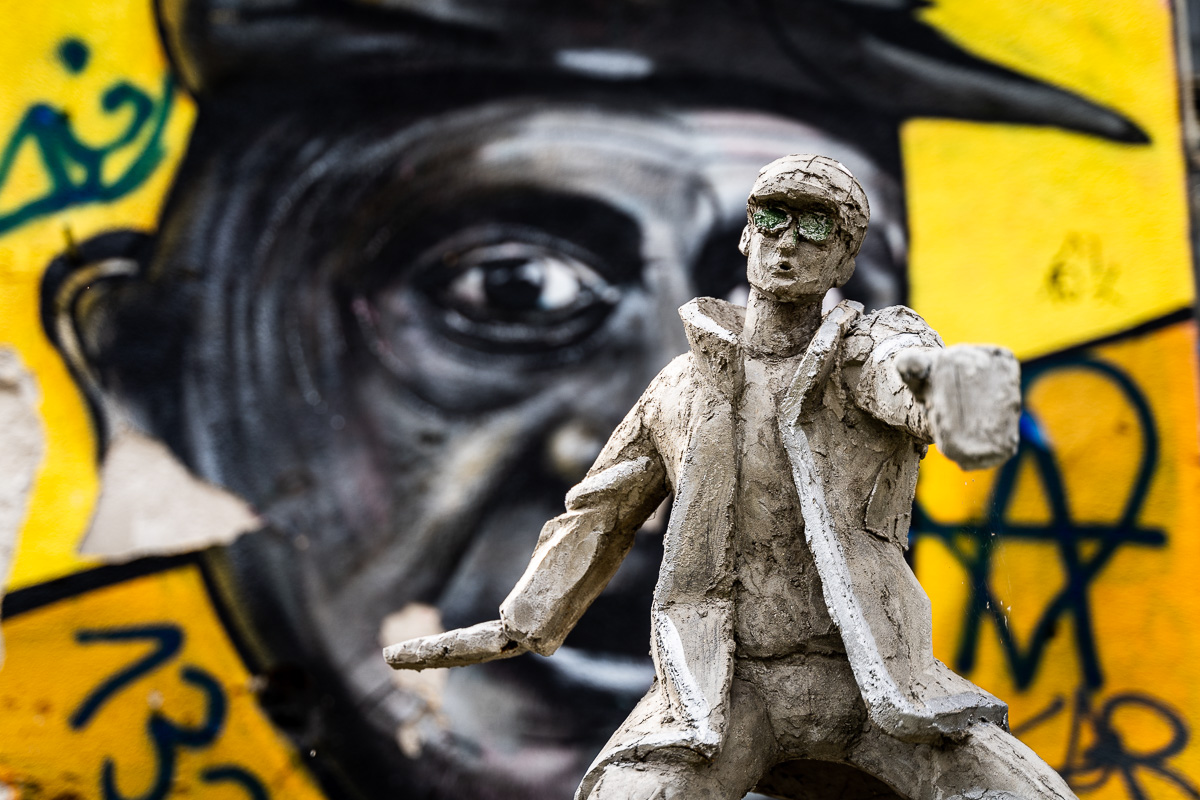
The first figure is easy to miss if I look only at the mural. It stands close to the camera while the eye behind it occupies most of the wall. That relationship gives the photograph its unease: neither face feels like a background for the other.
The shallow depth of field separates the sculpture without erasing the graffiti. I wanted the painted eye to remain legible enough to hold the composition together. This is a useful lesson throughout Metelkova. A blurred background can simplify a busy scene, but too much blur removes the very context that makes the subject belong here.
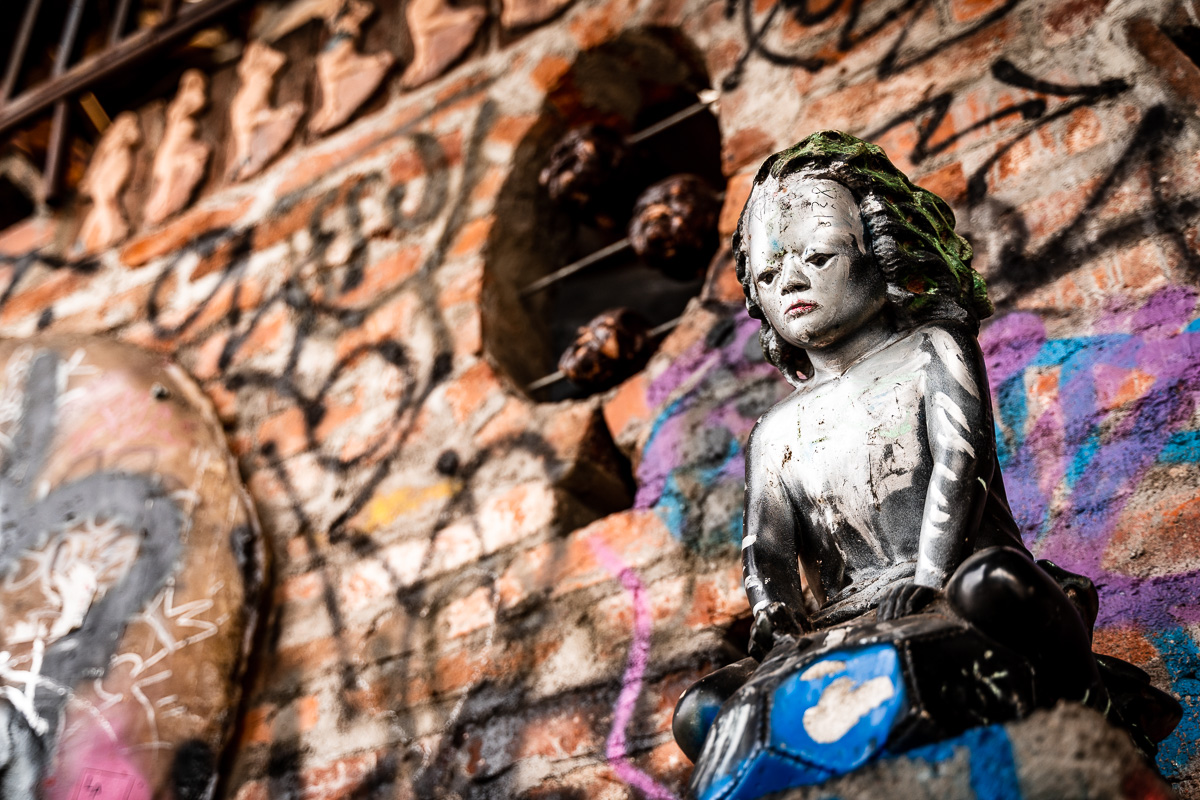
This figure feels less like a freestanding sculpture than something absorbed by the wall. Its pale surface echoes the worn mortar while the blue base supplies a small, concentrated colour contrast. I kept the brick visible because the age and texture around the figure say as much as the expression on its face.
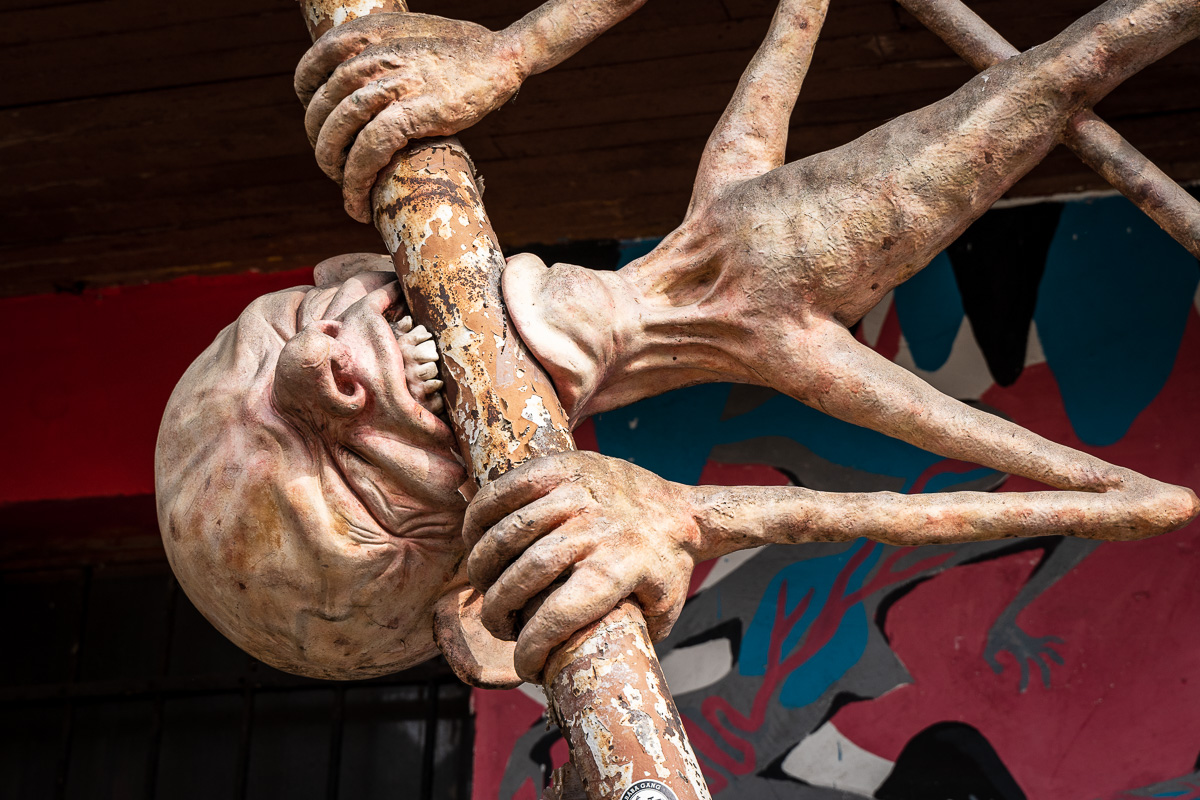
Some of Metelkova’s figures are decorative only in the broadest sense. This one looks as if it is holding the architecture together — or trying to escape from it. The tight frame removes most geographic clues. What remains is gesture, material and strain.
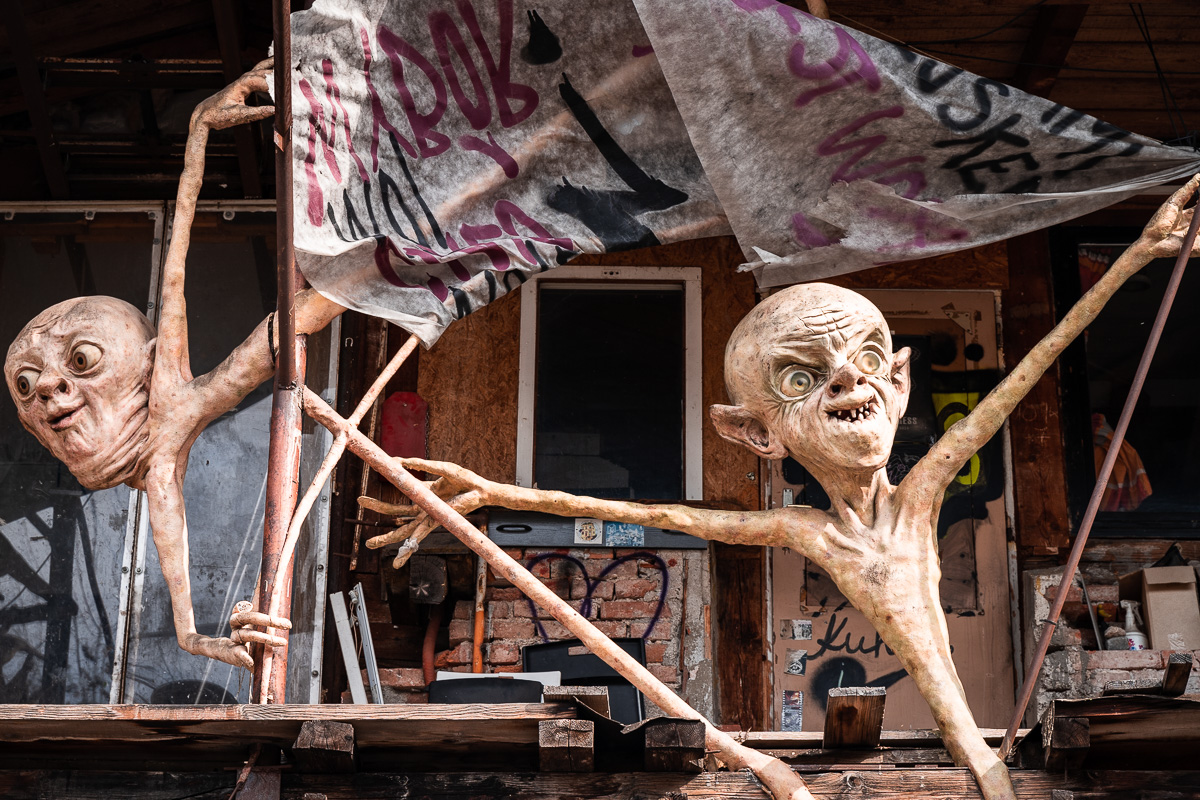
A wider view is necessary here. The two figures are part of a larger construction of timber, fabric, roofline and painted text. I like the way the horizontal beam stabilises the movement of the bodies. It is the sort of scene that can look chaotic in person but becomes ordered when the frame finds one strong line.
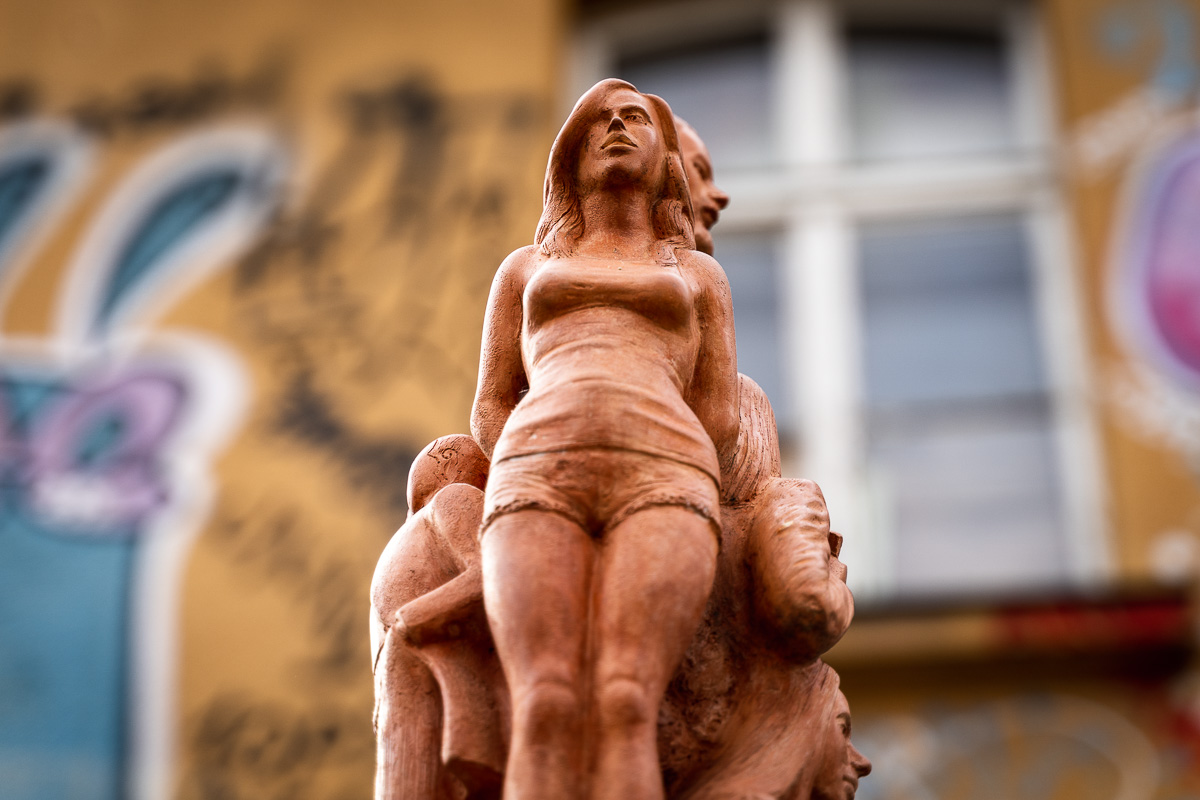
The sculpture is more conventional in form, but its setting prevents it from reading like a gallery object. Windows, walls and other painted surfaces remain just outside sharp focus. The low viewpoint gives the figure weight without pretending it is monumental.
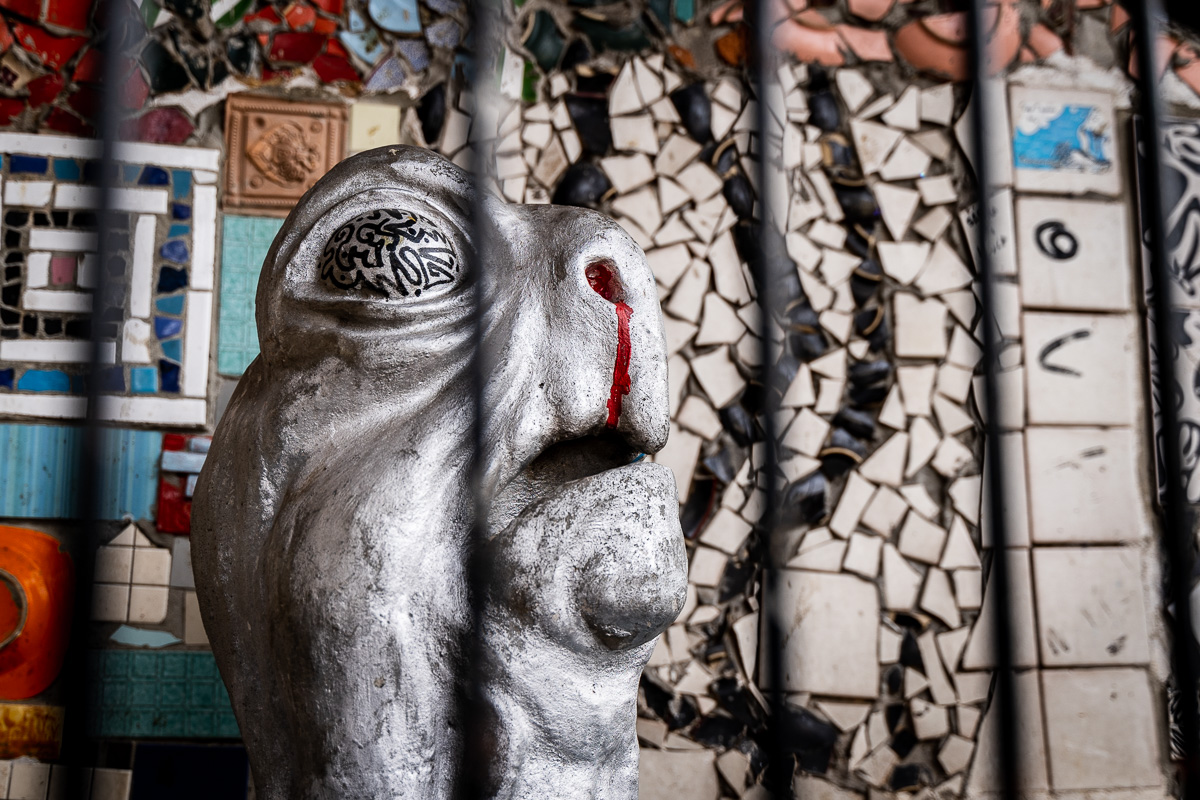
This photograph depends on obstruction. The bars are not clutter to be removed; they determine how the face is seen. The frame asks whether the figure is displayed, protected or confined, and the surrounding mosaic refuses to settle the question.
Walls that behave like collages
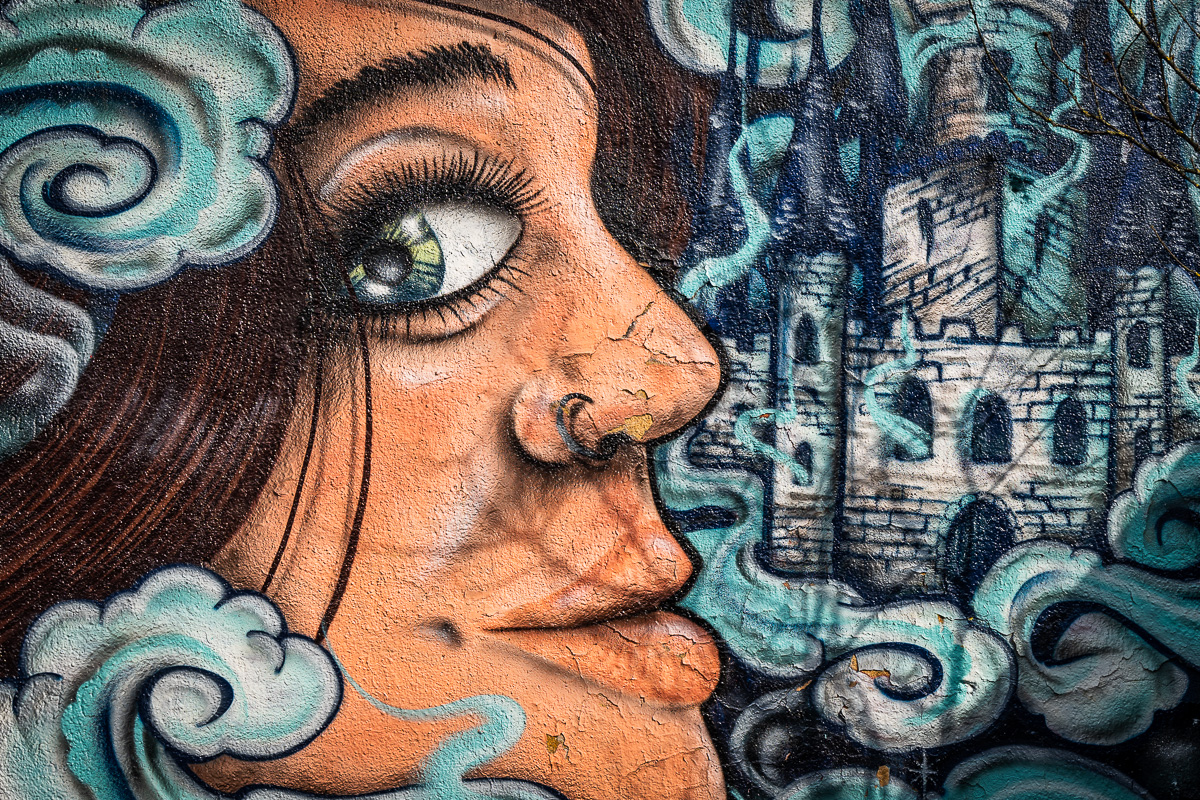
This mural is one of the cleanest compositions in the series. The eye supplies a focal point, the hair carries the gaze across the frame and the cool clouds balance the orange face. Even here, the edges matter. Older marks and the physical seams of the wall keep the image connected to Metelkova rather than letting it become a placeless illustration.
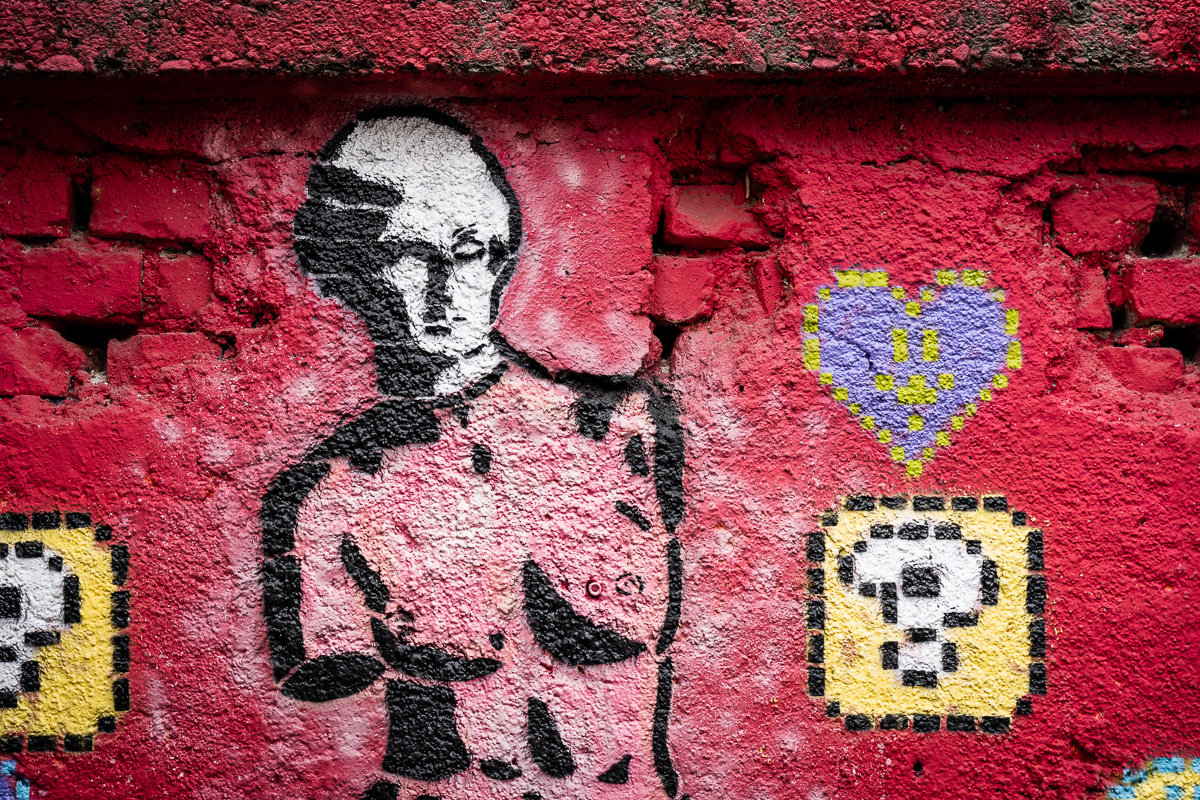
The restricted palette makes the damage and texture of the bricks more visible. Instead of trying to correct every uneven surface, I let the wall participate in the image. The small coloured heart interrupts the red field and stops the photograph from becoming entirely severe.

This is not a neutral documentation shot of a complete mural. It is a crop built from adjacent shapes. The bird pulls from the left, the pale mask holds the centre and the red pattern pushes back from the right. Metelkova rewards this kind of framing because the boundaries between individual works are often less interesting than the collisions between them.
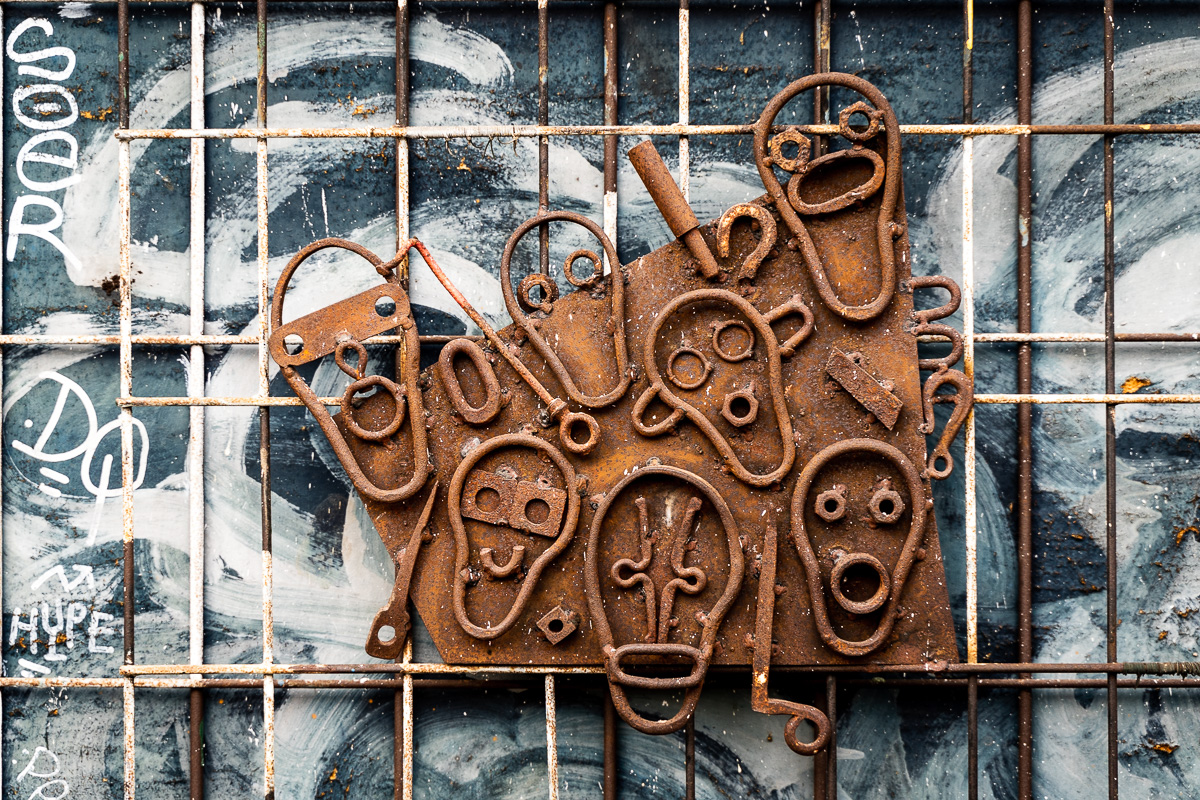
The colour is quiet here, so line becomes the subject. Rusted metal, steel grid and graffiti strokes operate at three different depths. I photographed the structure nearly straight on to keep those layers readable rather than exaggerating them with perspective.
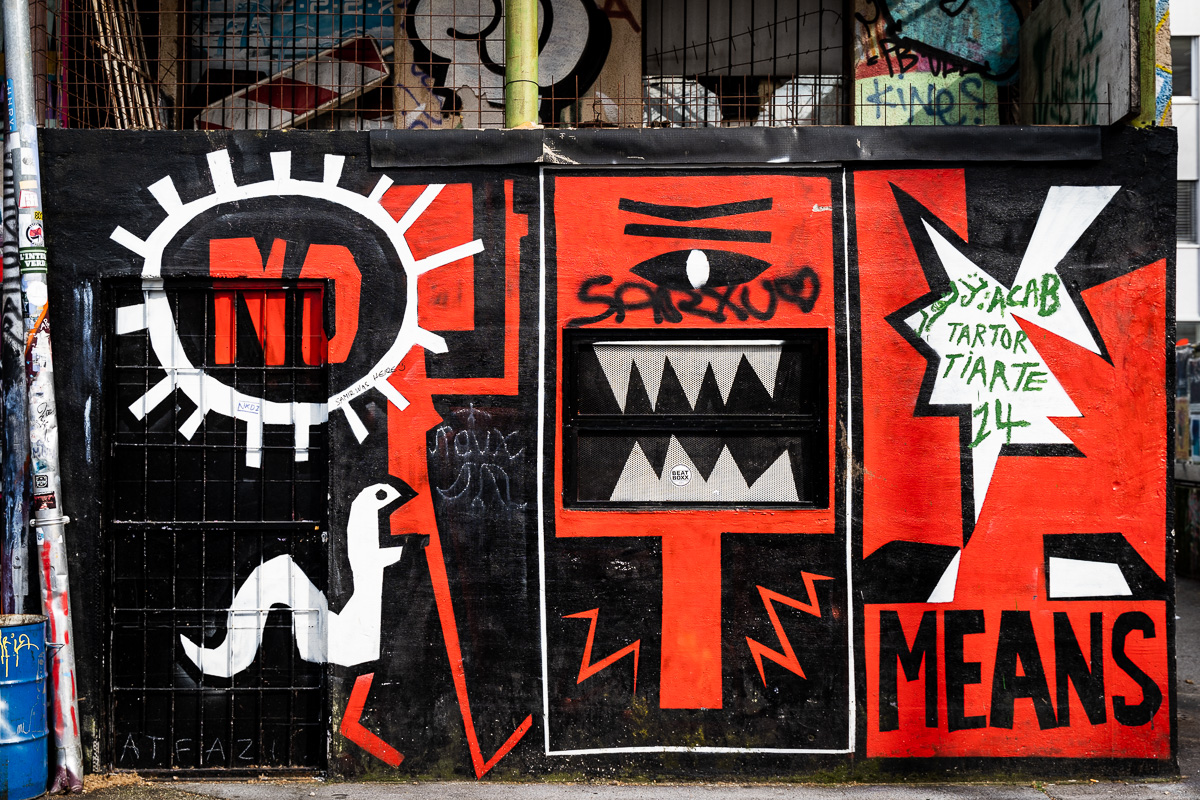
Metelkova repeatedly dissolves the line between artwork and ordinary object. A container that would normally be excluded from a photograph becomes the photograph. The wheels, lid and metal panels still identify its function, while the paint makes it impossible to dismiss as visual waste.
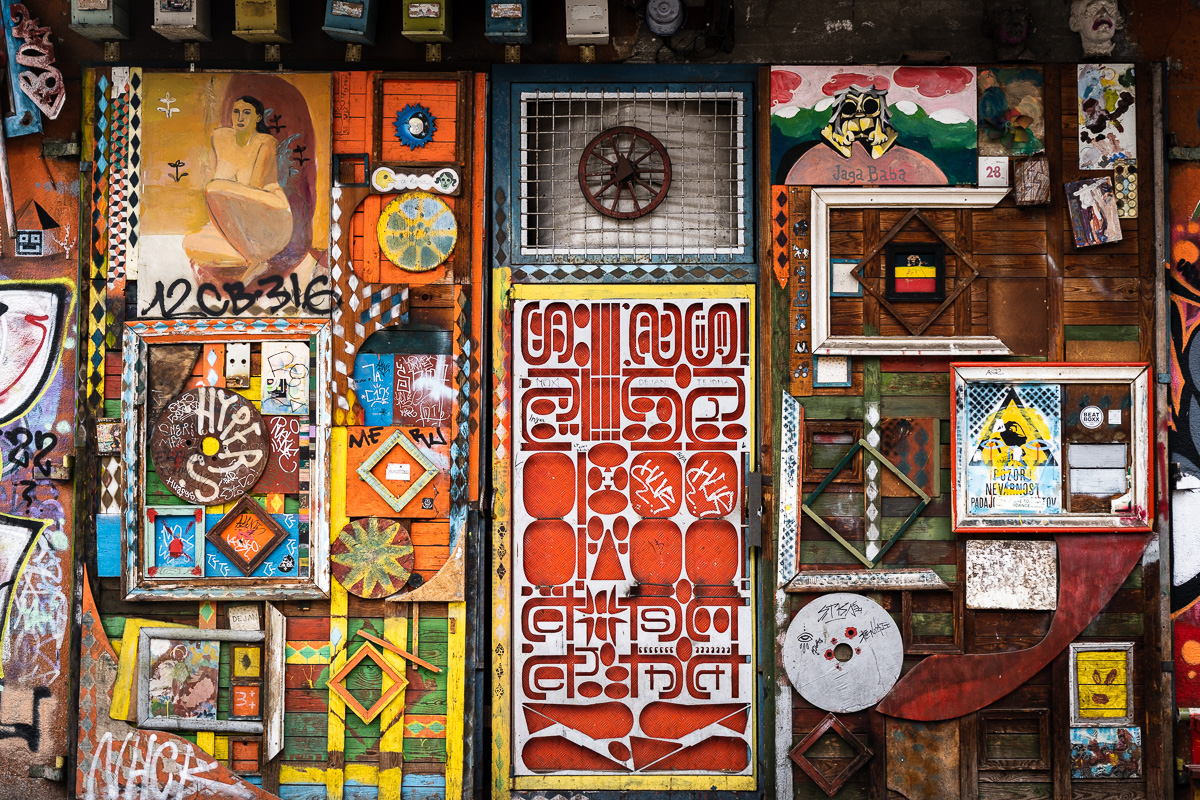
This doorway comes closest to explaining Metelkova in a single frame. It is useful architecture, image, noticeboard and archive at the same time. There is no empty area where the eye can rest, so I rely on the rectangular panels to create rhythm. The result is busy, but not random.
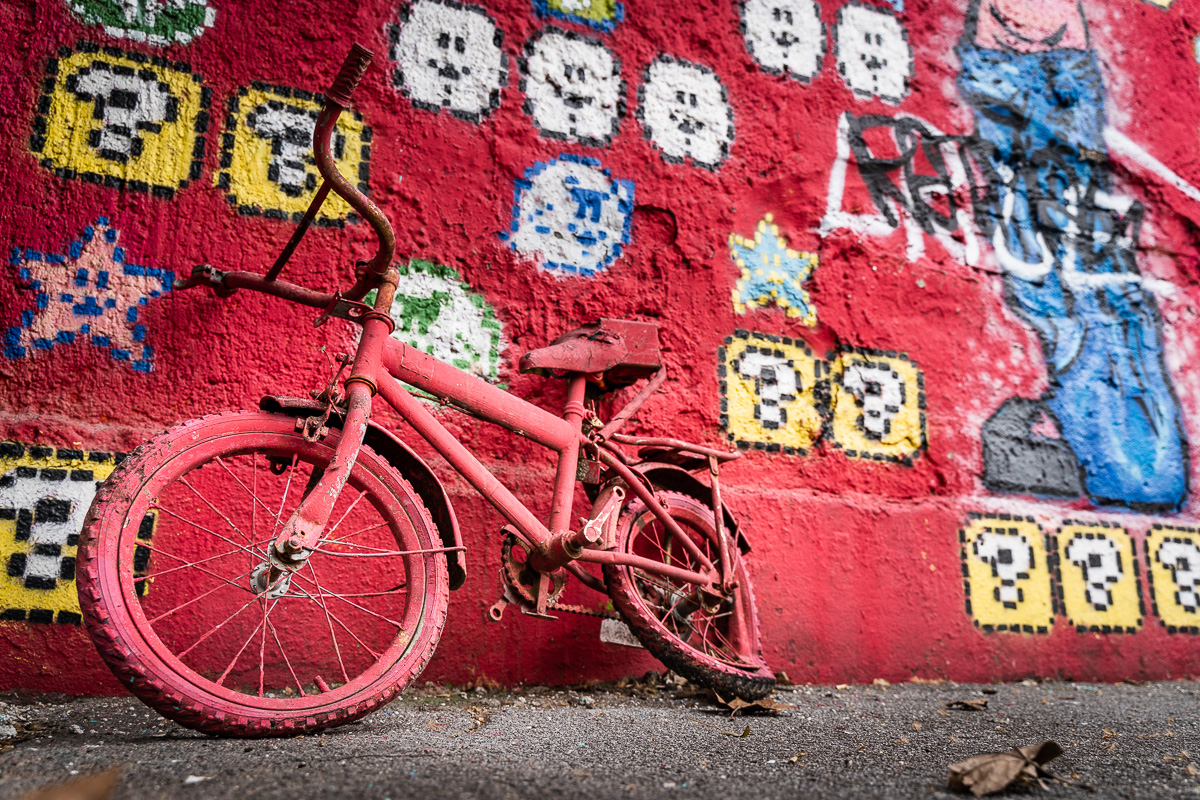
This is my favourite colour relationship in the set. The bicycle does not stand out through contrast; it survives through shape. Its wheels remain clear against the wall, while small areas of black and metal prevent it from disappearing completely. The photograph is a reminder that a subject can be found by matching it to its setting, not only by separating it.
Why Metelkova looks the way it does
The current appearance of Metelkova cannot be separated from the history of the buildings. Ljubljana Tourism describes the complex as late-19th-century Austro-Hungarian military barracks. The site later served the Yugoslav People’s Army. After the army left Slovenia, the future of the vacant complex became contested.
The Network for Metelkova brought together artists, cultural workers and intellectuals who proposed a new cultural use. In 1993, after demolition work began, around 200 volunteers occupied the northern section to prevent the buildings from being destroyed. That occupation marks the beginning of Metelkova as an autonomous cultural centre.
The familiar version of the story can sound almost effortless: barracks were abandoned, artists moved in, culture flourished. Reality was more difficult. Buildings needed repair, the status of the site was disputed, and the people working there had to create both physical spaces and organisational structures. The transformation visible today was not delivered as a finished redevelopment. It accumulated through work, conflict, improvisation and persistence.
That matters when looking at the art. The mosaics, sculptures, painted walls and welded additions are not simply a colourful skin applied to historic buildings. They are part of a long process of claiming, repairing, interpreting and using the site. Metelkova is often called an open-air gallery, but the phrase is incomplete. Galleries usually separate display from daily life. Here, art sits on doors that open, stages that operate and walls that continue to weather.
A place in constant transformation
Metelkova’s official and tourism descriptions both emphasise change. That is visible even without comparing decades of photographs. One surface may contain a carefully preserved mural beside a quick tag, a poster from an event, a repair and the remains of an older image.
I do not expect my photographs to function as a permanent map. Their value is the opposite: they hold one state of a place designed by no single hand. If you visit and cannot find the same figure or colour, the photograph has not failed. It has recorded a layer that may now sit beneath another one.
Daytime or nighttime: when should you visit Metelkova?
The best time depends on what you want from the place. A daytime walk and a night out should be treated as two different visits, even if they happen on the same day.
| Time | What to expect | Best for | What to remember |
|---|---|---|---|
| Morning | Usually quiet, with clear views of courtyards and façades | Architecture, details, low visitor numbers | It can feel inactive because most venues are closed |
| Afternoon | More movement, changing light and occasional activity | A first visit, colour, nearby museums | Strong sun can create harsh contrast on painted walls |
| Evening | The transition from visual site to social and cultural space | Atmosphere, scheduled events, meeting people | Check the programme; do not assume every venue opens nightly |
| Late night | Club and concert activity when events are scheduled | Nightlife and music | Crowds, low light and normal nightlife precautions apply |
Daylight is best for seeing the outdoor art
I prefer daylight when the photographs are the purpose. The courtyards are easier to read, colours remain distinct and I can look at small interventions without blocking an entrance in a crowd. Morning gives soft light and fewer people, but façades may sit in deep shadow. Later in the day, the changing direction of light can separate relief sculpture from the walls more clearly.
A quiet daytime visit is not evidence that Metelkova is abandoned or disappointing. Many of its clubs and performance spaces are organised around evening programmes. Daylight reveals the physical record; night reveals part of the activity that gives the record meaning.
Night is programme-led, not guaranteed entertainment
At night, I would not simply arrive expecting every door to open. Metelkova is made of independent venues with different programmes. The official AKC Metelkova Mesto calendar is the right starting point for current concerts, exhibitions, club nights and other events.
Names such as Gala Hala, Channel Zero, Klub Gromka, Menza pri koritu, Klub Tiffany and Klub Monokel appear across the site’s programme and user directory, but a name in a guide is not a promise of an event on a particular evening. Check the listing, the organiser and any ticket information on the day you plan to go.
This is especially important if music style or community focus matters to you. Metelkova is not one generic alternative club. Different spaces support different scenes, from live underground music and electronic events to queer cultural and nightlife programmes, exhibitions and community projects.
Where is Metelkova and how do you get there?
AKC Metelkova Mesto’s official visitor address is Metelkova ulica 10, 1000 Ljubljana. It sits northeast of the historic centre, close to Ljubljana’s main railway and bus stations. The adjacent museums face Metelkova and Maistrova streets, while entrances into the autonomous complex are reached around the northern part of the former barracks. You can open the exact location on a map before setting out.
Walking from Ljubljana’s historic centre
Metelkova is close enough to include in a walking day without reorganising the whole itinerary. From Prešeren Square or the Triple Bridge area, a direct walk generally takes around 15–20 minutes, depending on pace and the route chosen. From the railway station, the museum side of the complex is roughly a ten-minute walk according to the official +MSUM access information.
I would use the address or map pin rather than search only for the word Metelkova. A map can otherwise lead to one of the museums, a street address or the broader neighbourhood when the intended destination is the autonomous centre.
By bus, bicycle or car
Several city bus routes stop in the wider area. Routes and stop arrangements can change, so the Ljubljana city bus journey planner is more dependable than a permanent route list in this article.
Ljubljana is compact and cycling is practical, but I would park a bicycle where it does not obstruct a doorway, passage or artwork. The courtyards are social and working spaces, not bicycle shortcuts.
Driving is rarely the simplest choice for a central-city visit. Paid street parking and garages are available in the surrounding area, but capacity and tariffs change. If I were already staying in central Ljubljana, I would walk rather than spend the visit searching for the closest space.
How to visit Metelkova respectfully
The most useful rule is simple: remember that people work, organise, create and socialise here. A visually unusual place can tempt visitors to behave as if everything — and everyone — were part of a display. They are not.
Photograph art freely, photograph people carefully
Outdoor walls and sculptures are the natural subjects of a daytime visit. People deserve a different standard. I ask before making a close portrait or a photograph in which someone is clearly identifiable as the subject. A wide scene containing passersby is not the same as pointing a camera at someone from a few metres away.
This matters especially around doorways, studios, club entrances and community spaces. A person standing there may be working, waiting for friends or simply having a private moment in a public-looking courtyard. A telephoto lens does not remove the need for respect.
Do not move objects to improve a composition
Metelkova’s visual environment includes found objects, furniture, signs, bicycles, containers and temporary installations. Their status may not be obvious to a visitor. I do not move them, climb on them or ask someone else to hold them simply because the frame would look cleaner.
The same restraint applies to walls and sculptures. Touching textured work, leaning equipment against it or climbing for a higher viewpoint can cause damage. A photograph is not more important than the work it records.
Keep entrances and working areas clear
A doorway covered in art is still a doorway. Tripods, bags and groups can block access quickly. I make the frame, step aside and reassess from a place where people can pass. If a sign, barrier or member of staff says an area is private or closed, I treat that as the end of the question.
Support the programme if you use the place as a subject
Photography costs nothing during an ordinary outdoor visit, but Metelkova survives through activity, not through being looked at. If a current exhibition, concert, discussion or benefit event genuinely interests me, attending it is a more meaningful engagement than collecting a few bright backgrounds and leaving.
Is Metelkova safe?
No responsible guide can promise that a nightlife area is risk-free, and alarmist descriptions are not useful either. During the day, Metelkova is often quiet and many visitors walk through to see the art. At night, the environment changes with events, crowds, alcohol and the late hour — ordinary factors in any urban nightlife district.
I would use the same precautions I use elsewhere in a city at night: stay aware of belongings, do not leave a drink unattended, keep a charged phone, know the walking route back, and arrange a taxi if I do not want to return alone. If a situation feels uncomfortable, I leave rather than trying to prove that a guidebook called the area safe.
The appearance of old barracks, dense graffiti and improvised structures can make some first-time visitors feel uncertain. Appearance alone is not evidence of danger. At the same time, cultural openness does not suspend boundaries. Respect venue staff, local users, signs and any request not to photograph.
Families may find a daytime visit visually interesting, especially when combined with the museums across the street. Late-night club activity is a different environment and should be judged by the specific event, age policy and family preferences.
My photography guide to Metelkova
Metelkova is generous to a camera, but it is also easy to photograph as a mass of colour with no clear subject. The strongest images usually depend on one decision: which relationship in the scene matters most?
Start with one subject, then add context
I begin with a face, figure, door, bicycle or strong colour block. Only after choosing that anchor do I decide how much of the surrounding wall to include. This keeps visual density from becoming confusion.
The clay figure with the painted eye is a good example. The sculpture is the near subject, but the eye explains the setting. If I cropped too tightly, the figure would lose its strange scale. If I widened too far, both faces would compete with unrelated marks.
Use a normal or short telephoto lens for details
A moderate focal length makes it easier to isolate relationships without flattening the scene completely. On a full-frame camera, roughly 35–85 mm covers many of the photographs I would want here: wide enough for a doorway, long enough for a figure against a mural.
An ultra-wide lens can be useful for a whole courtyard or building, but it exaggerates the edges and often includes bright sky, parked objects and unrelated walls. I use it only when the architecture — not merely the amount of content — is the subject.
Keep enough depth of field for layered art
Bokeh is tempting in a place full of portraits and small sculptures. I use it selectively. At Metelkova, the background often carries essential information. An aperture such as f/5.6 or f/8 can keep two adjacent layers readable while still separating the closest object. For a flat mural or door, stopping down also helps preserve detail from edge to edge.
For a deeper explanation of that choice, see my guide to bokeh in photography. The important point here is not to chase the softest possible background. It is to choose how much context the photograph needs.
Watch the highlights and colour casts
Painted façades create difficult exposure. A pale sculpture may sit in sun while the wall behind it falls into shadow. Bright red and blue paint can clip in individual colour channels even when the overall histogram looks acceptable.
I expose for the important highlight, check the red channel when saturated paint dominates, and recover shadow carefully later. Deep shade can also turn blue, especially when open sky reflects into a courtyard. Some coolness belongs to the scene; removing it completely can make the image look disconnected from the light.
Photograph transitions, not only complete works
Many visitors stand squarely in front of the largest mural and try to include all of it. I often find more interesting photographs at the boundary: paint meeting a window, sculpture crossing a roofline, a bicycle matching a wall, a door holding years of smaller additions.
These transitions describe Metelkova as a place rather than reproducing an artwork as a flat document. They also help avoid the weak photograph in which a complete mural floats without scale or architectural context.
I use the same approach in my broader collection of street photography ideas: begin with a visual problem — a repetition, interruption, reflection or colour relationship — rather than walking around waiting for a spectacular subject to announce itself.
Return in different light
My gallery was made in daylight because I wanted texture and colour. Evening would produce a different body of work: artificial light, silhouettes, movement, queues, smoke and the relationship between people and venues. Those are valid subjects, but they require higher ISO, faster lenses and more care around consent.
I would not use flash indiscriminately at an event or point a bright light into people’s faces. Individual venues may also set their own photography rules. For organised performances, check before bringing professional-looking equipment.
Tripods and equipment
The outdoor courtyards are compact. A tripod can become an obstacle even when there are few people. I use one only when the light genuinely demands it, keep the legs close and move immediately if access is affected. For a normal daytime visit, image stabilisation and a slightly higher ISO are usually simpler.
I also travel light. One camera and a normal zoom or small prime make it easier to respond to detail without turning the visit into a production. Metelkova rewards attention more than equipment.
How I edited one of my Metelkova photographs
The old version of this article began with my Lightroom edit of a Metelkova graffiti photograph. The video still belongs here, but not as a detour before the reader knows what Metelkova is. It is more useful after the gallery, where the relationship between the original scene and the editing choices is clear.
My intention with the series was not to make Metelkova look cleaner or more saturated than it was. I wanted the photographs to retain surface detail, weathering and the slightly complicated colour relationships created by shade, paint and mixed materials.
That usually means protecting highlights, correcting perspective only when the architecture feels accidentally tilted, and resisting global saturation. Selective adjustments are more useful: a little texture on metal, controlled luminance in red paint, and enough shadow detail to reveal the wall without making every dark area equally bright.
Editing should not resolve all the visual tension. Metelkova is layered. If every surface becomes perfectly separated and uniformly vivid, the photograph may be technically clear but emotionally false.
What happens at Metelkova?
The answer changes with the calendar. The centre supports concerts, club nights, DJ sets, exhibitions, performances, discussions and community activity. Some events are international, others highly local. Some are public-facing; some spaces work more like studios, organisations or meeting points.
The official Metelkova programme is therefore part of planning, not an optional extra. I check it for the exact date, start time, venue, ticket information and organiser. Social posts can help confirm late changes, but the event or venue page should remain the main reference.
Clubs and concert spaces
The centre’s directory and programme include several long-running names. Gala Hala, Channel Zero, Klub Gromka and Menza pri koritu are associated with concerts and club culture in different forms. Klub Tiffany and Klub Monokel are important queer cultural and nightlife spaces. Other organisations, galleries and project spaces add exhibitions, workshops, archives and social programmes.
Listing them together should not suggest that they offer the same music, audience or politics. I choose by event rather than by the general reputation of Metelkova. That is the difference between visiting a cultural centre and merely visiting a location.
Street art is part of the experience, not the whole programme
The outdoor work is what a daytime visitor sees most easily, and it is what my photographs record. But reducing Metelkova to graffiti removes the people and organisations that keep it active. Its visual identity grew around use. The concert room behind a decorated door matters as much as the decoration on the door.
This does not make a short art-focused visit illegitimate. It simply changes the language I use. I can admire and photograph the surfaces while recognising that I have seen only one part of the place.
The museums beside Metelkova
The neighbouring museums make it possible to build a full cultural day around the area. They are especially useful in poor weather or when the autonomous complex is quiet.
| Institution | Focus | Practical note |
|---|---|---|
| Museum of Contemporary Art Metelkova (+MSUM) | Slovenian and international contemporary art, including the Arteast 2000+ collection and changing exhibitions | Check the official site for current exhibitions, hours and admission |
| Slovene Ethnographic Museum | Slovenian ways of life and cultural heritage, alongside collections and exhibitions concerning world cultures | Located at Metelkova 2; publishes separate family, group and accessibility information |
| National Museum of Slovenia — Metelkova | Applied art, design and craft heritage, with a large study collection | Entrance is on Maistrova ulica; check the museum’s current programme |
Museum of Contemporary Art Metelkova
+MSUM is the most obvious companion to an art-focused visit. Its programme places contemporary works in a formal museum context just across from the autonomous centre. Seeing both on the same day makes the contrast productive rather than confusing: institution and autonomy, conserved collection and changing outdoor surface, white gallery and occupied barracks.
The museum publishes current opening hours, ticket prices, access information and temporary exhibitions on its official visitor page. I would check it directly because seasonal Thursday hours, holidays and individual exhibitions can change.
Slovene Ethnographic Museum
The Slovene Ethnographic Museum broadens the day beyond contemporary visual culture. Its collections address everyday life, traditions, identities and cultural practices in Slovenia and elsewhere. It is a good counterweight to a visit dominated by façades and nightlife.
National Museum of Slovenia — Metelkova
The National Museum’s Metelkova venue focuses on applied art and includes objects spanning centuries of craft, decorative art and design. That emphasis creates another useful link to the autonomous complex: both places ask how objects carry cultural meaning, though their methods of display are entirely different.
A practical half-day and evening plan
Metelkova does not need a rigid itinerary, but timing the quiet and active sides of the area can prevent a disappointing mismatch.
Option 1: art and museums during the day
- Arrive in the morning or early afternoon and walk through the outdoor courtyards slowly.
- Photograph broad context first, then return to the doors, figures and small surface details that caught your attention.
- Visit +MSUM, the Ethnographic Museum or the National Museum according to the current exhibition programme.
- Continue on foot toward Tabor, the railway station area or Ljubljana’s historic centre.
This version works even when no event is scheduled. I would allow one hour outdoors if photography matters, plus at least 60–90 minutes for one museum.
Option 2: daylight details followed by an event
- Visit before sunset to see the walls and understand the layout.
- Leave for dinner rather than waiting in a quiet courtyard for hours.
- Return for a specific concert, exhibition or club night listed in the official programme.
- Confirm the final entrance policy, ticket and start time before returning.
This is the most complete way to experience the contrast, but it depends on the calendar. The gap between daytime and nightlife is not a problem to solve; it is simply how the place works.
Accessibility and practical limitations
The public space around Metelkova includes uneven ground, thresholds, older buildings, temporary objects and entrances with different levels of adaptation. I would not describe the entire autonomous complex as step-free. Accessibility depends on the specific venue and event, so anyone who needs confirmed access should contact the organiser directly.
The adjacent museums publish more detailed accessibility information. +MSUM states that its main entrance is suitable for wheelchair users and visitors with strollers and that floors are served by a lift. The Slovene Ethnographic Museum lists disabled access and other visitor aids. Those details apply to the institutions, not automatically to every part of AKC Metelkova Mesto.
Public toilets, cloakrooms and card payment should also be checked venue by venue. A courtyard is not a central facility, and an evening event may operate differently from a daytime museum visit.
Frequently asked questions about Metelkova Ljubljana
Is Metelkova worth visiting?
Yes, if you are interested in alternative culture, street art, adaptive reuse, independent music or urban photography. A daytime visitor should expect an evolving working complex, not a polished attraction. At night, choose a specific event rather than relying on the name alone.
Is Metelkova free?
Walking through the outdoor courtyards does not have a general admission gate. Individual concerts, club nights, exhibitions or other events may charge admission. The museums beside the autonomous centre have their own ticket policies.
What is the best time to visit Metelkova?
For street art and photography, I would choose morning or late afternoon. For nightlife, check the official programme and arrive for a named event. The most complete visit combines daylight observation with a scheduled evening return.
How long do you need at Metelkova?
A quick walk can take 20–30 minutes. I would allow 45–60 minutes for the outdoor art and longer if I am photographing carefully. Add at least another hour for one museum and a separate block of time for an evening event.
Can you take photographs at Metelkova?
Outdoor art and architecture are commonly photographed, but that does not turn people, interiors or private workspaces into unrestricted subjects. Ask before making close portraits, respect signs and venue rules, keep entrances clear and avoid flash during events unless permission is explicit.
Is Metelkova suitable for children?
A daytime walk can be interesting for families, especially with a museum visit across the street. Some artworks may be unsettling or adult in theme, and the ground can be uneven. Late-night concerts and club activity should be assessed according to the specific event and age policy.
Is Metelkova the same as Christiania in Copenhagen?
Comparisons are common because both places involve autonomy, alternative culture and contested urban space. They are not interchangeable. Their scale, history, governance, local politics and visitor experience differ. Metelkova should be understood through Ljubljana and its own organisations, not as a smaller copy of another European site.
Does Metelkova have opening hours?
There is no single opening time for the entire autonomous centre. The outdoor passage and individual organisations do not operate as one attraction. Clubs, galleries and events publish their own schedules. The neighbouring museums also maintain separate hours.
Can I visit Metelkova if there is no event?
Yes. The outdoor art, architecture and courtyards can still make a daytime visit worthwhile. Just expect quiet spaces and closed venue doors. If the cultural programme is the main reason for going, choose a date from the official calendar.
Final thoughts
The easiest way to misunderstand Metelkova is to demand one identity from it. It is neither only a nightlife district nor only a graffiti backdrop. It is a former military complex, an occupied cultural space, a network of independent venues, a workplace, a meeting point and a changing field of art.
My photographs hold the part that first drew me in: the close relationships between figures, walls and ordinary objects. A red bicycle is almost swallowed by paint. A sculpted head looks through bars. A door becomes an archive of small decisions. None of these images explains the entire place, but together they show why a clean overview would be the wrong ambition.
I return because Metelkova never seems finished. That does not mean it is waiting for a visitor to complete it. It means the place continues through the people who use it. The best visit begins with curiosity, but it should end with the recognition that this is not simply scenery. Look closely, check what is happening, support the work that interests you, and leave the space as you found it.