
The Empire State Building changes more than its familiar outline suggests. From across the river, it is a clean vertical marker above Midtown. From a nearby avenue, its upper floors disappear between façades and traffic lights. Seen from another observation deck, the setbacks become legible. At sunset, the pale limestone turns warm; after dark, the crown can carry an entirely different colour.
That variety is the reason to begin with photographs rather than facts. Someone searching for photos of the Empire State Building primarily wants to see the building: wide and close, in colour and black and white, isolated and surrounded by the city. The nine photographs on this page come first. After the gallery, I have added the context that makes them useful — where similar viewpoints can be found, how distance changes the composition, which light suits the façade, current camera restrictions and what to expect if you visit the observatory.
I first approached this building through photographs, films and research rather than through a set of field notes from a documented visit. I will not turn researched guidance into a story about standing somewhere I have not claimed to stand, and these are not my photographs. What I can offer honestly is the way I read these images as a photographer: what gives each frame its structure, what weakens it and how the same landmark can produce photographs that do not all look alike.
Empire State Building photos at a glance
| Photograph | View | What gives it character |
|---|---|---|
| Opening image | Distant skyline at warm hour | Clear separation between the tower and lower Midtown buildings |
| Vertical portrait | Elevated, relatively close view | The complete Art Deco silhouette and warm light on the façade |
| Wide Midtown panorama | High viewpoint at sunset | The Empire State Building as one element in a dense city |
| Avenue view | Street level | Traffic, façades and a yellow taxi create New York context |
| Black-and-white portrait | Elevated skyline view | Shape, tonal contrast and architectural age rather than colour |
| Golden-hour cityscape | Distant view from the south | Warm façades and repeated layers of rooftops |
| Distant neighbourhood view | Lower, longer-lens perspective | The tower’s crown remains visible above foreground buildings |
| Top of the Rock composition | Elevated north-facing viewpoint | Observation binoculars give the frame a human foreground |
| Window-framed view | Interior silhouette | A dark architectural frame concentrates attention on the tower |
A closer look at the nine photographs
The images fall into three useful groups: skyline photographs that explain scale, street photographs that explain place and framed photographs that turn the building into a graphic symbol. The strongest gallery needs all three. Nine similar telephoto views might be technically polished, but they would reveal less about the Empire State Building than a smaller set built from genuinely different distances.
The opening skyline: space around the landmark
The hero photograph works because the Empire State Building is not forced to fill the frame. The lower skyline forms a broad base, the tower rises clearly from it and warm light separates its limestone surface from the cooler sky. The city is dense, yet the composition remains readable.
This is the advantage of distance. Up close, the building is so large that the camera must look sharply upward. Farther away, the photographer can keep the verticals straighter and show why the tower matters to the skyline. The building becomes both a subject and a measure of everything around it.
A vertical portrait of the complete silhouette
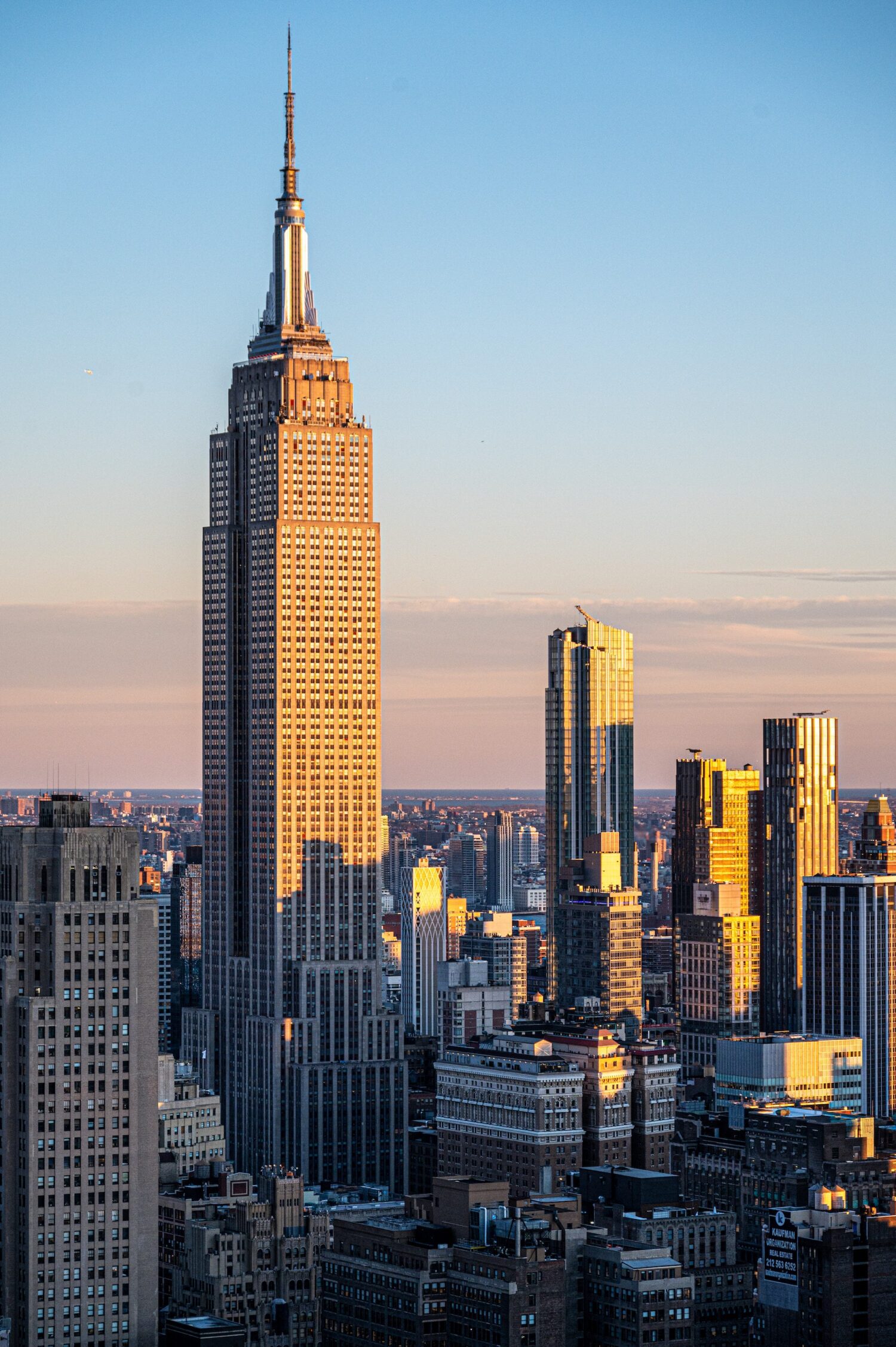
This photograph gives the building the treatment of a formal portrait. The tower is centred, nearly complete and clearly separated from the background. Warm light travels across one face while the opposite side retains enough shadow to describe volume.
The vertical crop is important. A horizontal frame would need more skyline on either side and would reduce the tower’s apparent height. Here, the narrow proportion follows the building’s upward movement. It is the most direct photograph in the collection: less about New York as a whole, more about the architecture itself.
Midtown as a field of buildings
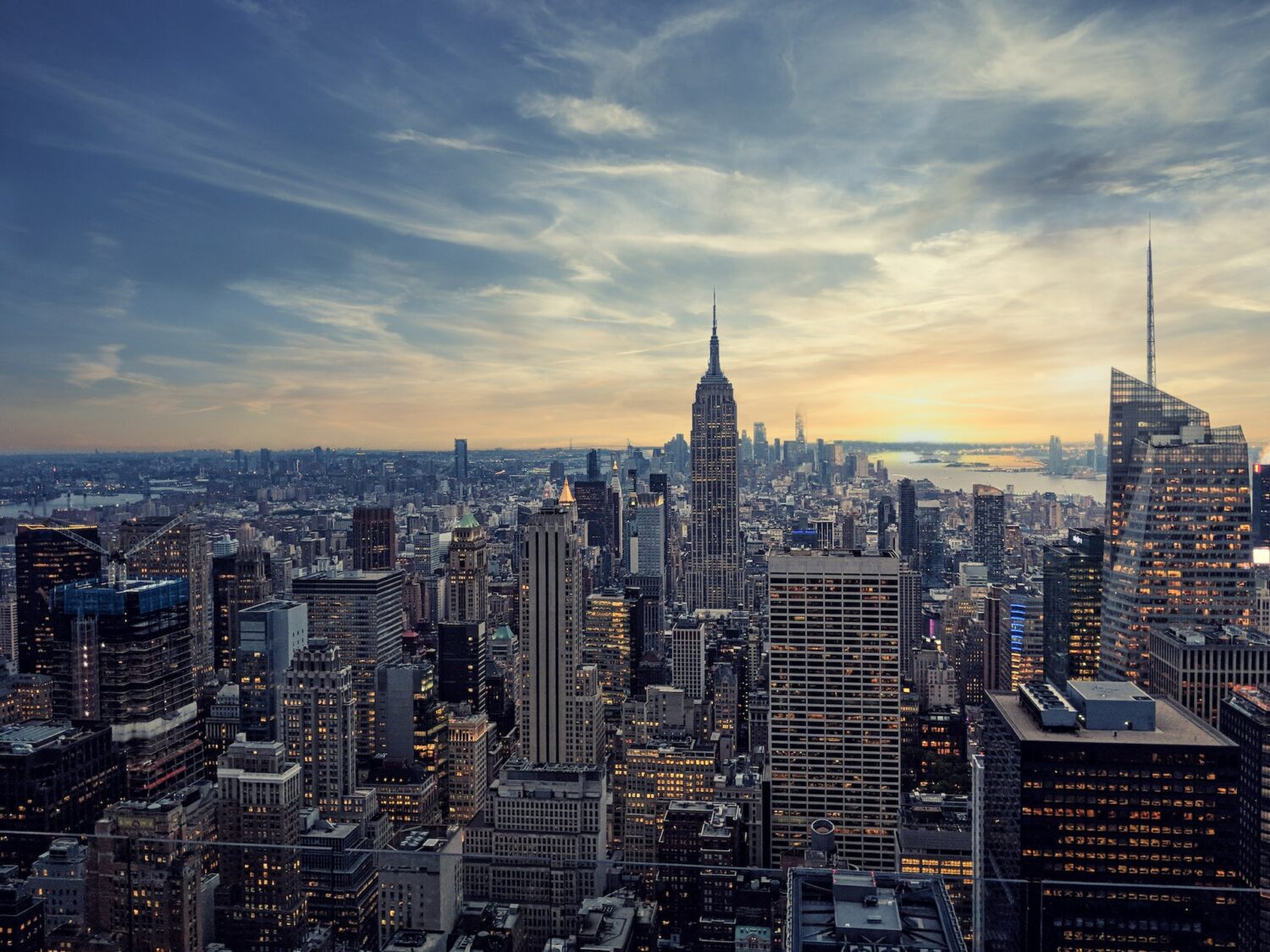
The wide panorama makes a different argument. The Empire State Building remains the visual anchor, but it has to share the frame with the entire texture of Midtown: rooftop water tanks, glass towers, long avenues and shadows collecting between blocks.
I like this kind of photograph because it avoids turning a city into a collection of isolated monuments. The Empire State Building is famous partly because of its position within New York. Its setbacks and stone façade become more distinct when placed beside later glass construction, while its height becomes understandable only when the surrounding blocks are visible.
At street level, context becomes the subject
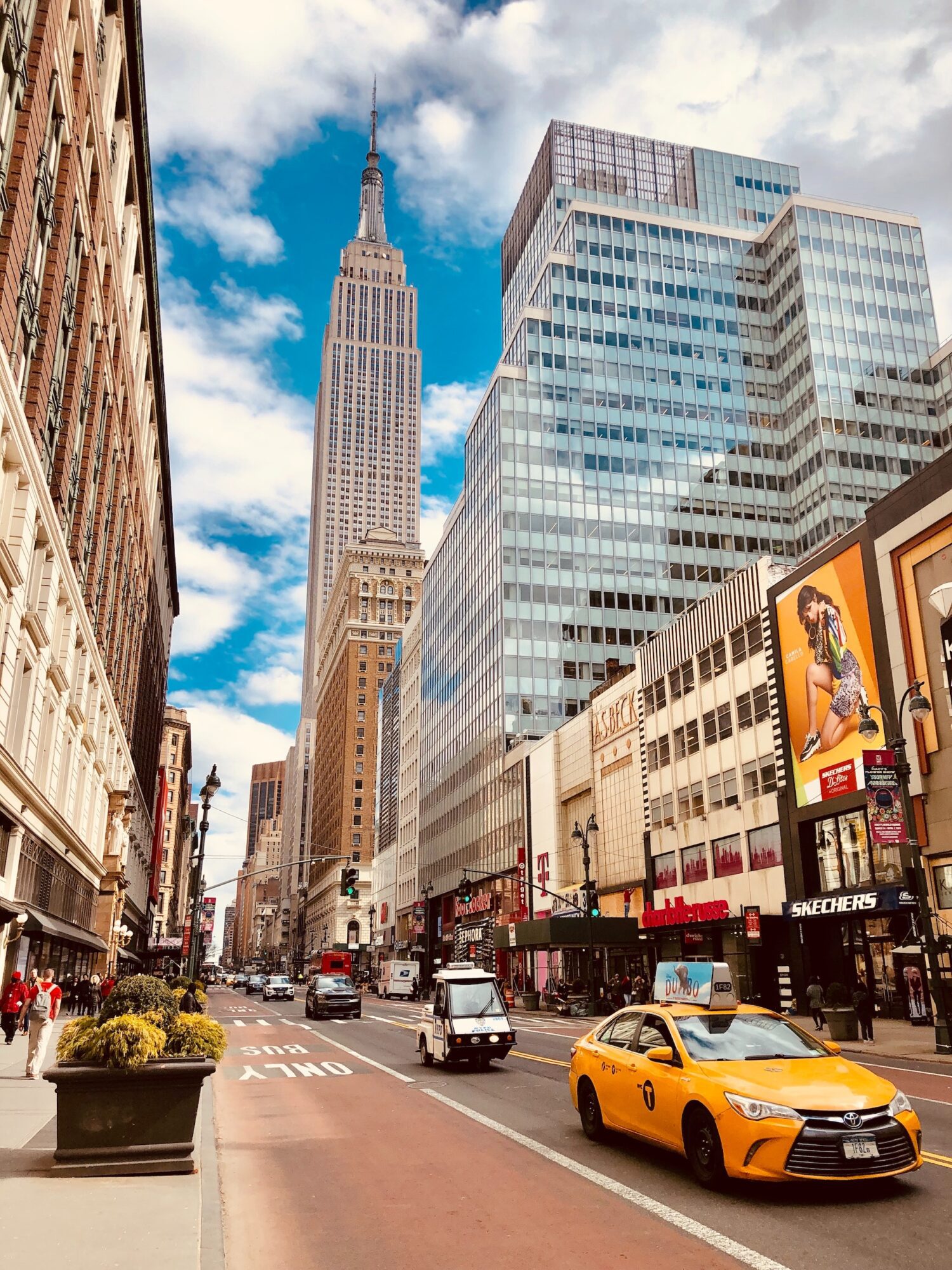
The building is partly obscured, and that is precisely what makes the image convincing. At street level in Manhattan, famous architecture rarely presents itself against an empty sky. It appears between delivery trucks, traffic lights, shopfronts, scaffolding and other buildings.
The yellow taxi supplies immediate local recognition without needing a caption. The street forms a leading line toward the tower, while the vertical frame allows the eye to travel from road surface to spire. This is not the cleanest architectural record in the gallery, but it may be the strongest description of place.
Black and white turns the tower into shape
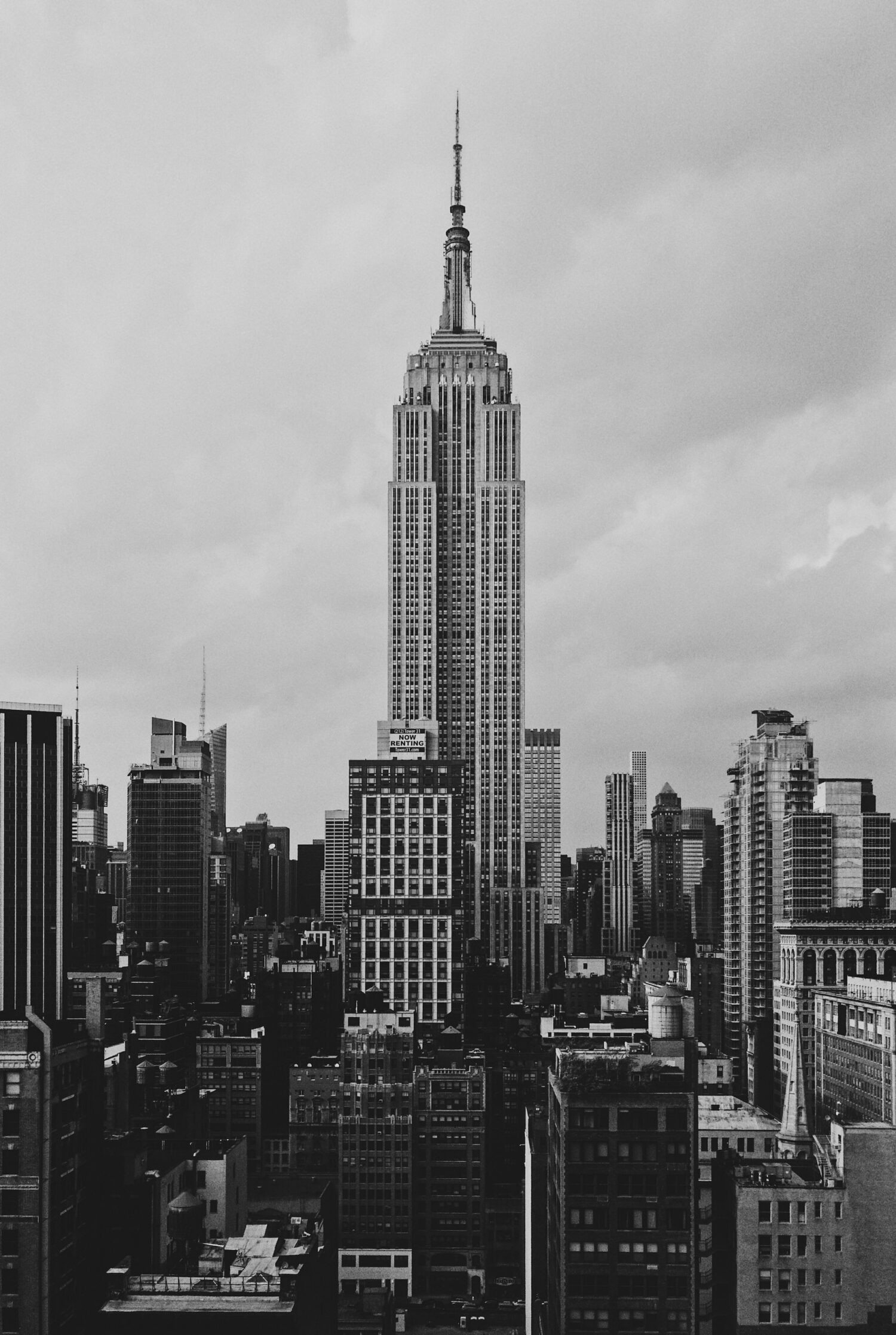
Black and white suits the Empire State Building because the building already belongs to the visual language of early twentieth-century New York. The treatment does not automatically make an image historical, and it should not be used to disguise weak light. Here it works because the architecture has enough tonal structure: pale stone, rows of dark windows, a grey sky and darker foreground towers.
A restrained conversion is more convincing than artificial “vintage” effects. The aim is not to imitate a damaged print but to reveal shape. The tower’s symmetry and setbacks become clearer when colour no longer competes for attention.
Golden hour makes the limestone warmer
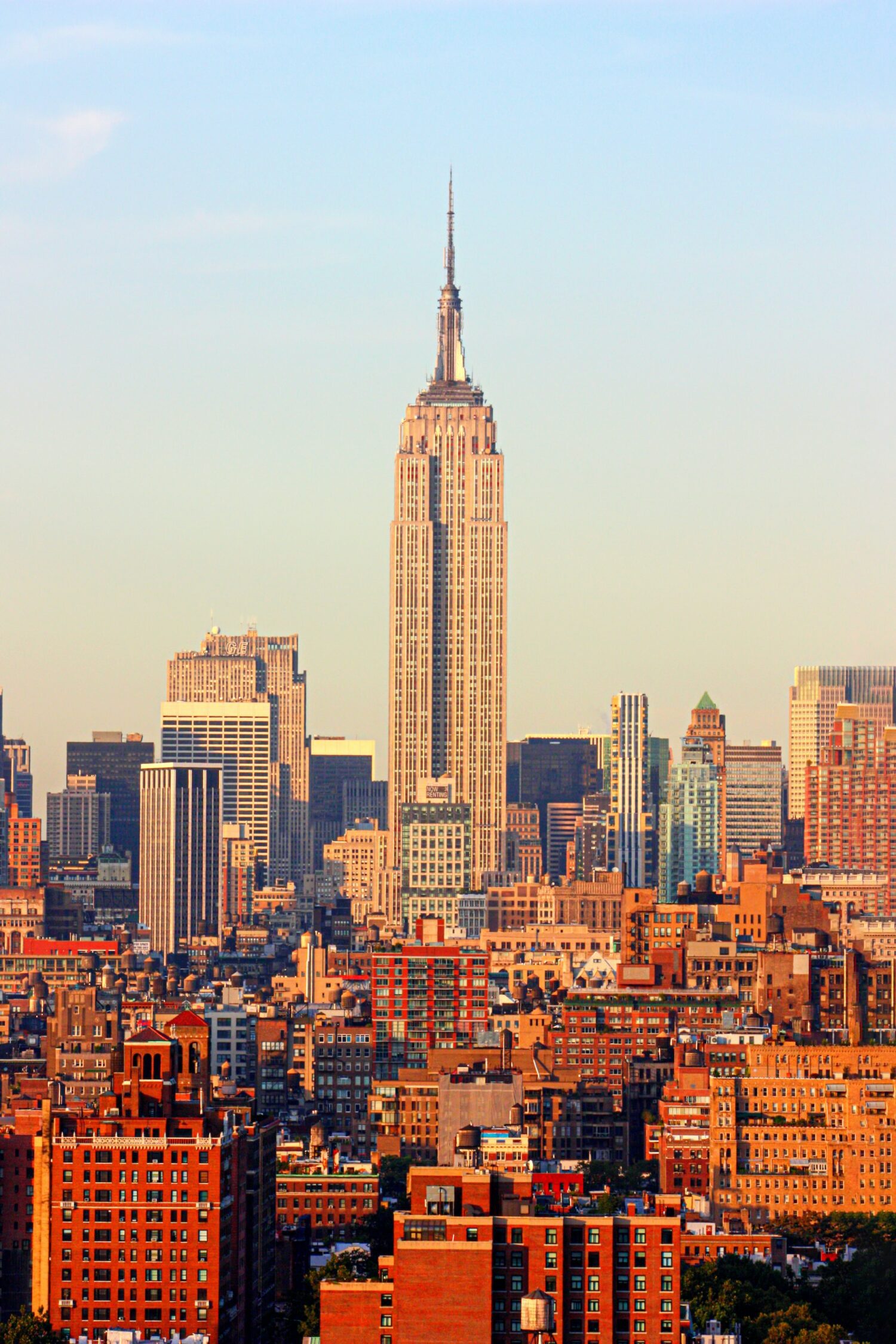
The Empire State Building is often described as grey, but its limestone and granite façade is highly responsive to colour temperature. In low sun it can shift toward pale gold or pink; under cloud it becomes cooler and flatter. This photograph uses the warmer version.
The foreground is as important as the tower. Repeated rooftops create layers leading to the subject, while the narrow frame concentrates those layers. A long lens would compress this distance, making the city appear denser and the Empire State Building larger relative to its surroundings.
A distant view leaves room for weather
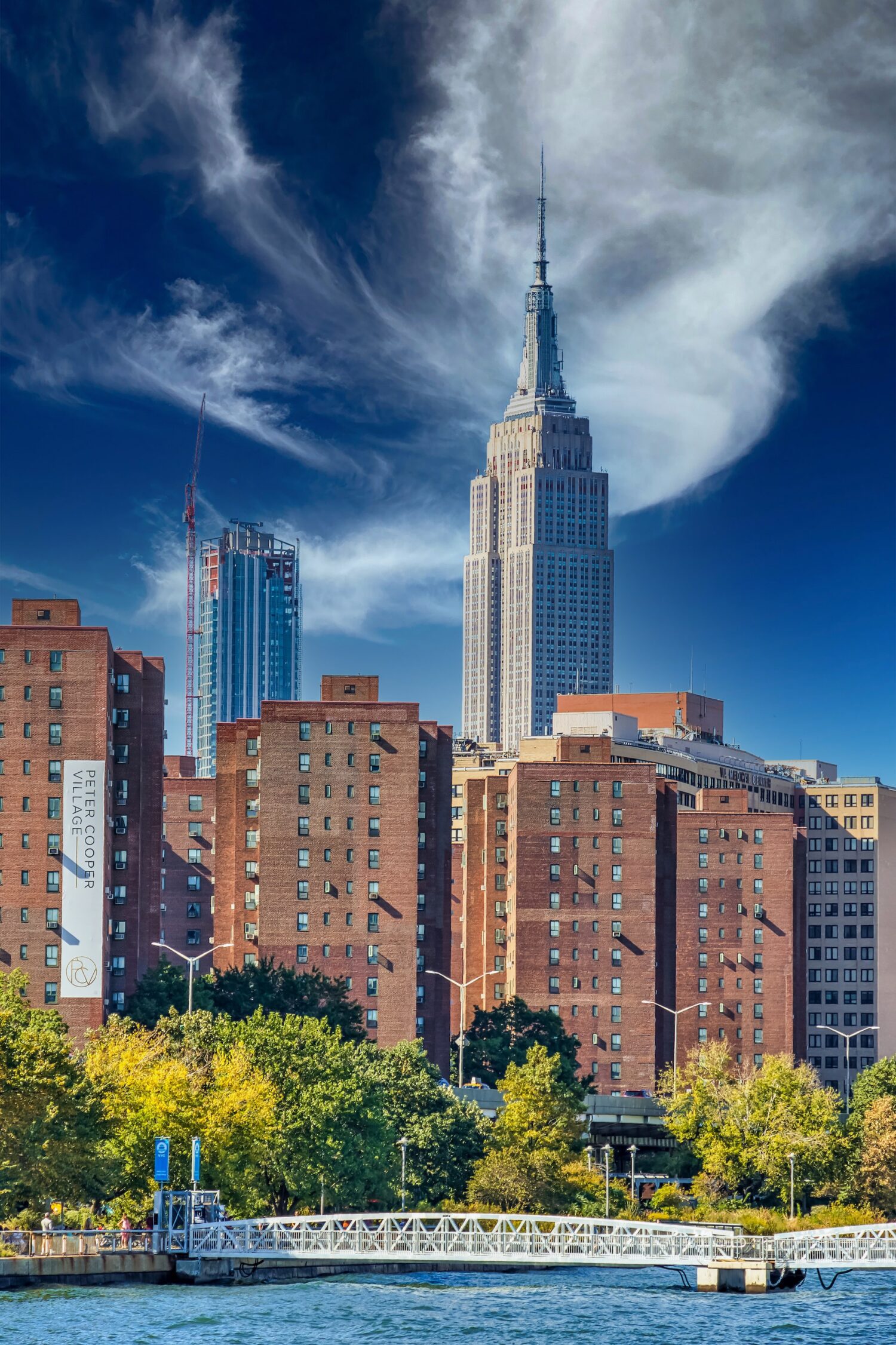
The tower occupies less of the frame here, but its crown remains unmistakable. The sky carries much of the drama. That balance is useful when weather is more interesting than the façade itself: the building becomes a stable vertical form against moving cloud.
This image also shows why a telephoto lens is not only for details. From a distant park or waterfront, a moderate telephoto lens can enlarge the tower while preserving foreground layers. The effect is different from an ultra-wide street photograph, which exaggerates nearby objects and makes distant ones appear smaller.
The classic Top of the Rock relationship
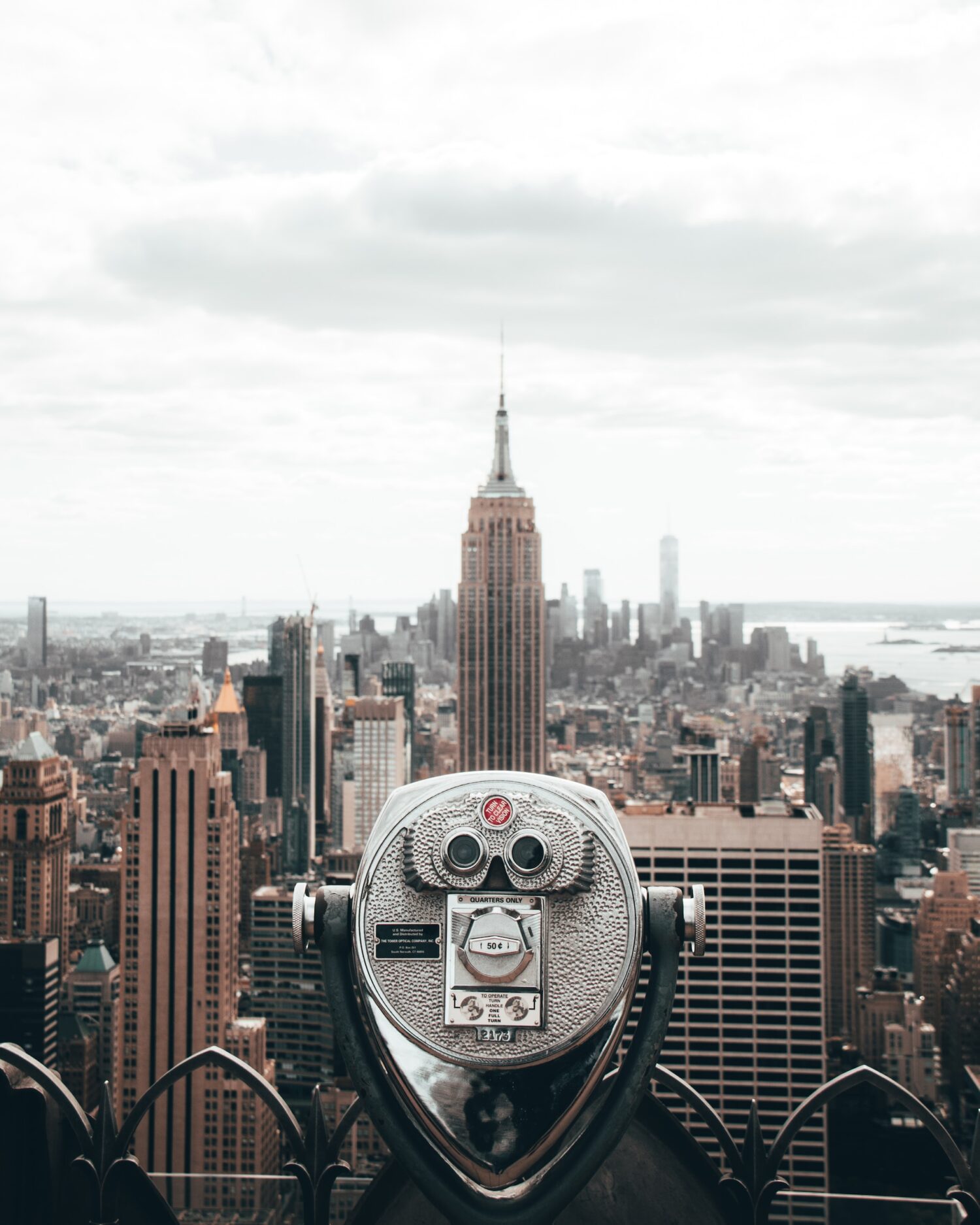
Top of the Rock is one of the best-known Empire State Building viewpoints for a simple reason: the building is included in the view. From the Empire State Building’s own observatory, the landmark disappears from the skyline photograph because the photographer is standing inside it. Rockefeller Center lies far enough north to show the whole tower and close enough for it to remain dominant.
The binocular is more than decoration. It provides scale, depth and a clear foreground. Without it, the scene would be another elevated cityscape. With it, the photograph becomes a record of looking.
A window creates a frame within the frame
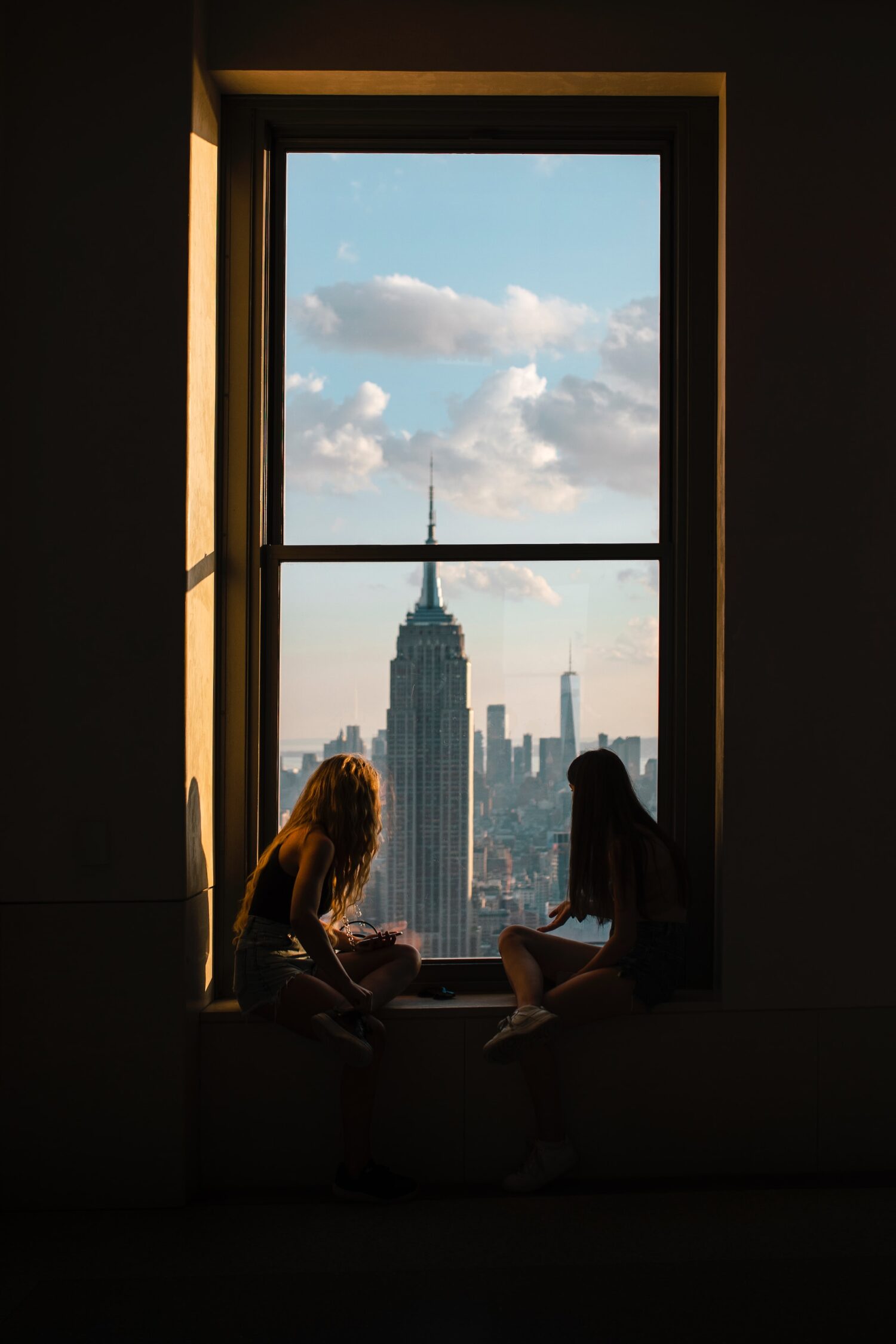
The final image is the most narrative photograph in the set. Two figures sit in shadow while the Empire State Building appears through the window. The view is smaller than in the other photographs, yet the building has more emotional weight because it belongs to a quiet human scene.
Exposure is the key decision. Preserving the bright exterior naturally turns the interior into silhouette. Trying to recover every shadow would weaken the frame and make the room compete with the view. I would keep the blacks deep, protect the sky and allow the people to remain anonymous shapes.
What the photographs reveal about the building
Across the gallery, the Empire State Building remains recognisable for three reasons: its setbacks, its pale stone surface and the long crown ending in the antenna. The composition can change completely while those features preserve identity.
The building’s official architectural height is 1,250 feet, or 381 metres. It reaches 1,454 feet, or 443.2 metres, at the antenna tip. The distinction corrects a common mistake: 443.2 metres is not the architectural height used for building rankings. According to The Skyscraper Center, the highest occupied floor is 1,224 feet, while the building has 102 above-ground floors.
Empire State Building facts at a glance
| Detail | Fact |
|---|---|
| Location | Midtown Manhattan, New York City |
| Building address | 350 Fifth Avenue |
| Observatory entrance | 20 West 34th Street |
| Architectural height | 1,250 ft / 381 m |
| Height to antenna tip | 1,454 ft / 443.2 m |
| Floors | 102 above ground |
| 86th-floor observatory | 1,050 ft / 320 m; open air |
| 102nd-floor observatory | 1,250 ft / 381 m; enclosed |
| Construction began | 17 March 1930 |
| Opened | 1 May 1931 |
| Construction time | 1 year and 45 days |
| Architect | Shreve, Lamb & Harmon; design led by William F. Lamb |
| Style | Art Deco |
Best places to photograph the Empire State Building
No viewpoint is best for every photograph. A clean skyline image, a close architectural study and a street scene need different distances. I would choose a location by deciding first how large the building should appear and how much New York should remain around it.
| Location | View | Best for | Main limitation |
|---|---|---|---|
| Top of the Rock | Elevated view from the north | The classic full-tower portrait and sunset skyline | Paid entry; sunset is busy; venue camera rules apply |
| Madison Square Park and the Flatiron District | Street and park views from the south | Tower above historic streets, trees and foreground buildings | The lower building can be obscured; seasonal foliage changes the frame |
| Fifth Avenue and West 33rd/34th Streets | Very close, low-angle view | Art Deco details, entrances, setbacks and street energy | Difficult to fit the entire tower without strong convergence |
| Gantry Plaza State Park, Queens | Long view across the East River | Midtown skyline, waterfront foreground and telephoto compression | The tower is distant and can merge into haze |
| Washington Square Park / lower Fifth Avenue | Long avenue view from the south | Arch, street axis and a small but recognisable tower | Long lens helps; traffic and crowds complicate alignment |
| SUMMIT One Vanderbilt | High, close view from the northeast | Modern Midtown context and reflections | Paid entry; reflective interiors can dominate the photograph |
| Edge at Hudson Yards | High view from the west | Broad Midtown skyline and open-air context | Empire State Building is one of several major towers in the frame |
| Jersey City or Hoboken waterfront | Wide western skyline | Sunset-facing cityscape, reflections and long-lens panoramas | Distance demands clear air and careful alignment |
Top of the Rock: the most direct elevated view
The official Top of the Rock page specifically describes direct sightlines to the Empire State Building. Its upper levels provide open-air views, and the south-facing position places the tower against Lower Manhattan rather than Central Park.
For a clean photograph, a moderate focal length is more useful than an extreme wide angle. The wide lens records the whole city; a normal or short telephoto lens gives the Empire State Building enough visual authority. Sunset slots are attractive but popular. Blue hour may be even more useful because the tower lights appear while the surrounding city retains colour in the sky.
Madison Square Park and NoMad: the building in its neighbourhood
South of the tower, the Flatiron District and NoMad offer a sequence of street-level compositions rather than one fixed marker on the pavement. Trees, older façades, taxis and avenue traffic can all serve as foreground. The walk is part of the process: a position that looks cluttered at one intersection can become clean half a block farther south.
A vertical frame is usually the natural choice. Keep enough street at the bottom to establish place, but watch for traffic lights touching the antenna or signs cutting through the setbacks.
Gantry Plaza State Park: Midtown from across the river
Gantry Plaza State Park in Long Island City officially highlights its Midtown views, including the Empire State Building. The greater distance allows the entire skyline to settle into one plane, while piers, restored gantries and the East River provide foreground choices.
This is a telephoto location. A wide lens makes the Empire State Building small; a longer lens can isolate it or compress it with nearby towers. Haze matters more here than it does on a close street view, so clear winter air can be more valuable than warm summer weather.
The best free view and the best paid view
If I had to simplify the options, I would choose Gantry Plaza State Park for a free, open skyline view and Top of the Rock for the strongest paid elevated portrait. Madison Square Park is the more flexible choice for a street-level photograph because it allows multiple framings without an admission time.
Light, weather and seasons
The same location can produce a different photograph every hour. The tower’s pale surface reflects warm light, the crown changes colour and weather determines whether the skyline is crisp or compressed into haze.
Sunrise, midday, golden hour and blue hour
| Time | Visual effect | Best use |
|---|---|---|
| Sunrise | Cooler streets, low warm light and fewer pedestrians | Street views and east-facing light when access allows |
| Midday | High contrast, bright sky and deep street shadows | Graphic details, black-and-white work and clear winter days |
| Golden hour | Warm stone, long shadows and separation between layers | Elevated portraits and distant skyline photographs |
| Sunset | Coloured sky and gradual appearance of tower lights | Top of the Rock, waterfronts and western viewpoints |
| Blue hour | Balanced sky and city lights | The most controlled night skyline photographs |
| Full night | Strong illuminated crown and dark city canyons | Telephoto details and reflections after rain |
Golden hour is not automatically the best. If the sun is behind the building, the façade becomes a silhouette. If smoke or humidity softens the skyline, a midday winter photograph may be clearer than a summer sunset. I would plan for the direction of light, then accept that weather makes the final decision.
Photographing the tower lights
The crown is not permanently one colour. Since 2012, its LED system has been capable of displaying millions of colours, and scheduled displays recognise holidays, organisations, sports and public events. The official tower lights calendar is the useful planning tool; social-media guesses are not.
Expose for the crown rather than the darkest buildings below it. Coloured LEDs clip easily, especially red and blue. Take a test frame, check the brightest channel and lower exposure before trying to recover detail later. At blue hour, the remaining sky reduces the brightness difference between the crown and its surroundings.
Seasonal differences that matter in photographs
- Winter often brings the clearest long-distance air, earlier blue hour and bare branches, but batteries drain faster and wind on observation decks can be severe.
- Spring adds fresh foliage and unsettled weather. Rain can give streets useful reflections, while pollen and humidity can reduce distant clarity.
- Summer provides long evenings and dramatic storms, but haze can flatten skyline layers. Sunset occurs late, so paid observation-deck timing needs care.
- Autumn combines lower warm light with coloured foliage. The best days can be visually rich, but popular viewpoints also become crowded.
Snow does not need to fall in the frame to shape the photograph. A bright surface can lift light into street canyons, while low cloud can erase the upper tower entirely. When that happens, I would not force a postcard view. A crown disappearing into cloud can say more about height than a perfectly clear sky.
Camera and phone guidance
The Empire State Building does not require exotic equipment. The main challenge is deciding how much context to keep and controlling vertical perspective, reflections and bright lights.
Lens choice by distance
| Situation | Useful starting range on full frame | What it does |
|---|---|---|
| Directly below the building | 14–24 mm | Fits more of the tower but exaggerates convergence |
| Nearby Midtown street | 24–50 mm | Balances architecture with street context |
| Top of the Rock or nearby high view | 50–135 mm | Creates a clean portrait and compresses the skyline |
| Queens or New Jersey waterfront | 100–300 mm | Enlarges the distant tower and isolates details |
| Phone photography | Main camera first; telephoto where light permits | Usually gives better quality than extreme digital zoom |
An ultra-wide lens solves the fitting problem but creates another one: the tower narrows dramatically toward the top and nearby objects stretch at the edges. That can be expressive at street level. It is less suitable when the aim is an accurate architectural portrait.
Exposure starting points
These are starting points, not fixed recipes. Stabilisation, focal length, wind, traffic and the photographer’s ability to hold the camera matter more than copying one setting.
| Situation | Starting point | Priority |
|---|---|---|
| Bright daytime skyline | ISO 100, f/5.6–f/8, 1/250 sec or faster | Detail and protected highlights |
| Golden-hour handheld | ISO 100–400, f/4–f/8, 1/250 sec or faster | Sharp skyline layers |
| Blue-hour handheld | ISO 400–1600, wide aperture, 1/125 sec or faster | Prevent camera shake |
| Night on a permitted tripod | ISO 100–400, f/5.6–f/8, several bracketed shutter times | Light trails and clean shadows |
| Bright crown against dark sky | Underexpose from the general city reading and bracket | Preserve LED colour |
| Phone through glass | Use the main lens, press close to clean glass and lower exposure | Reduce reflections and clipped lights |
Keep verticals intentional
If the camera is tilted upward, parallel building edges converge. That is physics, not a mistake. The photograph becomes awkward only when the effect looks accidental or is corrected so aggressively that the top stretches unnaturally.
For straighter lines, move farther away, keep the camera more level and crop later. A tilt-shift lens offers more control, but it is not necessary for a travel photograph. For a dramatic street view, embrace convergence and centre the composition carefully so the lean remains symmetrical.
Reflections, polarising filters and windows
When photographing through glass, switch off the flash and bring the lens close to the surface without striking it. Shield the sides with a hand or dark cloth. Dark clothing produces fewer visible reflections than a bright shirt.
A circular polariser can reduce glare in daylight, but it is not a universal fix. Laminated or treated glass can show colour patterns, and a polariser can make a wide blue sky uneven. Rotate it while watching the frame and use it only when the improvement is visible. I rarely treat a filter as mandatory; moving the camera a few centimetres can do more.
Empire State Building map, location and visitor entrance
The Empire State Building occupies the block between West 33rd and West 34th Streets, Fifth Avenue and Sixth Avenue in Midtown Manhattan. The office address is commonly listed as 350 Fifth Avenue. Observatory visitors use the dedicated entrance at 20 West 34th Street.
The 34 St–Herald Sq subway station, served by the B, D, F, M, N, Q, R and W lines, is close to the visitor entrance. Penn Station and the 34 St–Penn Station subway stops are also within walking distance. Allow more time than the map suggests: Midtown pavements, security screening and finding the correct entrance can slow a timed visit.
Visiting the Empire State Building observatories
Going to the top and photographing the building are different experiences. The observatories reveal New York’s geography, Art Deco details and the scale of the streets below, but they cannot include the Empire State Building in the skyline because the camera is inside it.
86th floor or 102nd floor?
| Feature | 86th Floor Main Deck | 102nd Floor Top Deck |
|---|---|---|
| Height | 1,050 ft / 320 m | 1,250 ft / 381 m |
| Environment | Open-air deck with indoor areas | Fully enclosed, temperature controlled |
| View | 360 degrees with outdoor atmosphere | Higher view through floor-to-ceiling glass |
| Photography strength | Open air reduces window reflections; metal barriers remain | Higher perspective and shelter from weather |
| Ticket | Included in standard observatory admission | Premium ticket includes both 86th and 102nd floors |
The 86th floor is the more atmospheric photographic experience because it is open to the air. The 102nd floor is higher and calmer, but every photograph passes through glass. For a first visit, the 86th floor provides the essential experience; the 102nd floor is an upgrade for height and enclosure rather than a completely different city.
Current hours and prices
The Empire State Building is open every day, but hours change through the year and timed reservations are required. When this article was updated on 13 August 2026, the official schedule listed 9 a.m. to midnight from 14 May through 17 September, with the entry door closing at 11 p.m.
At the same update, official online prices started at:
- 86th Floor Main Deck: $44
- 86th and 102nd Floor Top Deck: $79
- Booking charge: $5 per transaction
Dynamic dates, sunset demand and ticket type can change the final price. Check the current hours and official ticket page for the actual day rather than treating an article’s price as permanent.
Camera, bag and accessibility rules
The official visitor FAQ permits ordinary visitor photography but prohibits professional camera equipment and all stands, including tripods, monopods and bipods. Large bags, suitcases and carry-on luggage are prohibited, and the building has no lockers. Leave unsupported equipment at the hotel rather than discovering the restriction at security.
The observatory is ADA-compliant. The West 34th Street entrance is accessible, ramps and elevators accommodate wheelchairs, accessible restrooms are provided and the 86th floor includes lowered viewing walls and binoculars. Strollers are allowed but must be folded on the observation decks.
Most visits take at least an hour, and the official guidance describes one to two hours as a normal range when the museum and views are included. There is no need to race the deck once you arrive. Waiting ten minutes for a gap in a crowd or a change in light can improve a photograph more than another piece of equipment.
A brief history behind the photographs
The Empire State Building rose from the site of the old Waldorf-Astoria hotel. Demolition began in October 1929. Construction of the new steel-framed tower began on 17 March 1930, and progressed at a pace that still feels improbable: more than four floors in some weeks. The building opened on 1 May 1931, after a construction period of one year and 45 days.
Designed by Shreve, Lamb & Harmon, with William F. Lamb leading the design, it was the first building with more than 100 floors. Its setbacks responded to New York’s 1916 zoning rules, which sought to preserve light and air at street level as buildings grew taller. Those receding volumes later became the visual rhythm photographers rely on.
The building became the world’s tallest in 1931 and held the title for about four decades. The Skyscraper Center records it as the tallest from 1931 until the early 1970s, when the original World Trade Center surpassed it. Today it ranks far below the newest supertalls by height, yet it remains more immediately recognisable than many buildings above it.
Its continuing relevance is not only nostalgic. A major energy retrofit modernised systems and rebuilt all 6,514 windows into more efficient units while reusing more than 96 per cent of the existing materials on site. In 2026, the building announced that it had become the first building in New York State to achieve LEED v5 Platinum certification. A ninety-five-year-old skyscraper has therefore become a case study not just in building tall, but in keeping a large existing building useful.
The Empire State Building in film and music
Photography made the building famous, but cinema gave it a personality. King Kong attached adventure and danger to the crown almost immediately after the building opened. Sleepless in Seattle turned the observatory into a meeting place. Music videos and album imagery repeatedly use the tower as a shorthand for New York.
King Kong and the crown
The 1933 film arrived only two years after the building opened. Its finale transformed a new office tower into a mythic stage, and later adaptations renewed the association for new audiences.
Sleepless in Seattle and the observatory
The 1993 film used the observation deck as the destination of its romantic plot. The sequence depends on the building’s recognisability: viewers understand the place before the characters explain it.
Empire State of Mind
Jay-Z and Alicia Keys used the building within a broader visual portrait of New York. I would not treat every appearance as proof of architectural importance, but repetition matters. The tower is useful to filmmakers and musicians because a single frame establishes the city immediately.
The building’s role in popular culture also explains why photographers keep returning to familiar angles. The challenge is not to avoid every classic composition. It is to bring a clear decision to it — weather, foreground, distance, colour or human presence — so the photograph is more than proof that the tower was there.
Frequently asked questions
Where can I find the best photos of the Empire State Building?
This page contains nine Empire State Building photographs ranging from distant skyline and street views to a Top of the Rock composition and a window-framed silhouette. For taking a similar elevated portrait, Top of the Rock is the most direct paid viewpoint. Gantry Plaza State Park and Madison Square Park provide useful free alternatives at very different distances.
What is the best place to photograph the Empire State Building?
Top of the Rock is the clearest elevated choice because it provides a direct, unobstructed sightline to the entire tower. For a free skyline photograph, use Gantry Plaza State Park. For street context, walk through Madison Square Park, NoMad and the streets south of West 34th Street.
What is the best time to photograph the Empire State Building?
Golden hour warms the façade, while blue hour balances the illuminated crown with remaining colour in the sky. Clear winter days are often best for long-distance detail. The correct time also depends on the viewpoint and direction of light; there is no single hour that works from every side.
Can I take photos inside the Empire State Building?
Yes, ordinary visitor photography is allowed. The building prohibits professional camera equipment and stands, including tripods, monopods and bipods. Security staff make the final decision on permitted items.
Can I photograph the Empire State Building from its own observation deck?
You can photograph the building’s Art Deco details and the city from the deck, but you cannot place the Empire State Building itself in the skyline because you are standing inside it. Choose Top of the Rock, another observation deck, a park or a waterfront if the tower must appear in the frame.
How tall is the Empire State Building?
Its architectural height is 1,250 feet, or 381 metres. The antenna raises the total height to 1,454 feet, or 443.2 metres. The 1,454-foot figure should be labelled as height to tip rather than official architectural height.
Is the Empire State Building still the tallest building in New York?
No. It was eighth in New York City by architectural height when this article was updated in August 2026. One World Trade Center holds the city title at 1,776 feet. I explain the current ranking in my guide to the tallest building in New York.
How many floors does it have?
The Empire State Building has 102 above-ground floors. The main open-air observatory is on the 86th floor, and the enclosed premium observatory is on the 102nd.
How long did construction take?
Construction was completed in one year and 45 days. Work began in March 1930, and the building officially opened on 1 May 1931.
Why does the Empire State Building change colour at night?
Its LED tower lights recognise scheduled events, holidays and organisations. The colour is not always intuitive, so use the official tower lights calendar to identify or plan a display.
Is the 86th or 102nd floor better for photography?
The 86th floor is better for an open-air atmosphere and fewer window reflections. The 102nd floor is higher and enclosed behind floor-to-ceiling glass. Neither includes the Empire State Building itself in the skyline view.
Can I bring a large camera bag?
Avoid it. The official rules prohibit large bags, suitcases, carry-on luggage, professional equipment and camera stands, and there are no storage lockers. Bring a compact, hand-held setup that can pass security.
What else can I photograph nearby?
The New York Public Library, Bryant Park, Herald Square, the Flatiron District and Madison Square Park are all within a manageable Midtown walk. For a longer photographic route, continue north toward the locations in my Central Park photo spots guide or south and east toward the Brooklyn Bridge photo spots.
Final thoughts
The best photos of the Empire State Building do not all solve the subject in the same way. Some need distance and a clean skyline. Some need a taxi, a window or a pair of observation binoculars. Some depend on the colour of the crown; others become stronger when colour is removed entirely.
What holds the gallery together is the building’s ability to remain itself at every scale. Its 381-metre architectural height is no longer a record, and newer towers rise above it. Yet the stepped silhouette still organises the skyline with unusual clarity. I would not try to make every photograph original through spectacle. I would choose one honest relationship — tower and street, tower and weather, tower and viewer — and give that relationship enough space to be seen.